

Table of contents
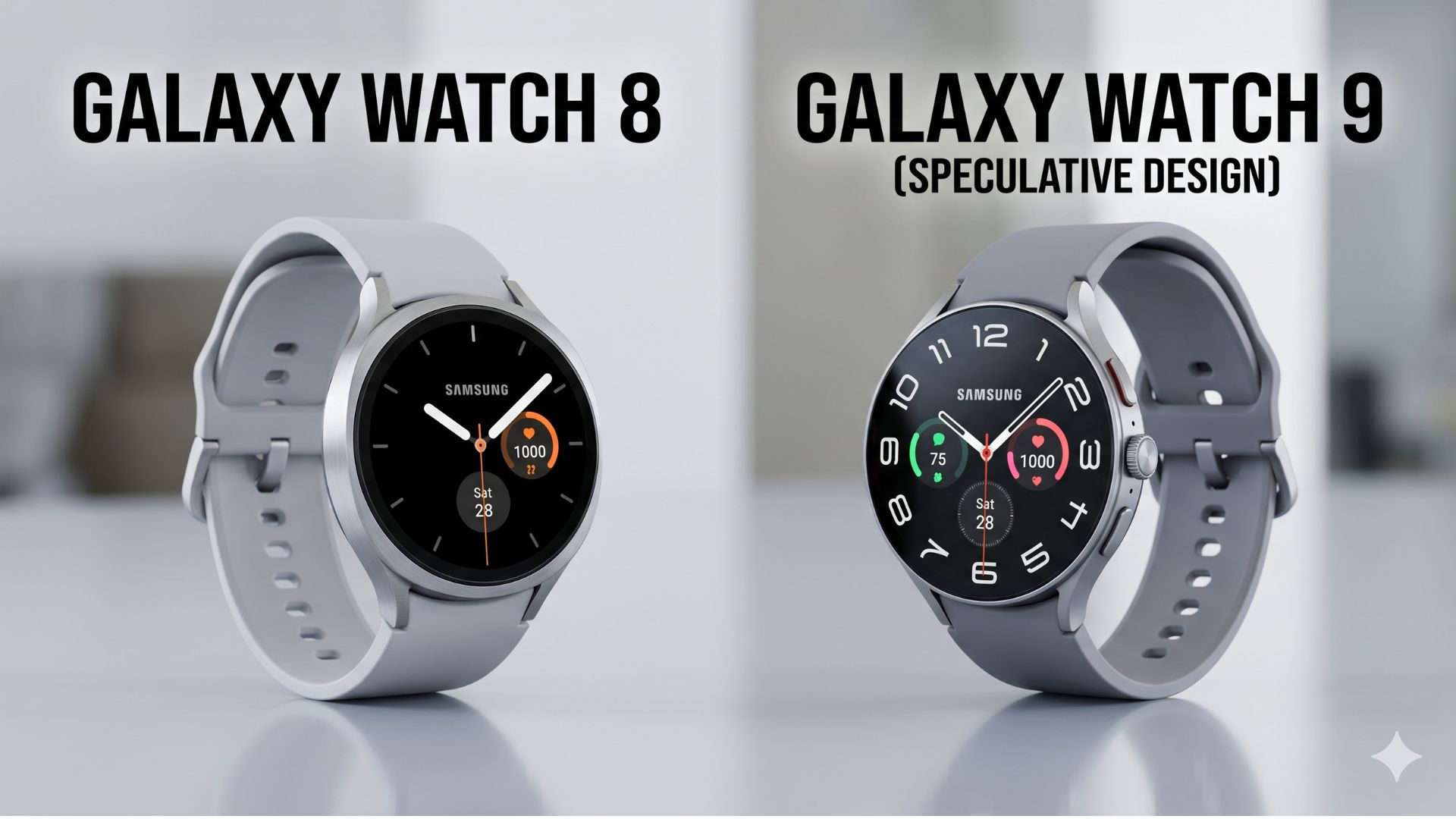
Samsung has not announced the Galaxy Watch 9 yet, but there is enough information to already compare it to the Galaxy Watch 8. This article separates what Samsung and its suppliers have confirmed from what remains speculation, so you know exactly what to trust before deciding whether to upgrade.
Based on available information so far, the design and the display look will be similar to the Watch 8. The 44mm battery and the charging speed look unchanged too. The bigger story is the chip. Samsung’s longtime chip partner is being replaced by Qualcomm on at least one model in the new lineup, and that single change could shape how useful the AI features in your watch turn out to be.
Two questions are still open and worth keeping in mind as you read. The first is which chip the standard Watch 9 actually uses. The second is whether a Watch 9 Classic with the rotating bezel makes a comeback this year.
There is also a wider reason Samsung needs the Watch 9 to land well. Counterpoint Research data reported in June 2026 showed that Galaxy Watch shipments fell 28% year over year in the first quarter of 2026, pushing Samsung’s global smartwatch share down from 7% to 5%, even as the overall market grew and Apple gained ground. That puts pressure on Samsung to make the Watch 9 worth your money against the Pixel Watch and the Apple Watch.
Below, you will find a full spec comparison table, a feature-by-feature breakdown, a price comparison, a release date estimate, and a final verdict on whether you should upgrade now or wait.
Galaxy Watch 8 vs Galaxy Watch 9 at a Glance
Here is how the two watches compare side by side, based on what Samsung has confirmed and what has leaked so far.
| Spec | Galaxy Watch 8 | Galaxy Watch 9 |
|---|---|---|
| Announced | July 9, 2025 (confirmed) | Expected July 22, 2026, in London. Samsung has not confirmed this (leaked) |
| Released | July 25, 2025 (confirmed) | Expected early August 2026 (rumoured) |
| Sizes | 40mm and 44mm (confirmed) | 40mm and 44mm (leaked) |
| Display | 1.34 inch and 1.47 inch, 3,000 nits (confirmed) | Same sizes and brightness expected (rumored) |
| Chipset | Exynos W1000 (confirmed) | Snapdragon Wear Elite or Exynos W1000, not settled (conflict) |
| RAM and storage | 2GB, 32GB, and 64GB on Classic (confirmed) | Not leaked yet. 2GB and 32GB expected (rumoured) |
| Battery, 40mm | 325mAh (confirmed) | About 400mAh marketed, up 23% (leaked) |
| Battery, 44mm | 435mAh (confirmed) | 435mAh, unchanged (leaked, disputed) |
| Charging | 10W wired (confirmed) | 10W wired, unchanged (leaked) |
| Durability | 5ATM and IP68, plus MIL-STD-810H (confirmed) | Expected to carry over (rumoured) |
| Software | Wear OS 6, One UI 8 Watch (confirmed) | Wear OS 7, One UI 9 Watch (leaked) |
| Colors | Graphite and Silver. Classic in Black and White (confirmed) | Black and Silver leaked, plus a possible Beige (leaked) |
| Classic model | Yes, 46mm with rotating bezel (confirmed) | No Classic number filed so far (conflict) |
| Starting price | $349 / £319 / €379 (confirmed) | Not leaked yet. Outlets split on direction (conflict) |
Galaxy Watch 8 vs Galaxy Watch 9: Feature by feature
Now let’s go deeper into each part of the watch, comparing what Samsung has confirmed for the Watch 8 with what has leaked or remains unconfirmed for the Watch 9.
1. Design
The Galaxy Watch 8 confirmed a new “cushion” shaped case, sometimes called a squircle, that blends square and round lines. It is 11% slimmer than the Watch 7. It weighs 30 grams in the 40mm size and 34 grams in the 44mm size, and uses an aluminum frame with sapphire crystal on top. And it also introduced the Dynamic Lug band system, which lets you swap straps without tools.
The Watch 8 Classic uses a stainless steel case instead of aluminum and retains the rotating bezel. It also adds a third button called the Quick Button. It comes in one size, 46mm, and weighs about 63.5 grams.
Leaks point to the same squircle design returning to the standard Watch 9, with one tipster describing it as even more squared-off than before. New band designs are expected across the lineup. The bigger redesign appears to be reserved for the Watch Ultra 2, which leaks describe with a boxier chassis and thinner bezels.
Color leaks mention Black and Silver for the Watch 9. A Beige option has also leaked, though it is not yet clear if Beige applies to the standard Watch 9, the Ultra 2, or both.
2. Display
The Galaxy Watch 8 confirmed a 1.34-inch screen on the 40mm model and a 1.47-inch screen on the 44mm model, both reaching 3,000-nit peak brightness with a sapphire crystal cover. Resolution comes in at 438 by 438 pixels on the smaller size and 480 by 480 pixels on the larger one.
The Watch 9 display has not leaked. Outlets that track Samsung wearables expect the same screen sizes and a similar 3,000-nit peak brightness to carry over, simply because nothing has surfaced to suggest otherwise. Treat this as an assumption rather than a leak.
3. Performance and chip
The Galaxy Watch 8 runs on Samsung’s own Exynos W1000 chip, built on a 3-nanometer process with 2GB of RAM. Storage sits at 32GB on the standard model and doubles to 64GB on the Classic. This is the same chip Samsung used in the Watch 7 and the 2024 Watch Ultra.
At MWC 2026, Qualcomm announced a new smartwatch chip, the Snapdragon Wear Elite, built on a 3-nanometer process. Samsung’s own technology strategy lead backed the announcement, saying the new chip would help the next Galaxy Watch become a more complete wellness companion. Qualcomm never named the Watch 9 directly. It only referred to the next-generation Galaxy Watch. Every model-specific claim you read elsewhere is the outlet’s own guess, not Qualcomm’s words.
This has created a genuine split among outlets, and it stays unresolved as of this writing. One camp believes the standard Watch 9 keeps the Exynos W1000, and only the Watch Ultra 2 moves to the Snapdragon. A second camp believes both watches make the switch. A few outlets, including this one, simply say the question is open until Samsung confirms it.
Why does this matter to you? The Snapdragon Wear Elite carries a dedicated AI processor that Qualcomm says can run large on-device models quickly. Wear OS 7’s headline Gemini features depend on that processor. If the standard Watch 9 keeps the older Exynos chip, it would miss out on the on-device AI features that the Ultra 2 gets.
Qualcomm’s own numbers claim up to 5 times faster CPU performance and up to 7 times faster graphics compared with the previous wearable chip. The company also claims up to 30% longer battery life per charge. These are the manufacturer’s own claims, made under controlled testing, so treat them as a ceiling rather than a guarantee until reviewers test the watch themselves.
Some industry voices are already managing expectations. One outlet covering the chip change in March 2026 noted that big jumps in daily battery life are unlikely from the chip alone, and that most of the benefit will likely show up in AI features rather than raw speed.
4. Battery life
The Galaxy Watch 8 ships with a 325mAh battery on the 40mm model and a 435mAh battery on the 44mm model. The Classic carries a slightly bigger 445mAh cell. All three charge at 10W over a wired or magnetic connection.
A leak attributed to a source covering Samsung leaks says the 40mm Watch 9 carries a 382mAh rated battery, which Samsung is expected to market as roughly 400mAh, a 23% jump from the Watch 8’s 325mAh cell. The 44mm model is listed at 435mAh, the same as the outgoing Watch 8. Charging remains at 10W per a separate certification.
That means any battery-life gain on the 44mm model will have to come from the new chip or new software, not from a larger cell. Some regulatory filings from June 2026 even cast doubt on whether the 44mm capacity changes at all, so treat that figure as leaked rather than locked in.
One thing working in your favor regardless of which watch you buy: Google says Wear OS 7 improves battery life by up to 10%, based on testing it ran between August 2025 and April 2026. That update reaches the Watch 8 too once One UI 9 Watch rolls out, so current owners get part of this benefit without buying anything new.
5. Health and sensor features
The Galaxy Watch 8 confirmed a few new health tools, in addition to its existing BioActive sensors. The Antioxidant Index measures carotenoid levels in your skin through a 5-second thumb press and gives you a score out of 100. Bedtime Guidance studies 3 days of your sleep data and suggests when you should start winding down.
It also added Vascular Load and Running Coach. Existing tools like ECG, blood oxygen, skin temperature, and FDA-cleared sleep apnea detection were carried over from earlier watches. Blood pressure tracking started rolling out in the US in March 2026, though it needs a cuff calibration about every 28 days. The more advanced tools need a Samsung Galaxy phone to work.
Samsung announced a major Samsung Health app overhaul through its Global Newsroom on June 4, 2026, with the update arriving from June 8, 2026, onward. Samsung’s own digital health lead said the update connects the data your watch collects with AI-based insights, so you can better understand your body. The new app introduces five sections: Sleep, Activity, Nutrition, Mindfulness, and Vitals.
Inside Vitals, the watch tracks five overnight signals- heart rate, heart rate variability, breathing rate, skin temperature, and blood oxygen- then compares them with your normal baseline and only alerts you when something looks off. A new Heart Health Score combines your Vascular Load with body composition into a single daily number. A Fitness Index compares your VO2 max and heart rate with those of people similar to you.
Glucose tracking without a needle has been rumored for years, and there is still no confirmation that it is coming. Regulators have not cleared any smartwatch for glucose measurement, and Samsung’s own digital health lead has said it could still take years to arrive.
One useful thing to keep in mind: because these health features live in the Samsung Health app rather than in new hardware, most of them will also be available on your current Watch 8. That weakens the case for buying a new watch just for the software.
6. Software
The Galaxy Watch 8 confirmed Wear OS 6 with One UI 8 Watch, featuring the Now Bar and glanceable tiles, plus quick access to Gemini.
The Galaxy Watch 9 has leaked, reportedly shipping with Wear OS 7 and One UI 9 Watch, built on Android 17. Wear OS 7 already started rolling out in June 2026 to Pixel Watch models, bringing Live Updates and a new Wear Widgets grid that replaces the old Tiles layout. The catch is that Wear OS 7’s on-device Gemini features need a dedicated AI processor to run locally. That is exactly why the chip question above matters so much. If the standard Watch 9 keeps the Exynos W1000, it likely will not get the same on-device Gemini experience as a Snapdragon-powered model.
Price
Watch 8 launched at $349 for the 40mm Bluetooth model, with UK and EU pricing at £319 and €379. The 44mm size adds $30, and adding LTE adds $50 on top of either size. The Watch 8 Classic starts at $499 and rises to $549 with LTE.
That confirmed price already marked a $50 jump over the Watch 7, which started at $299 the year before.
The Watch 9 price hasn’t leaked yet. Outlets disagree on what comes next: some expect Samsung to hold prices steady this year, while others expect another increase given how much Samsung raised prices across its Galaxy S26 phone lineup earlier in 2026. Both sides are guessing without an actual number to point to, so the Watch 8’s launch prices remain your best guide until Samsung says otherwise.
Release date
Samsung announced the Galaxy Watch 8 on July 9, 2025, and put it on sale on July 25, 2025, a gap of 16 days. The year before, the Watch 7 was announced on July 10, 2024, and went on sale on July 24, 2024, a gap of 14 days.
Reports point to a Galaxy Unpacked event on July 22, 2026, in London, featuring the Watch 9 alongside the Galaxy Z Fold 8 and Z Flip 8. Samsung’s new Galaxy Glasses are expected to join them too. Samsung has not confirmed this date.
If Samsung follows the same pattern it used the last two years, you can expect the Watch 9 to go on sale roughly two weeks after the announcement, which would put retail availability in early August 2026. Regulatory filings cleared in mid-June 2026 suggest the hardware is finished and on schedule, even though the public announcement has not happened yet.
Should you upgrade?
If you already own a Galaxy Watch 8, you can likely skip this generation. The design and the 44mm battery both stay the same. The display does not change either. Most of the new health features are already arriving on your current watch through the Samsung Health app update anyway. The main reasons to consider switching are the unconfirmed chip change and the larger 40mm battery, neither of which is locked in yet.
If you are still using a Galaxy Watch 7 or an older model, the case for upgrading is stronger. You would gain the full 2025 redesign and the brighter sapphire display. You would also gain the newer health sensor lineup, including the Antioxidant Index and Bedtime Guidance. And you also gain a full chip-generation jump, no matter which 2026 chip Samsung ultimately uses.
It helps to know what else is out there, too. The Pixel Watch 4 starts at $349.99 for the 41mm size and $399.99 for the 45mm size, with a battery life rated at 30-40 hours and built-in satellite SOS. The Apple Watch Series 11 starts at $399 with blood pressure tracking, but only works fully with an iPhone. If you are committed to Android, Samsung’s sensor range and ecosystem still give it an edge over both.
Since Unpacked looks to be only weeks away, waiting makes sense even if you are on the fence. The event should settle both open questions, the chip and the Classic model, and Samsung usually rolls out trade-in deals around launch that lower the actual cost of switching.
One more thing worth knowing if you love the rotating bezel: a leak from late May 2026 suggested a Watch 9 Classic was in development, but newer signals from June, including the FCC filing and a fresh design leak, point to no Classic this year. If that holds, the next rotating bezel Galaxy Watch may not arrive until 2027.