
The past few years have witnessed one of the most rapid expansions of artificial intelligence the industry has ever seen. New models ship faster than teams can evaluate the last ones. Capabilities that felt experimental twelve months ago are now embedded in daily workflows. And with every major release, every new Claude update, every GPT announcement, and every benchmark breakthrough, the same question quickly resurfaces: “Will AI take our jobs?”
It is an understandable fear. But the conversation tends to collapse a complicated reality into a simple threat. And in doing so, it misses what is actually happening inside the teams where AI is being used well. Most product teams still move too slowly. Design takes two weeks. Mockups sit in Figma. Frontend starts implementation. Product notices something feels off halfway through the build. The team goes back into review mode. Days disappear, and eventually, the cycle repeats.
The truth of the matter remains that AI tools like Claude and GPT haven’t removed this problem, though they’ve mostly shifted where the friction lies. This is the gap the HAIL Framework was built to close, a Human-in-the-Loop AI development workflow designed to help modern digital product teams move faster without lowering standards.
The problem with how teams are using AI today
There is, in fact, a pattern emerging across product teams: generate a screen, copy the output, ship the feature, move on. It runs into the same gaps that have always existed in digital product development, just appearing at a different stage. AI-assisted development, when treated as a handoff rather than a collaboration, breaks quickly. The design-to-development gap has not disappeared. It has, simply, shifted. AI-generated interfaces still carry weak accessibility, poor responsiveness, bloated frontend code, and performance issues that only surface once real users arrive.
This is not a failure of the tools. It is a failure of workflow. And it is exactly the problem the HAIL Framework was built to solve: putting human judgment back at the centre of AI-assisted development at every stage where it matters most.
The HAIL framework
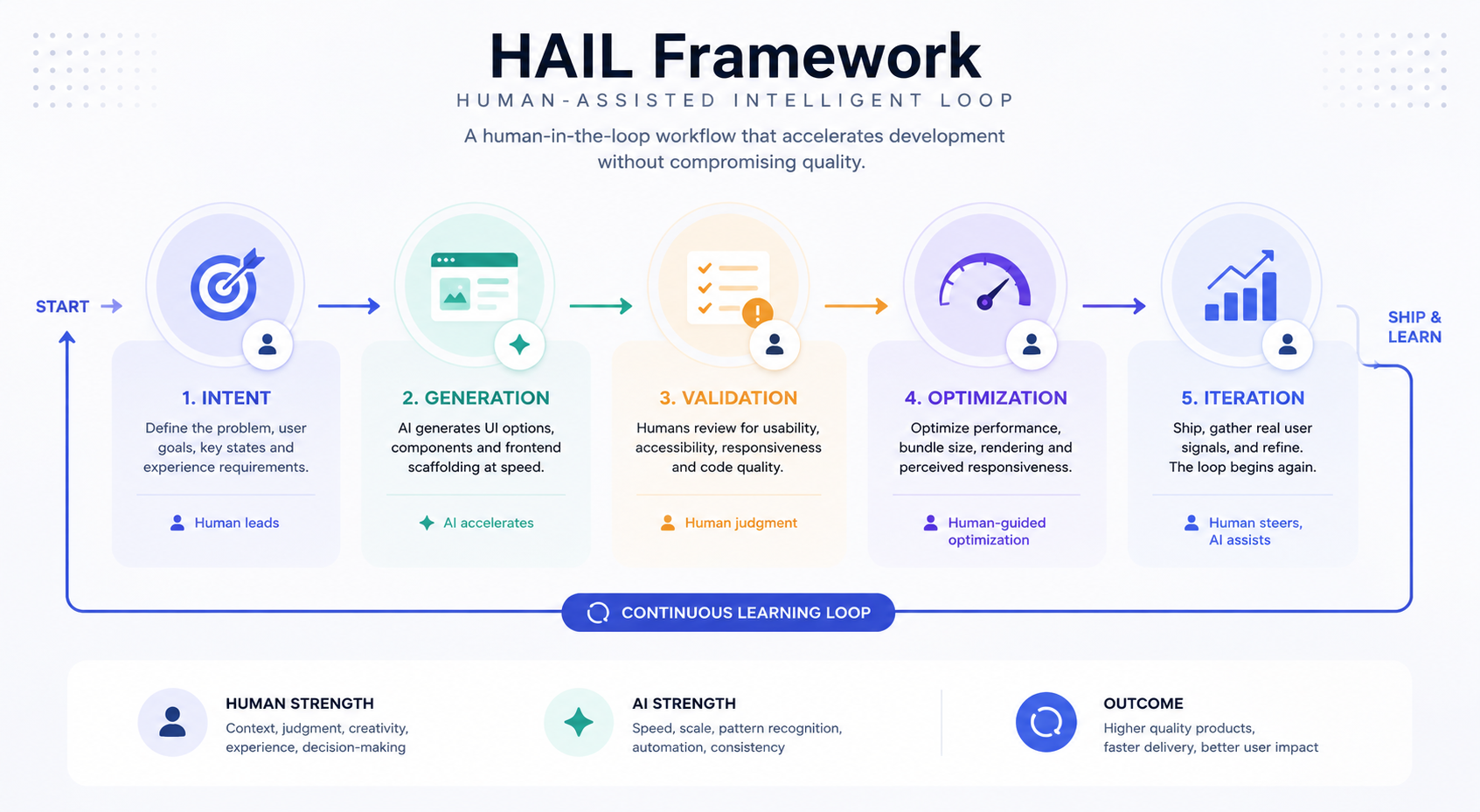
HAIL Framework: Human-Assisted Intelligent Loop is a structured workflow model built to integrate AI into product design and frontend development without sacrificing the quality and standards experienced teams spend years developing. It defines clearly what AI should accelerate and what humans still need to own. There are five layers. Together, they form a loop, not a linear handoff.
Intent is where the workflow begins and where most AI workflows fail. Every weak AI output traces back to a weak starting point. Product work depends on specificity: the problem the user is actually solving, which states need to exist, and how the experience should feel under different conditions. Translating product goals into structured direction is still human work, and it is the most important contribution a team makes to any AI-assisted development process.
Generation is where AI earns its place. With clear direction established, the speed advantage becomes real. Five interaction patterns can be explored in an hour instead of one. Frontend scaffolding is generated quickly enough that product discussions happen earlier, before weeks of implementation have made changing course expensive. The distance between intention and working artefact is significantly compressed, and that compression changes how and when collaboration occurs across design and frontend development teams.
Validation is the layer most teams skip and the most important one. AI-generated code often works in isolation while failing inside real product environments, missing accessibility labels, inconsistent spacing logic, and weak responsiveness across breakpoints. Validation is where product judgment lives. It requires the kind of experience that accumulates from shipping products, reviewing pull requests, and watching how real users actually behave. It is the irreducible human contribution to the loop.
Optimization sits between validation and shipping. Frontend performance affects user behaviour; slow products lose users. AI can generate a functioning component, but without guidance, it will not correctly optimize bundle size, rendering behaviour, or perceived responsiveness. The tradeoffs involved are product decisions as much as technical ones, and they carry defined ownership inside the HAIL Framework.
Iteration is where the loop closes and starts again. Teams ship, gather signals, refine flows, and adjust based on user behaviour in production. This is where AI compounds its value by refactoring components, adjusting responsive behaviour, and testing alternate layouts. The repetitive work shrinks. Teams spend more time reviewing decisions and less time rebuilding patterns they have already built.
What this means for the future of digital product development
The job replacement conversation gets the threat exactly backwards. The role of frontend developers and product designers is not disappearing, instead it is shifting. Less value now sits in manually producing every interface from scratch. More value lies in clearly defining problems, critically reviewing AI-generated output, and making product decisions that hold up under real-world usage conditions. Human-in-the-loop AI is not a compromise between speed and quality. It is the architecture that makes both possible simultaneously.
The future of digital product development will involve structured collaboration between AI systems and human expertise. Product teams that integrate AI into design-to-development workflows while maintaining usability, accessibility, frontend performance, and product quality will gain real advantages in speed, iteration, and delivery efficiency. Not because AI replaced their expertise, but because they built structures that amplified it.
Claude AI, GPT workflows, and the models that follow them are not the end of product design and frontend development as disciplines. They are a shift in where the most important work happens. The teams that adapt earliest by building the clearest workflows around human judgment and AI-assisted execution, will define what great digital product development looks like in the years ahead. The HAIL Framework is built for those teams.