TechCabal

Search

Follow us

  • X
  • LinkedIn
  • TikTok
  • WhatsApp
  • Facebook
  • Instagram
  • YouTube

Flagships

Ask An Investor

Center Stage

My Life In Tech

Factsheet

Digital Nomads

The BackEnd

Web3

Quick Fire

Newsletters

TC Daily

Entering Tech

The Next Wave

TC Weekender

Francophone Weekly

Events

Reports

TC Insights

Video

About

Advertise

Tech Women Lagos

Editorial Policies

TechCabal

Quick Links

  • 2026 Predictions
  • The Builders’ List 2025
  • Calculate your tax

Search

Menu

Menu

Categories

Newsletter

Events

Happily Authenticated!
  • If you spend a lot of time on YouTube, the odds are that you’ve come across someone promising to teach you how you can make millions of dollars from dropshipping. 9 times out of 10, that guy lives in Bali and has social media accounts that show a life of luxury. 

    But this is not a conversation about dropshipping or the truth behind it. Wired covered that here.

    Instead, this is a conversation with Olumide, a digital nomad who lives in Bali, Indonesia’s most popular tourist destination. 

    While Bali is a beautiful island, it has become popular in the last few years for digital nomads who move there to work while enjoying cheaper living costs. 

    Olumide is one such nomad who has taken a circuitous route to Bali. But his story starts in Nigeria. 

    “My father was a salesman for a company that made poultry feed.” He tells me. “I don’t remember a lot about living in Nigeria, but I remember that we were comfortable and lived in a big compound.” 

    His reality would soon change when his family made the move from Nigeria to the U.K. “We went from a rich Nigerian family to a struggling immigrant family. The choices we made transformed us.” 

    His story almost becomes a stereotype from here: the immigrant who focuses on education to try to rise above his struggles. Despite these struggles, there was a bit of traveling in his childhood. 

    At 13, the family moved to America, where he lived until 2016. He attended college in America, studying for an undergraduate degree in Physiology as well as a Masters degree in epidemiology and behavioral sciences. 

    He tells me: “I went to grad school because I was trying to figure out what I wanted to do.”

    Trying to figure things out is the common theme to many of Olumide’s life experiences. So, when he shares his travel experiences, he says “I went to Honduras for missionary work when I was 22,” but that was his parents idea so he’s quick to strike it out. 

    What he would rather talk about is deciding on moving from Columbus, Ohio to San Diego for grad school. “I bought a round trip ticket to California and the plan was to stay for two or three months. But while I was there, I got accepted to San Diego state University for a Masters degree.” 

    “During graduate school, I met people from Nigeria, Saudi Arabia, Germany and these were the people I could relate to. It was the first time I saw a mix of people different from me.”

    This experience of diversity and San Diego’s warm climate meant that it saw a lot of social activity. Olumide, who already fancied himself an entrepreneur, needed a way to cash in on San Diego’s outgoing community. So he founded “The Tribe Network.”

    “Setting up the  network was really what got me into travel. At the time, I would organise networking events that charged $7- $10 at the door.” 

    Here’s one of The Tribe Network’s Facebook posts from 2018 inviting people to one such event: “Tribe Inner Circle 2.0 will be an invite only members network of millennials comprising the best of the best from every field: Art, Music, Medicine, Real Estate, Law and more.”

    “I partnered with a real estate agent, rented a mansion and managed to build out a luxury networking community. It was an interesting time, I was living the life on Facebook as though I was a young millionaire.” 

    While the networking circuit seemed promising, he wasn’t making enough money. But there was another problem: “People who were trying to network upwards were always trying to get into the faces of upscale people to try to pitch ideas to them.” 

    An excerpt from an article on networking events: “From 2013 to 2016, I spent a lot of my time trying to network my way into connections. But they’re completely useless if you want to network upwards.”

    “Most of the people there are value hunting so you’re at a gathering with people like you: sideways networking and downward networking.”

    Today, Olumide’s perception of networking is different. “For me, networking has to be curated. You need to understand what everyone who shows up wants. You can’t mix and match groups.” 

    By the time this lesson was learned, Olumide was taking a gap year instead of accepting the university’s offer for a PhD place. 

    “After you finish your Masters program, they expect you to do a PhD. The university gives you grants to help you along the way and there’s a diversity enrichment program. But I never saw myself as a PhD Professor.”

    What he saw himself as instead was a global entrepreneur, so he decided to travel. His first stop was Germany where he couch surfed with the friends he had made at grad school. He also started to tune in on opportunities in social media.

    “When I was in Germany, I started to learn the value of social media. Before then, I was documenting everything I was doing on social media and growing a following. I started to earn $500/month from social media management.” 

    But $500 was not enough to live on in Germany and he had to subsist on government aid.

    “I said no to a $100,000/year PhD track to get government aid in Germany while I was under the delusion that I was an entrepreneur.”

    To make the jump from broke entrepreneur, there was some hard learning to do and mistakes along the way. 

    Olumide’s note: In the beginning, I was gaining clients, not getting results and losing them quickly, so I started learning by watching a lot of videos on YouTube and asking questions on Google. I didn’t pay for courses, I stitched together all the bits and pieces of free information the experts offered for free online. 

    There’s no magical “grass to grace” story here. From Germany, he moved to Mexico city where he lived for all of three months before seeing Bali on Instagram. 

    “I speak Spanish yet making useful connections in Mexico City was difficult. I was always in front of my computer working and I didn’t make a lot of friends. While I was in Mexico, I saw Bali on Instagram and you know what Bali does to people.” 

    Social media influencers and digital nomads in Bali

    Social media influencers like Tai Lopez who market a life of affluence and teach online courses on how “you can get rich too” have made Bali popular. Think: posh villas, a garage full of cars, the whole nine yards. 

    “Tai Lopez was the first guy to get on the Internet to say: hey guys, I’m rich, let me tell you how to be rich too. Iman Gadzhi is another young British kid who teaches you how to put systems in your business.” 

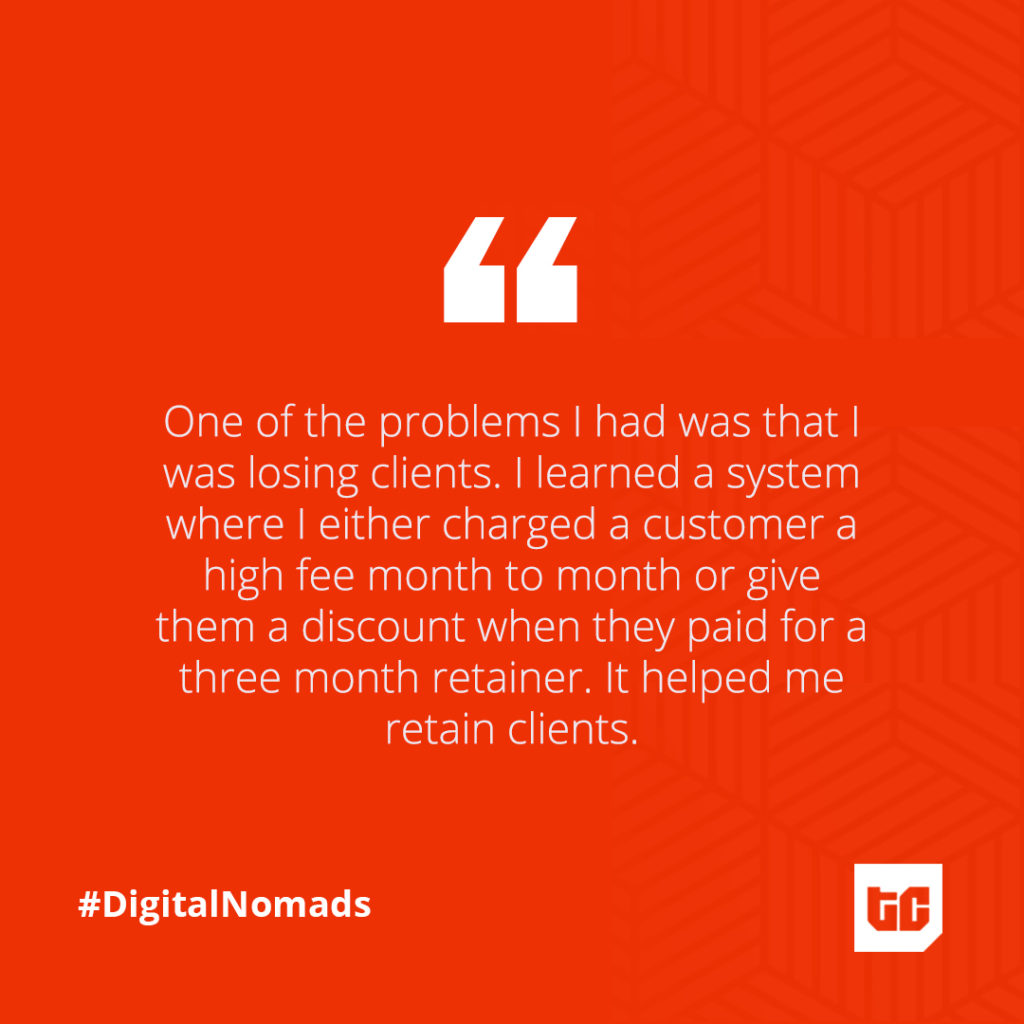
    An important thing Olumide learned from online courses: One of the problems I had was that I was losing clients. I learned a system where I either charged a customer a high fee month to month or give them a discount when they paid for a three month retainer. It helped me retain clients.
    Digital Nomads Bali: Olumide shares his experience

    After taking a few online courses on creating systems for his business, he bought a round-trip ticket to Bali. 

    “In Bali, tourists get a one-month visa on arrival, but what a lot of people do is a visa run. One day before the visa expires, they leave the country, get back in and get another one-month visa. Some people have been doing this for eight years.” 

    While tourists like this help Bali’s economy, the government is taking a harder stance on visa runs and is kicking out digital nomads who don’t have a specific type of visa. But Olumide says the government’s new stand does not affect him.

    “I now have a multiple entry visa which means I don’t have to worry about being kicked out. But I have to leave every two months.”

    Away from visa problems, one of the more challenging parts of moving to Bali was that his clients were now in a different timezone from him. “I was worried about my big ticket clients because I wasn’t looking to be homeless in Bali. But I did a lot of learning on how to manage a remote business before coming here.” 

    Unlike Germany and Mexico, Olumide says that in Bali, you get the sense of community. “Everyone in Bali is here to change the lifestyle they have. Everyone is trying to build an online business. It doesn’t mean they are wealthy, but they are building businesses.” 

    One of the reasons people travel halfway around the world to start an online business is the cost of living in Bali. Olumide says that in California, the rent for a basic room is at least $1500 per month. That same amount will get you a villa in Bali. 

    It explains why it is easy for social media influencers there to sell a vision of success to their followers. 

    “When I got here, I realised that there’s a difference between social media influencers and entrepreneurs. A lot of social media influencers here aren’t making money. People soon start to realise that a lot of the glamorous lifestyle is not necessarily true and the portrayal of a specific lifestyle to sell courses is definitely a problem.” 

    The real differentiator for him is that entrepreneurs create value. He uses the opportunity to dovetail into another lesson in creating systems for his business. 

    “In the first few months in Bali, when I bring in a client, I would run their Facebook and Instagram ads, monitor the analytics and sometimes get on calls. It used to feel like a full time job while living in paradise.” 

    But he soon learned how to leverage on the expertise of others to free up time for himself as well as deliver better value for his clients. 

    “If I take $1500 for a social media management job, I hire another freelancer with expertise and pay $500 per month. We work on projects together and the job becomes easier. I find most of these experts on Fiverr or Upwork and I hire them from all over the world; Pakistan, Philippines, Malaysia and Nigeria.” 

    Digital Nomads Bali: Olumide shares his experience

    Olumide’s advice for freelancers on Fiverr and Upwork: Everyone is looking for expertise, so it helps that even in a general field, you should highlight the specifics of what makes your work stand out. It’s also important to be perceived as premium: that’s the easiest way to get hired. No one really cares where you come from.

    While we’re talking about making bank, you have to wonder how tourists who work from Bali receive money seeing as you can’t open a bank account with a tourist visa. The answer is digital banks. 

    “Most neobanks like Revolut and N26 work here, but one problem is that they will not deliver your bank card to Bali. I lost a few of my cards recently and I had them sent here through DHL. So if you’re coming here, it’s a good idea to have your cards first because your bank won’t mail it to you for free.” 

    Besides banking, the most important thing in an island filled with people working online has to be the internet. Yet, internet connectivity in Bali is far from great, and at some point in our conversation, Olumide turned off his video to try to make the call less choppy. 

    “WiFi is good, not great. Things like video conferencing can be challenging and it affects business. You never know when the internet is going to be spotty.”

    He says it took some four days to upload videos from a Digital Nomads summit he hosted in June. “If you’re a copywriter or you do a lot of basic things, the internet is fine, but anything heavier can be tricky.” 

    Mobile data can be a good back up, as you can get up to 14GB of data for $10, a lot cheaper than the U.S. For the Wi-Fi, there’s no big worry about the cost, because it comes as part of facilities when you rent a house. 

    Yet, Olumide, who has bigger dreams than social media management remains undaunted. He’s currently building the digital nomads summit, to connect digital nomads around the world. 

    “One way to help people is to connect them to others. So, I’m connecting a community of people who are working. I started by hosting small events in Bali and then I decided to create something unique.” 

    Although he planned for a physical event earlier in the year, COVID-19 disrupted those plans. He took the event digital and says he used the online events platform, Hop in to host the summit which he says over a thousand people attended. His assessment of the event is cautiously optimistic.  

    “We had some glitches with the internet and one speaker didn’t show up but on the whole, it was great for the level we’re playing at.” 

    He says there will be another event in September and he hopes the borders will be open by then so a physical event will be possible for digital nomads to meet up and network. It feels like a good time to ask him who a digital nomad is, after all, he is something of an “original.”

    His definition is well rounded and gives the feel that he has stated it a few times. “I believe a digital nomad is a person who can live a comfortable lifestyle traveling the world legally, live and work where they choose while giving back to the community.” 

    In the end, a digital nomad is only as effective as the structures or limitations of the country they work from. So, he rates the United States on a scale of 1-10 for his tech experiences, because he says the environment doesn’t support the remote work movement. 

    Mexico gets a 5 because the cost of living is great, even though the trade offs are traffic and noise. 

    Bali gets a 9 only because nowhere is perfect because, “it delivers everything a digital nomad needs.” 

    Want to share your digital nomads story or know someone who will be a great fit to share their story? Send me an email: muyiwa@bigcabal.com

  • You are reading Factsheet, our series of specific guides on experiencing and using technology platforms in Africa. Whether you are looking for knowledge on getting your African film on Netflix, raising a seed round or finishing an online design course, we are covering all that.

    —

    A partner at a venture capital firm likes your product and has a good feeling about what it could become. 

    After a couple of chats and a drink at a poolside bar, she is comfortable with your personality. There’s an inclination to invest in your startup.

    Depending on the firm, a formal pitch may not be necessary. After all, your startup is just getting off the ground. But at this point, all you have is an indication of interest.

    To walk their talk, the firm will ask to begin a due diligence process. That’s when an investment is indeed in motion.

    Venture capital firms are attracted to an investment on the basis of the business case a founder makes. It’s for the founder to sell an imagination, and it’s for the firm to verify how realistic the dream is by undertaking due diligence.

    Think of it as a subscription to a postpaid internet broadband plan. No matter how great the advertisement or how affable the marketer, you have a duty to be sure that you will get good value for your investment.

    For the venture capitalist, the need for diligence is even more: the money is someone else’s.

    Due to the fact that venture investment in tech isn’t as developed in Africa as in other startup ecosystems, there are only a handful of firms operating in the very early pre-seed stage. 

    Some seed to growth stage firms may take a chance on pre-seed companies. Such deals could involve a famous founder riding on his antecedents to start a new venture, or an entrepreneur crossing from one sector where he’s known to have an established network to new tech ventures.

    For new founders, the dedicated pre-seed funds represent the best chance of early funding. They have more bandwidth and patience to put in the first money and help shape initial market penetration strategies.

    While these are typically small firms that do not expend lots of resources on due diligence, it is still a cornerstone of investment. Firms differ in their particulars, but here are the basics every startup founder should prepare for.

    Background check: Founder-product fit 

    Firms who buy into a startup’s vision seek out assurances of the founding team’s accountability, integrity and executive capacity.

    This could be done by going over aspects of your origin story and professional claims with references, or communicating with people you have worked with in previous endeavors.

    A motivation for this background check is not necessarily to uncover or clarify misdeeds through some FBI-style investigation. The main aim is to ensure that there is a consistent pattern of behaviour to suggest a capacity to execute on the idea.

    Above “product-market fit” is “founder-product-market fit.”

    — Naval (@naval) December 28, 2017

    Founder-product fit is the less heralded block of the founder-product-market fit blockchain, but it is not any less necessary. Ideas are a dime a dozen but implementation is not evenly distributed.

    Potentially rocky times (like a pandemic, or recession) means firms have to consider a founder’s disposition to adversity.

    Adaptability, flexibility and dynamism are all key indicators of capacity as Tokunboh Ishmael, co-founder and managing director of Alitheia Capital, says.

    Industry/Market and commercial diligence 

    Through a mix of desk research and interviews, the firm verifies claims made by the founder about the addressable market and the competition.

    Depending on the market size, interviews with customers to get feedback may be undertaken. 

    Claims made on contracts and sales figures will typically be checked too. So if you say you have got 1,000 users and $4,000 in recurring deals, be sure to expect the firm to speak with a few of your clients/users.

    Technical diligence

    When you say “we use AI” do you actually use AI?

    Like the “I’m competent with Excel” claim on job applications, founders are often tempted to chip in an overstatement or two in their pitch to investors. AI is arguably the biggest trend of the moment, used by startups to signal predictive capabilities. 

    Good for you if indeed your product relies on machine learning but be ready to have a technical member of the firm’s team take a look at your claim. Where there isn’t one on staff, some firms may consult a third-party specialist to help evaluate products in emerging sectors. 

    But that will most likely happen in deep-tech sectors. Otherwise, it is typically too early an investment stage for external parties. Firms would not want to put too much extra cost for small ticket investments.

    Legal

    The other major category of due diligence, which is by no means the least, involves legal documents, from articles of company incorporation to shareholder and stock documents if you have already issued stocks. VC4A has a checklist of legal and accounting documents that covers the breadth of what deals in the seed stage would require.

    How long does this take?

    A due diligence process for per-seed investments could take anywhere from two to four months. 

    Investors know founders, especially experienced ones, will try to create a bit of FOMO (fear of missing out) during this process by creating an impression that there are other suitors, as well as by putting in more effort to increase user metrics. 

    It is not uncommon for firms to wait a little in order to ascertain the organic traction a business has. Of course this comes with the risk for them that the founder indeed finds a more favorable off-taker mid-process and goes with them. 

    Deal terms are typically agreed before the due diligence process begins but that doesn’t mean some deals don’t fall through during the process. 

    In all, founders can dictate the pace of the process by nudging the investor along towards a final decision. At the same time, it will also be obvious when the investor’s interest has begun to wane. That would not mean the business isn’t viable, but it could be time to look elsewhere.


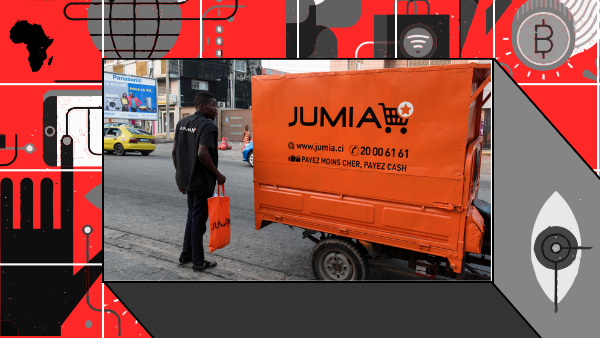
  • Jumia briefly reclaims unicorn status following stock market rally

    • Share
    • Tweet
    • Share
    • Share
    Share

    Strive Masiyiwa is having a hard time selling part of his stake in Liquid Telecom

    in partnership
    with
    FLUTTERWAVE
    31.07.2020

    Hello there,

    Welcome to TC Daily! In today’s digest: Jumia briefly reclaims unicorn status, Zimbabwe’s Strive Masiyiwa is having a hard time selling part of his stake in Liquid Telecom, and Huawei’s dominance in Africa has a new challenger.

    Please take a moment to subscribe to our newsletter if this email was forwarded to you.

    PARTNER CONTENT

    Get access to quality medical consultations from licensed Medical Doctors right from the comfort of your home, at any time and at the tip of your fingers.

    Here’s a great opportunity for Medical Practitioners to earn more money from consultations. Learn more here.

    AFRICA’S UNICORN

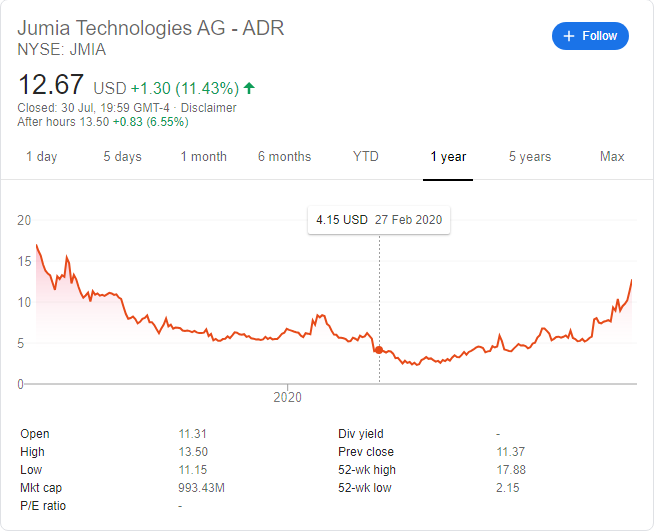
    Jumia is making a resurgence on the stock market. The online retailer’s share price has consistently increased since May 14 when it traded at $3.95 with a market capitalisation of around $309 million. But on July 30, its stock made an impressive performance, rising above $13. It peaked at $13.36 according to Bloomberg data, giving Jumia a valuation of at least $1 billion – its highest level since August 2019. Jumia’s stock ended the day priced at $12.67 with a market cap of $993.43 million.


    There is no clear explanation for
    this recent growth. A few investors on Twitter
    have been bullish for some weeks, believing that its shares could “reach for the moon” soon. My basic understanding after speaking with one of them is
    they’re anticipating impressive results following the company’s 8th annual anniversary sales promotions which started in June.

    That said, there is a lot of optimism around Jumia in recent months. High losses and a challenging path to profitability are two challenges the company has faced over the last eight years. But in its Q1 2020 financial report, it doubled down on plans to control losses and chase profits. In Q1, Jumia lost less money for the first time in six consecutive quarters despite pandemic supply chain challenges. The company’s balance sheet also improved by
    12%, slightly reducing capital worries as global economic uncertainty rises.

    Meanwhile, Jumia is recording fast growth in its other businesses like JumiaPay and Jumia Food. The latter is growing at around 30% month on month benefitting from an increase in the number of logistics operators in Nigeria, its biggest market. Additionally, Jumia has expanded fully to South Africa, leveraging the architecture of its existing online fashion retailer, Zando.

    Yet, the pandemic is having mixed results on Jumia’s businesses. On the one hand, there is a greater
    incentive to shop online to reduce the spread of the
    virus. On the other hand, the pandemic has caused economic challenges and is having a negative impact on income levels in Jumia’s key markets. Also, its biggest market, Nigeria is at risk of a recession caused by both the pandemic and unstable global oil prices.

    We should get a better understanding of Jumia’s market realities when it publishes its Q2 earnings report on August 12.

    LIQUID TELECOM

    Zimbabwean businessman, Strive Masiyiwa, is under pressure from a tight deadline to sell some shares in Liquid Telecom, the cloud and fibre company. According to Bloomberg, the billionaire wants to sell up to 34% equity in the
    company for as much as $600 million. The sell will help offset a $375 million loan he used to finance his pay-TV company, Kwese, which failed in 2019. The loan was backed by the Public Investment Corporation, South Africa’s state-owned asset management company managing a $135 billion fund. As collateral for the loan, Strive pledged shares in Liquid Telecom. He planned to do an IPO for the telco in early 2020, but that plan was cancelled.

    Since then and with the pandemic, he has struggled to find buyers for the limited stake in the company. Bloomberg reports that potential buyers wanted more time to assess the effects of the pandemic and control measures on the African economy. But Strive has limited time. After already granting one extension, the PIC has reportedly given him till the end of August to conclude a deal.

    LOCAL AFRICAN INVESTORS

    The African tech ecosystem is having serious conversations about the “colour of investment” into the continent. Foreign capital flows more into foreign-led companies, causing some to question if investors have a funding bias against local founders. It’s a serious question. However, while that conversation is ongoing, there is also the realisation that outside South Africa, African investors and high net worth individuals have
    continued to shy away from backing local companies.

    Instead, African investors are focused on proven industries like construction, real estate, oil and gas and traditional financial services. When Nigerian veteran banker, Jim Ovia, led a $5 million round in fintech startup, TeamApt in 2019, that was an exception. Another former Nigerian banker, Tony Elumelu has previously made two similar public investments in tech startups; both non-African.

    According to Forbes, in February 2014, Elumelu’s investment company, Heirs Holdings invested an undisclosed amount in US company, Planet Labs. And in December 2014, he backed Wonderloop, a company founded by Norwegian entrepreneur Hanna Aase. Since 2015, He has focused on backing African early-stage ideas through a $100 million fund that invests up to $5,000 in local founders.

    Other financial heavyweights like Africa’s richest man, Aliko Dangote and Atedo Peterside sit on the board of Endeavor Nigeria, a high impact startup fund. However, it is unclear if either of these gentlemen has invested their own money in tech startups.

    In this Business Day article, Frank Eleanya writes that the last time local investors dominated tech investing in Nigeria was in the early 2000s. Back then, Nigerian investors and banks laid the foundation that ushered in the telco boom which has had a transformative impact. In that article, Eleanya asks can Nigerian investors
    lead tech investments again?

    HUAWEI IN AFRICA

    This week on the China Africa Project’s podcast hosted by Eric Olander, I was asked an interesting question. Have the efforts of the US government made any impact on Huawei in Africa? There’s a lot here.

    Huawei is at the centre of the US-China dispute more so as the 5G race hits up. The Trump-led US administration is forcing allies to stop the use of Huawei’s technology in their future telecom infrastructure projects. In the most recent case, the US has told Brazil there would be “consequences” if it allows the Chinese company to supply 5G equipment.

    However, in Africa, Huawei doesn’t seem to have much to be concerned about. Since 2016, the US government has practically ignored the continent as it recedes from global politics. In an infamous remark in 2018, Trump referred to African countries as “shitholes” and has made minimal policy measures for the region.

    With US interest low, Huawei has bolstered its presence in Africa building new data centres and other infrastructure. According to US military publication, SOFREP, Huawei is the dominant telecom builder in Africa and is responsible for 70% of the continent’s 4G infrastructure. In South Africa, the company partnered with telecom company Rain to roll out the country’s first standalone 5G network a few months ago. Kenya’s Safaricom says it will use Huawei’s equipment to
    develop its 5G. And in Nigeria, the government recently approved a 2018 initiative to expand fibre infrastructure across the country. Huawei is providing technical support for this project.

    “What will we do in terms of the American statements about not using Huawei?” asked Michael Joseph, Safaricom’s acting CEO told Reuters in February. “We don’t have that situation in Africa,” he said.

    However, one US company, Parallel Wireless, is trying to upend Huawei’s infrastructure lead on the continent. Using a new standard called OpenRAN, Parallel Wireless is helping telcos to adopt vendor-neutral equipment to build their infrastructure, essentially reducing Huawei’s leverage. The US company is led by Steve Papa who believes the 5G race is a zero-sum game. His company is building for MTN and Vodacom in Africa, and earlier this year Ghana announced it will use Parallel Wireless’
    technology to connect 1,000 communities.

    Huawei shouldn’t get too comfortable, I guess.

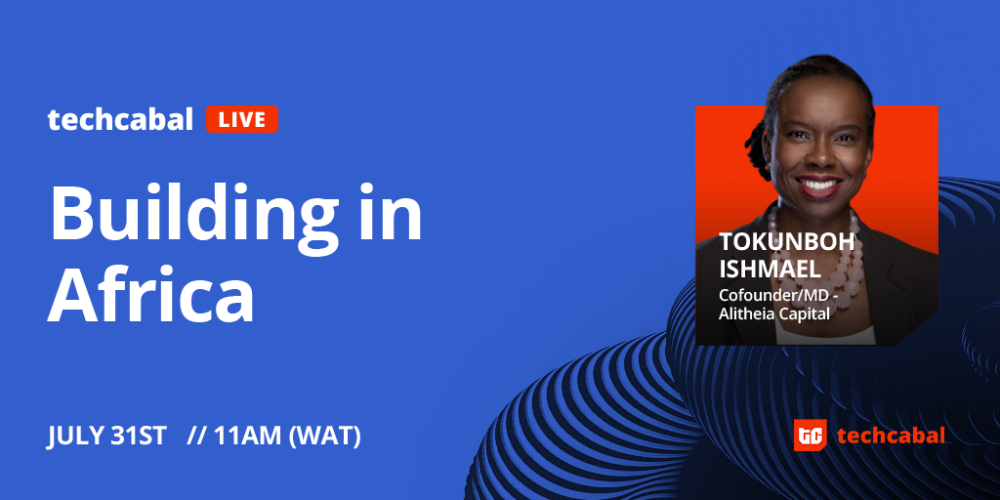
    TC LIVE WITH TOKUNBOH ISHMAEL

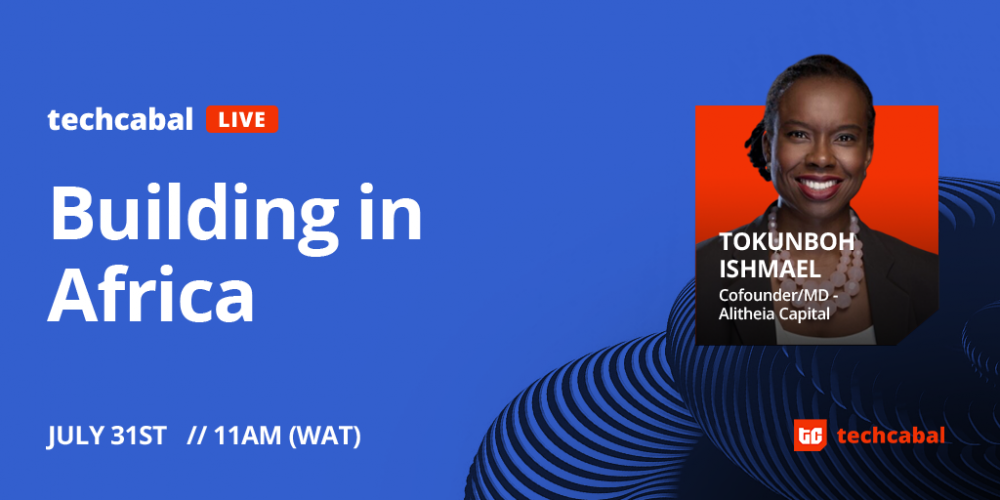
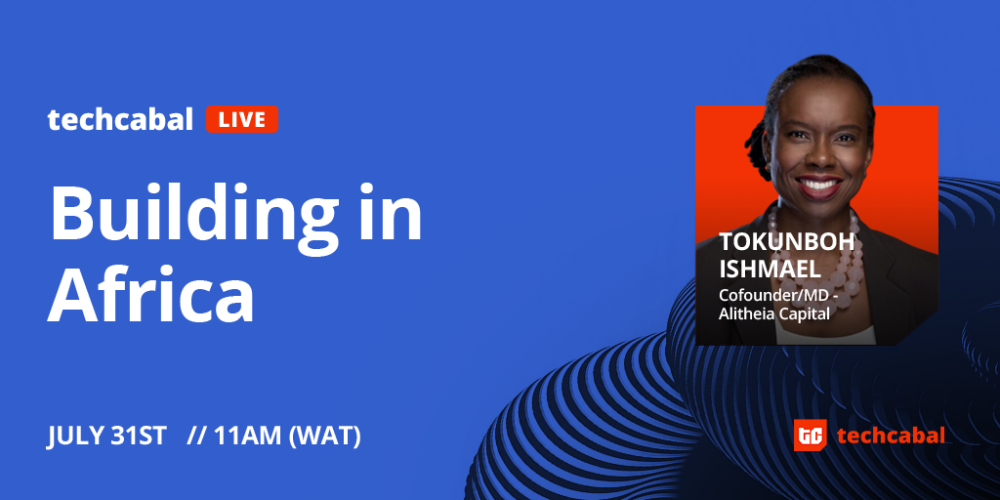
    The next TC Live session is holding today Friday, July 31st. We will interview Tokunboh Ishmael, co-founder and Managing Director at Alitheia Capital whose portfolio companies include MAX, Lidya and Tomato Jos. Alitheia Capital is one of the continent’s most prolific local investors. Ms Ishmael has a 20-year experience spanning investment banking, private equity investing, technology and new business development on and off the continent. She will answer questions in an interactive session about Building in Africa. Register here to join the session.

    MUST READS!

    • The BackEnd: BVN’s central role in re-shaping Nigeria’s credit repayment culture
    • This grassroots govt in Lagos is threatening Nigeria’s vision for financial inclusion.
    • Nigeria moves to regulate its logistics sector, but new requirements threaten all players

    Thanks for reading,

    See you next week.
    – Abubakar

    Share TC Daily with your friends!

    Copyright © 2020 Big Cabal Media,

    All rights reserved.
    You are receiving this email because
    you signed up on TechCabal.com

    Our mailing address is:
    Big Cabal Media
    18, Nnobi Street, Animashaun, Surulere, Lagos
    Surulere 100001
    Nigeria

    Add us to your address book


    Want to change how you receive these emails? You can
    update your preferences or unsubscribe from this list.


    Sent to: _t.e.s.t_@example.com

    Unsubscribe

    Big Cabal Media, 18 Nnobi Street, Surulere 23401, Lagos, Nigeria


    Email Marketing by ActiveCampaign


  • On 11 July, mobile money agents in Agbado/Oke-Odo Local Council Development Area (LCDA), a suburban area in Lagos, received a notice. The grassroots government of the area had introduced a new weekly levy of ₦600 for all mobile money agents.

    “They just sent the circular about two weeks ago that they’ll start locking up shops and kiosks and business places if we don’t pay before the July 25,” said a mobile money agent identified simply as Tina.

    Agents disregarded the notice, hoping the move would be reconsidered and the levy will never be collected.

    That didn’t happen. By July 25, the LCDA started enforcement.

    “This morning [July 25], we saw his [LCDA] taskforce everywhere victimizing people forcing them to pay the money by force,” Tina posted on Twitter.

    She explains to TechCabal that there was no prior dialogue between mobile money agents in the area and local authorities. Both the notice and enforcement were decided unilaterally and carried out in a similar manner.

    Agency banking is gradually becoming an important part of the Nigerian financial system. Around 60.1 million Nigerian adults are financially excluded according to EFInA [PDF]; meaning they have no bank accounts and are unable to access credit, insurance or basic banking services. Another high number of adults are underserved as banking services are limited in their locations. EFInA estimates that while 40% of adults had access to payments services, only 2% had access to either savings or lending providers.

    Agent banking is one fix for these. By enabling agents to carry out basic banking operations – money transfer, withdrawals and account opening – agency banking is crucial to financial inclusion in the country.

    But in the Agbado/Oke Odo area, the government has a different understanding. A predominantly rural neighbourhood with fewer well-connected road networks, the area generated ₦293.9 million revenue in 2015. It had the 14th lowest revenue among the 57 LCDAs in Lagos. Together, these LCDAs generated over ₦22 billion in 2015.

    However, Agbado/Oke Odo is also highly populated. Although statistics are unavailable, the area is part of the larger Alimosho Local Government Area which had a population of 2.05 million in 2015; the highest in Lagos.

    The Agbado/Oke Odo LCDA has high levels of commercial activities and has the highest number of shops in Lagos. But according to a 2015 government report [PDF], the LCDA has limited banking and financial services. There are only ten bank branches catering for over 6,500 shops, markets and kiosks in the area. Mobile money agents help to provide basic banking services to small businesses and individuals residing in the area.

    The grassroots authorities see mobile money agents as just another group of people who should pay levies. Every small business in this area – passenger motorcycles, taxis, informal traders, etc – is heavily taxed.

    Tina says she already pays over ₦27,000 annually as levies to local authorities for everything from her shop’s signboard to a tarpaulin extension outside her shop. Shop owners also pay a separate levy of around ₦2.000 if they own TV and radios.

    She told TechCabal that mobile agents were not expected to pay separate levies to operate. In addition to bank stamp duty of POS withdrawals, payments companies automatically collected the charges on each transaction.

    “We thought that alone was enough,” Tina said, “until we got the circular.”

    “It’s seriously crazy, that’s why we had to speak up this time [because] adding this to the bills we already pay is outrageous.”

    A few mobile money companies like Paga have indicated that they were not informed about the new levy before it was enforced.

    Mobile money agents are already suffering a significant impact as a result of the pandemic. According to a recent study by EFInA, monthly income of agents has dropped by almost 50% since the outbreak of COVID-19. Pre-pandemic, agents earned an average of ₦54,662 monthly, but now that figure has dropped to ₦27,944 monthly.

    Mobile money agents in the area have already teamed up to oppose the new levy. 

    At first, they organised themselves in a WhatsApp group chat, but the matter has now been taken up by the Association of Mobile Money & Bank Agents in Nigeria (AMMBAN).

    AMMBAN says it represents all money agents in the country and has been having conversations with the LCDA authorities since Monday, July 27.

    In a conversation with TechCabal, Lagos State Chairman of AMMBAN, Azeez Olowu said the issue was being handled. He did not provide more details.

    In a memo to members, AMMBAN said it was invited for a meeting with Agbado Oke Odo LCDA authorities on Monday, July 27. “But unfortunately we could not reach a conclusive decision,” it said.“In view of this, I will urge all AMMBAN members to keep calm and continue with their usual business but shun any form of circular related to levy collection or tax by any contractor from Agbado Oke-Odo LCDA till further notice.”

    When asked if similar levies have been imposed elsewhere in Lagos, Olowu said no, claiming this is an isolated case.

    Yet this is a slippery slope especially for a country with a history of rent-seeking. If this alleged isolated case is not seriously opposed, there is a tendency that other grassroots governments across the country will impose their own levies on mobile money agents. This will be catastrophic to the financial inclusion goals pushed by the Central Bank of Nigeria (CBN).

    A recent AMMBAN press release says this may already be happening.

    “[We] have been inundated with distasteful reports of how local government councils/LCDAs officials and their contractors have been intimidating, disrupting and in many instances molesting our members and indeed, all Mobile Money and Bank agents across the country on the basis of the collection of levies and daily tolls,” AMMBAN wrote on July 27.

    “Any levy or toll outside [regular charges, levies and taxes] are devilish and anti-people,” it added.

  • The BackEnd explores the product development process in African tech. We take you into the minds of those who conceived, designed and built the product; highlighting product uniqueness, user behaviour assumptions and challenges during the product cycle.

    —

    When next you request a loan from a Nigerian bank, you may be required to agree to a clause granting the bank access to your other bank accounts in case you default on repayment.

    In mid July, the Central Bank of Nigeria (CBN) issued Operational Guidelines on Global Standing Instruction (GSI) – Individuals. The document explains a new loan recovery and risk protection strategy that will henceforth guide the credit sector. 

    The main beneficiaries of the initiative will be banks and fintechs who lend to individuals. The broader goal, according to the CBN, is to facilitate an improved credit repayment culture, reduce non-performing loans and watch-list consistent defaulters.

    The move has been over a year in the making. After a Banker’s committee meeting on the 26th of August 2019, Aishah Ahmad, the deputy governor of the Central Bank in charge of the financial services system, made the first major announcement of an industry-wide standard for loan recovery. 

    This was to be a consolidation of agreements some banks already had between themselves to recover borrowers’ loans by sharing information. 

    Background: How banks lend to individuals

    To be eligible for a loan from a Nigerian bank, it is the custom that you must have an account there. 

    For some banks, a borrower’s salary has to be domiciled there as a guarantee of regular income. Standard Chartered, for example, requires a potential borrower to submit pay slips from three months and a letter of awareness from the employer’s human resources.

    They check your indebtedness to other institutions and may request a letter of non-indebtedness if necessary.

    Despite this, lending to individuals is a high-risk venture for banks. Weak identity infrastructure in the country complicates the recovery process. After internal and external collection teams recover the much they can, defaults are reported to credit bureaus.

    But one piece of identifying information could be the beginning of a solution to the problem: the Bank Verification Number (BVN). 

    Administered by the Nigeria Inter-Bank Settlement Scheme (NIBSS), the eleven-digit biometrics-based ID is unique to every Nigerian bank account holder. The fact that it binds an individual to multiple accounts is the key cog in the GSI’s potential success.

    How GSI will work on NIBSS backend

    The GSI depends mainly on the interaction of four parties: the borrower, the banking offering credit, other financial institutions in the credit system, and NIBSS.

    By default, every borrower’s account has a BVN. These BVNs show up on the Nigeria Central Switch, the base from which NIBSS coordinates interoperability between institutions in the financial system.

    For every new loan application after August 1 2020, banks offering credit to individuals have a duty to inform the borrower of the GSI mandate. Banks must make it clear that the borrower’s other banking accounts will be debited without requesting consent in the event of delayed repayment of principal loan amount with interest.

    The agreement, according to the CBN’s guidelines, can be executed either on physical paper or digitally. 

    For a hypothetical individual, Shola, who borrows from UBA but also has accounts with First Bank, GT Bank and Access Bank, the mandate will work as follows:

    • Shola signs credit application agreeing to GSI mandate and borrows from UBA
    • After repayment is past due, UBA triggers GSI for outstanding principal amount and interest by making a balance enquiry through NIBSS to other accounts linked to Shola’s BVN. Balance enquiry is one of the Instant Payment protocols facilitated by NIBSS 
    • If Shola’s other accounts have money, NIBSS administers the process of initiating debit instructions and instantly transferring the collected funds to the account in the creditor bank.

    All of this is subject to the Central Bank’s supervision and monitoring, according to the guidelines, with periodic reports submitted on the frequency and success of GSI triggers.

    The CBN’s other function is to maintain a Credit Risk Management System where banks and other institutions will submit information on borrowers.

    How will this change account ownership?

    The effect on individual accounts is straightforward; you need a bank loan? Agree to the new terms.

    But GSI will also cover joint accounts. That means if you are a co-signatory to an account held by a defaulting borrower, the money in the account will be subject to instant debit without prior notice from your bank.

    There is at least legal objection to this on the basis that it violates privity of contract. When two or more people agree to open a joint account, they usually agree to a consensus on issues around loans and debits.

    GSI could have the effect of adding another consideration to the process, whereby potential owners of a joint account check each other’s financial prudence before entering the ownership agreement. It would be interesting to see how spouses and families with joint accounts adjust to the change.

    BVN’s usability expands

    Introduced in February 2014, BVN has become arguably the most important unique identifier in Nigeria. Unlike an international passport or driver’s license, it is issued once. And unlike a voter or national ID, most Nigerians feel an incentive to have one.

    BVN has been foundational to the rise of fintech in Nigeria. Startups in payments and money transfer, savings and loans all require it as a KYC feature. 

    As of July, there are 42.7 million BVNs on the NIBSS database, giving a rough idea of how many unique bank account holders there are in Nigeria.  With an estimated 200 million people in the country, this amounts to about a 21% bank penetration rate.

    GSI might well help foster a repayment culture which encourages banks to lend more. However, its reliance on BVNs means the many unbanked adults remain outside the financial system. 

  • In June, Safeboda celebrated 100,000 rides in Ibadan. It was a reminder to mobility players in Lagos of what might have been. And now new regulations may also see small logistics companies struggle. 

    On Saturday, July 25, hundreds of concerned Nigerians used the hashtag #SaynotoNIPOSTfees to protest new regulations imposed on logistics companies. 

    There have been talks around the regulation of logistics companies in Lagos for months, with the Courier Regulatory Department, the regulatory part of Nigerian Postal Service (NIPOST) having shared a letter showing a new licencing regime in May. 

    Although the regulations are from the federal government, there’s hardly any city where the effects would be felt as much as Lagos, Nigeria’s commercial capital. In Lagos, dispatch riders have been popular for years. In a congested city  struggling with bad roads and traffic, moving things around is a service that is always in demand. 

    Because of their dexterity, motorcycles are the way to deliver items to the many customers who expect their items on the same day. There’s a shortage of trust in Lagos and it means that same-day deliveries are a way to allay some fears. 

    While small-scale dispatch businesses are more popular for same day deliveries, a lot of the big courier companies provide the same service. But their pricing is steep. 

    *Victor, a journalist who works in Lagos says he tried to send a small parcel from Lagos to Abuja using one of the big logistics companies. His bill was ₦4,000 ($10). That is almost half the fare to travel from Lagos to Abuja. 

    This type of pricing provides an opportunity for independent delivery services to find a foothold in the market. With a few motorcycles, entrepreneurs offer cheaper and flexible delivery services to small and medium businesses. 

    While they serve small businesses, some of these dispatch services also partner with the big courier services to help them deliver orders. It shows that despite the small scale of their operations, they’re an important part of the logistics sector. But plans to enforce regulations in the sector may see them struggle in a sector that is already difficult to thrive in. 

    The difficult business of registering a dispatch service

    The website of the Lagos State Employment Trust Fund (LSETF) lists some of the requirements for operating a delivery business in Lagos.

    “In addition to registering each motorcycle in your fleet, your courier company has to be registered with the Federal Ministry of Communication and Technology and registration is done with Nigerian Postal Service (NIPOST). Failure to go through due process of registration can lead to arrest and impounding of the motorcycle. It’s that serious.”

    The new registration and licencing process the LSETF references in its website is handled by the Courier Regulatory Department (CRD), a specialised arm of NIPOST. 

    New categories for Nigeria's logistics operators as regulations begin
    New categories for Nigeria’s logistics operators

    Under the new licencing structure, there are six categories of licences that range from  ₦250,000 for SMEs like restaurants to ₦20,000,000 for international courier companies like DHL.

    Despite being a federal licencing arrangement, Lagos state announced its readiness to enforce the regulations months ago. In a conversation with TechCabal in May, the Commissioner for transportation in Lagos, Dr. Frederick Oladeinde said: “these regulations are from NIPOST first.”

    It is only after companies meet the NIPOST requirements that it will have to meet the slew of requirements in Lagos state. Despite the decision, it still came as a surprise to logistics companies when the enforcement began without any warning.

    Reports indicate that from July 23, policemen in Lagos began arresting hundreds of dispatch riders in Lagos, and seized their motorcycles for failing to have the NIPOST licence. 

    Minister asks NIPOST to suspend new licencing fees

    The Courier and Logistics Services Operations regulation (2020) was issued by the Ministry of communications and Digital economy. It is the framework under which the new licencing categories are contained.

    It is especially important because the new regulations repealed the Courier Service Regulations (1992) in which NIPOST acted as operator and regulator. 

    Despite the fact that the regulations were approved by the ministry, the minister of Communication, Isa Pantami has now done an about-face.

    The about face is as a result of public censure over the seizure of hundreds of dispatch motorcycles in Lagos. 

    https://twitter.com/tap_logistics/status/1286934496932171782?s=19

    Isa Pantami asked that the fees be stopped immediately, while claiming that the new licence fees were not part of approved regulation.

    In a tweet he put out on Saturday, July 25, he said:“Please NIPOST, our attention has been drawn to an increase of licence fee, which was not part of the regulation I earlier approved for you. Your chairman and PMG (Postmaster-General) were yesterday contacted to put the implementation on hold and send a report to our ministry by Monday. Best wishes!” 

    But the suspension is hardly a victory, as there’s another part of the new Courier Service Regulations that will potentially harm the players in the sector. 

    Logistics operators to contribute 2% of revenue to postal fund

    According to Regulation 8(5) of the Courier Service Regulations, logistics companies are mandated to contribute part of their revenues to a postal fund.

    “There is now an obligation on a courier operator to contribute a sum equal to 2% of its total revenue to the Postal fund, which will be used for postal development and delivery of postal services in rural and underserved states.” 

    This provision is perhaps the most worrying part of the new regulations, seeing as it makes revenue contribution necessary. It also throws up the question of legality and whether the minister has such powers as impose taxes on courier companies.

    It cannot also be overlooked that the postal fund, by constitutional definition can only receive funds from the federal government as well from services rendered by NIPOST. While the licencing fees are a battle worth fighting, regulation 8(5) is the bigger problem. 

    There are some other worrying introductions to the new Courier service regulations. Regulation 8(7) is the requirement for referral of specific items to NIPOST for processing and delivery.

    According to this section, 

    “items/articles such as rights issues, share certificates, statements of accounts, cheques, letters or offer documents weighing below 0.5kg sent to courier service operators for delivery must be recorded and referred by such operators to the nearest post office of NIPOST for processing and delivery.” 

    “Any operator that fails to comply with this requirement will be liable to pay a penalty of 90% of the amount charged on the item by such an operator.” 

    This section raises a host of questions such as why courier services cannot take responsibility for documents under 0.5kg, and what constitutes “processing” of a document by NIPOST. In addition, it also raises questions about transferring liability. What happens when a document goes missing? Will NIPOST be held liable?

    But that question only scratches the surface. The biggest question is, if a customer enters an agreement with a private courier company, does the minister have the powers to ask that the company transfer that contractual agreement to NIPOST?

    Subsections like these make it hard to agree with this assessment that “the new regulation shows that it is a great improvement on the old one as it addresses some of the underlying puzzles about the regulation of the logistics sector.”


  • A $288 million African fintech acquisition

    • Share
    • Tweet
    • Share
    • Share
    Share

    Questions over a Chinese loan for broadband connectivity in Nigeria

    in partnership
    with
    FLUTTERWAVE
    30.07.2020

    Hello there,

    Welcome to TC Daily! In today’s digest: Dubai-based payments company acquires Africa-focused DPO Group, Nigeria’s legislative chamber raises questions about a Chinese loan for broadband connectivity and we explore tackling venture capital bias.

    Please take a moment to subscribe to our newsletter if this email was forwarded to you.

    PARTNER CONTENT

    Get access to quality medical consultations from licensed Medical Doctors right from the comfort of your home, at any time and at the tip of your fingers.

    Here’s a great opportunity for Medical Practitioners to earn more money from consultations. Learn more here.

    ACQUISITION
    Dubai’s Network International is set to acquire Nairobi-based fintech DPO Group for $288 million.

    DPO Group is one of the largest pan-African online payment platforms with a presence in 19 countries across the continent. In 2019, it reported $16 million in revenue and its major markets include Kenya, South Africa, and Tanzania. The
    fintech currently works with about 47,000 merchants across the continent.

    The acquisition helps Network International consolidate and accelerate its presence in Africa. The deal is expected to be completed in Q4 2020. DPO’s founders will have $13 million in their ownership of the company rolled over into Network International shares and a two year holding period after the acquisition.

    The DPO deal is the second major fintech acquisition within the space of a month in Africa where tech exits are an exception and not the norm. But there’ve been at least 3 others within the past year. Last month, MFS Africa acquired
    Beyonic
    , a Uganda-based digital payments company. Earlier this, Paga acquired Apposit, a software development company based out of Ethiopia.

    It’s still too early to say whether these are signals of a change in the landscape but these are surely interesting days for fintech in Africa.

    VENTURE CAPITAL BIAS

    After an eleven-year career at General Electric helping expand its business portfolio in Africa, Ivorian entrepreneur Swaady Martin founded YSWARA; a South African gourmet tea company that sources ingredients across Africa and exports to 17 countries around the world.

    Despite her network, professional achievement and sector knowledge, Martin says she has been unable to raise funding for the company. But she continues to see capital cycle from white funders to white founders in ways that mimic the transfer of World Bank loans from
    Washington institutions to Africa-based NGOs led by white people.

    Martin believes funding bias in favor of African businesses founded by non-Africans “is another form of neo-colonialism.”

    Over the past few weeks, an old conversation about funding bias has re-emerged within the African tech community. Alex spoke with key industry players about how to tackle the bias.

    CHINA + AFRICA

    Nigerian lawmakers have raised questions over a clause in the country’s loan agreement with China according to local media reports. Part of the loan, about $328 million from the China-EXIM bank is expected to be used for expanding fiber infrastructure to 19 states in Northern Nigeria.

    The problematic clause reads as follows:
    “The Borrower hereby irrevocably waives any immunity on the grounds of sovereign or otherwise for itself or its property in connection with any arbitration proceeding pursuant to Article 8(5), thereof with the enforcement of any arbitral award pursuant thereto, except for the military assets and diplomatic assets.”

    The House has accused the Finance Ministry of surrendering Nigeria’s sovereignty to China in exchange for the loan. Although the matter is yet to be investigated, it
    ties into concerns about China’s role in Africa and whether nations are mortaging their futures in exchange for loans.

    Nigeria’s House of Representatives has summoned the Minister of Digital Economy, Isa Pantanmi, Minister of Finance, Budget and National Planning, Mrs. Zainab Ahmed, among others. They ‘ve been asked to appear before the House Committee on Treaties, Protocol, and Agreements on August 17.

    CREDIT

    Credit data marketplace, Carma which is currently present in Nigeria and Kenya has launched in Zambia. Carma seeks to provide lending companies with access to real-time credit data, on a peer-to-peer basis, through a pay-as-you-go service

    In Zambia, CARMA has signed an agreement with NASCU Zambia to
    provide credit reference services for 1,122 credit unions. The credit unions serve almost 1.5 million credit union members which are about 15 percent of Zambia’s adult population.

    #MYLIFEINTECH

    During her internship year in university, Olamide Ajah first learnt about Visual Basic. Her boyfriend at the time, now her husband, “had gone for training in Visual Basic and came back to school bubbling with this new knowledge that he had gained,” Ajah told TechCabal.

    “I was amazed by how you could think of an idea and create something tangible by tapping a few strokes of your keyboard. That caught my attention and that’s where it all started,” Ajah narrating the event.

    Today, Ajah is the Chief Technology Officer at Seamfix, an organization that provides identity management and verification solutions. She shared her story and her journey in tech with Kay in this week’s #MyLifeInTech.

    TC LIVE WITH TOKUNBOH ISHMAEL

    For the next TC Live session on Friday, July 31st we will interview Tokunboh Ishmael, co-founder and Managing Director at Alitheia Capital whose portfolio companies include MAX, Lidya and Tomato Jos. Alitheia Capital is one of the continent’s most prolific local investors. Ms Ishmael has a 20-year experience spanning investment banking, private equity investing, technology and new business development on and off the continent. She will answer questions in an interactive session about Building in Africa. Register here to join the session.

    WHAT ELSE IS HAPPENING?

    • The long road to paywalls in the Nigerian media.
    • Sean “Diddy” Combs’ REVOLT TV is launching an online series exploring Hip Hop culture in Africa.
    • 50 finalists selected for Jack Ma Foundation’s Africa Netpreneur Prize
    • How Takealot crushed Makro

    Thanks for reading,

    See you tomorrow.
    – Olanrewaju

    Share TC Daily with your friends!

    Copyright © 2020 Big Cabal Media,

    All rights reserved.
    You are receiving this email because
    you signed up on TechCabal.com

    Our mailing address is:
    Big Cabal Media
    18, Nnobi Street, Animashaun, Surulere, Lagos
    Surulere 100001
    Nigeria

    Add us to your address book


    Want to change how you receive these emails? You can
    update your preferences or unsubscribe from this list.


    Sent to: _t.e.s.t_@example.com

    Unsubscribe

    Big Cabal Media, 18 Nnobi Street, Surulere 23401, Lagos, Nigeria


    Email Marketing by ActiveCampaign


  • My Life In Tech is putting human faces to some of the innovative startups, investments and policy formations driving the technology sector across Africa.

    Olamide Ajah came into tech by chance and has since spent the last decade and more leading teams building software solutions that serve to simplify identification and KYC processes for various organisations. This is her life in tech.

    Olamide Ajah, Chief Technology Officer at Seamfix, had wanted to take after her father, a mechanical engineer who was also a publisher. She doesn’t recall which it was, the availability of the course at the university she intended to enroll in or her father’s encouragement to pursue some other area of engineering, but she went for a degree in Computer Engineering instead. 

    Her long term interests in the field however, was sparked by her husband whom she was dating at the time. 

    “We were classmates in university and during our internship year, he had gone for a training in Visual Basic and came back to school bubbling with this new knowledge that he had gained,” Ajah says.

    He wanted to share that excitement with someone and she easily became his sounding board eventually learning Visual Basic as well.

    “I was amazed by how you could think of an idea and create something tangible by tapping a few strokes of your keyboard. That caught my attention and that’s where it all started.”

    Back home, she created her first software tool. An inventory system for her father’s publishing company. 

    “He was excited and proud,” she says, in the way Nigerian parents are proud that their financial commitments towards their children’s education are not in vain. 

    For her National Youth Service year, Ajah was posted to Seamfix, which she thought at the time was perhaps a fashion-focused firm and had called her dad to ask that he pull some strings to help her secure a more suitable spot in another organisation. 

    It turned out Seamfix was her match made in heaven. 

    “Here was this hungry person that wanted to learn more about tech and what it could be used for, how it could impact society, and here was this company that had leaders with so many ideas of the good they could do in society so it was a perfect match,” she says.

    Ajah joined Seamfix when the company had only five staff members. That was 11 years ago. Now, the company has a 91-94 workforce. 

    Ajah says four years in, she was enthralled not only by the work she was doing at the company but the people she was working with so that even when juicier job offers came, she stayed on.

    The sacrifices have paid off. Ajah has climbed the ladder over the years taking on even more roles than officially designated and is currently the Chief Technology Officer (CTO) at Seamfix. 

    As the company has grown over the last decade, part of her longstanding journey with with it has also been borne out of the responsibility to give back by way of helping  lay the foundations and structures for building an environment where people thrive. 

    “With growth comes chaos,” she says. 

    What big lessons has she learnt about creating an environment where people thrive?

    “I think it is very important that the people you’re working with are intrinsically motivated,” Ajah says. 

    It is important that they connect with the company’s vision and goals as they evolve, that they connect with it and that they want to really be a part of bringing those goals to fruition. What that means is that the leadership has a clear vision of what they have set out to do, can communicate the same to staff and, earn their trust and commitment to help build that vision. 

    “So beyond the money you pay them, they are passionate about what you do and want to go on the journey with you,” she says. 

    The second is about people. 

    “This sounds obvious but when you look at many companies you’ll realise that it is not that obvious afterall,” Ajah explains.

    The recognition that people are the most critical and valuable assets of an organisation is what she refers to. 

    “Several times, we tend to treat people as just tools to do the work, the work takes preeminence,” Ajah says.

    Once companies realise that people are the most important variable in their success equation, then building effective company structures and workforce cultures that provide a conducive work environment will come naturally.

    So, you want to create a harassment policy for your startup?

    Seamfix is primarily known for its identity management and verification solutions however, there’s also a lot of software solutions it creates around helping organisations manage their processes better as an enterprise software company. 

    To deploy a product, Ajah says the company often employs a design thinking framework where it either sees a need in the market and creates a product that solves the need. Or finds a suitable market, notices a problem that needs solving and proceeds to create a product that fits the market’s need. 

    “We analyse the market and the need,” Ajah explains. 

    “We clarify for ourselves that this problem we think we can solve is not being addressed already by a competitor and if it is, what unique differentiator we could bring to our solution.”

    “Once we can certify this, we have an MVP which we trial on our target audience, get feedback and do a launch or make changes depending on the feedback we receive.”

    “We tend to adopt design thinking a lot in our processes where we go through the entire ideation process to launch a product.”

    There are not many women you will find with Ajah’s job role in the country. Not only are there few women in the industry, even fewer make it into the C-suite executive level at top technology companies in the country. 

    The causes are mostly a combination of culturally nuanced stereotypes that trail girls from childhood into adulthood and then corporate practices that make the journey even harder.

    “I remember when I first joined Seamfix, about a year after and I was always at the office working late and on weekends. I recall one family member told me this is not how I was going to find a husband and that was a recurring thing early on in my career,” Ajah says.

    She  was supposed to be more concerned about marriage and motherhood, two things she has been able to attain alongside her career. 

    “I was able to shut my ears to it and said I would find a way to balance both. Currently I am married and I have a three year old daughter.”

    Much of the ability to do this has also been the corporate support of her organisation.

    “When I first gave birth and had to return to work, I couldn’t leave my baby at a daycare center at three months old so I had to bring her to work and this is another area where the company provided immense support. They had created a nursery.”

    If she was not at Seamfix, Ajah believes she would still be creating software solutions that improve processes for individuals in their organisations, perhaps from a people management perspective.

    “I am a process person. I would have been building software that makes it easier to build the right culture, recognise employees when they perform well, keep your fingers on the pulse of your company,” she explains. 

    “I am keen on helping to build processes that bring structure to an activity or sector.”

  • The Nigerian media space has been slow to come to the conversation about paywalls and revenue. But these conversations are now happening as some newspapers think about the future.

    Nigeria’s traditional print newspapers have all but faded from public consciousness. It is surprising for a sector that, globally, has at many times served as a public watchdog. From the start to the peak of their powers, Nigeria’s newspapers have always had a mission.

    For Iwe Irohin, Nigeria’s first newspaper, it was to “engender the habit of seeking for information by reading.” Azikiwe’s West African Pilot railed against colonialism, much the same as Daily Times under Ernest Ikoli. 

    Guardian and TELL fought Nigeria’s many military rules. But it is not these sentiments alone that gave newspapers their relevance, it was the limited number of players in the newspaper space.  Print media is an expensive venture with a high barrier to entry. Whoever could scale that cost would be one of the few newspaper advertisers could go to. 

    But the internet has since disrupted the Nigerian business landscape. Where news outlets with prohibitive costs of entry were once few, today, anyone can start a news business. 

    Nigerian news media’s struggle with a sustainable business model

    “In the past, we knew all our competitors. “[Today] you cannot name all the news outlets that exist. The landscape has changed.The consumption pattern has also changed and we’re learning to take the news to people where they are” -Lolade Nwanze (Former head of digital, Guardian Newspapers).

    Anyone can start a media business 

    The internet changed the notion of scarcity that newspapers once enjoyed. In its place came a flood of online news outlets that could churn out news as it was happening. You no longer need to wait for a newspaper van to travel 6 hours from Lagos to bring you the news. 


    They are one-man operations: reporters without beats who made short work of 300 word articles.

    They covered every story, from politics to sports, entertainment and metro. But some others tried their hands at niche blogging. In the end, it was the generalists who survived. 

    Their thinking was practical: write on as many trending topics as possible and gather all the eyeballs you could. A few of these first wave online news outlets became popular and for the first time, put print media on the back foot. 

    While print continued to bask in their advertising revenues, a new stream of digital revenue had opened up for the online upstarts. The 20-something-year-old entrepreneur could now make dollar revenue from AdSense. 

    Many also had considerable social media presence and could promise advertisers visibility. Post 2014, they delivered trending hashtags before Twitter tweaked their algorithm and gamed impressions. In a few short years, the Linda Ikejis and NotjustOks had become the face of the online media business. 

    Yet it would hardly spell an end to print media, a sector that had survived for years through resilience.

    Beating them at their own game: print media moves online 

    Despite years of experience running newsrooms and having more professionals on payroll, traditional media houses decided to use the same playbook as their newer counterparts. 

    They realised that their top quality journalism or influential columnists alone weren’t going to win the battle for eyeballs. Enter “viral content” and clickbait headlines. Press releases were repackaged as news stories, fact-checking and verification became redundant. 

    Aanu Adeoye says, “the traditional gatekeepers of journalism (newspapers) in this country don’t give a hoot about the quality of what they’re churning out daily.”

    In a few years, stories from Nigeria’s top newspapers looked as hurriedly written as stories from blogs. It had become a game of who could break the news the fastest and who could churn out the most news. 

    Nigerian traditional media beat the upstarts at their own game and occupied spots at the top of Nigeria’s most visited websites. But the true cost of this pyrrhic victory was quality control. 

    The hard fought win would also meet some newer realities. With circulation for print going to the gutters, there was an equal fall in advertising revenues. The revenues from digital would also necessarily fall, with competition remaining stiff and platforms like Google and Facebook taking the chunk of the ad revenues.

    It meant that Nigerian newspapers were late to the global discussion of  creating new and innovative revenue models. 

    “Yet in the face of a worldwide threat to their industry, Nigerian newspapers are failing — due to ineptitude or a lack of willpower, or both — to adapt to meet new demands. The worrying thing is it’s at the simple things they’re failing at…their websites are a smouldering mess of low-res images and retardation not fit enough for a personal blog, let alone the digital arm of a national news provider.” – Aanu Adeoye

    COVID-19 forces a reckoning in the Nigerian media space

    If newspapers could pretend for years that all was well, COVID-19 forced a reckoning. 

    A memo which was sent by the management of Punch Newspapers to members of staff was leaked to the press. It is the clearest picture yet of the situation.

    “This pandemic has dealt with our business telling and severe blows. Our circulation and advertising revenues dipped dangerously, compounding the operational and revenue challenges birthed by the migration of a majority of print newspaper readers and adverts to digital platforms.

    “I am not at liberty to disclose all of the measures that the management has taken so far. But the ones that could be made public include an immediate reduction in print pagination; staff furloughing to comply with government and expert advisories on social distancing; the temporary shutdown of the sports newspaper; and significant financial reengineering.”

    Presumably, one of the company’s responses to the threat of falling revenue is the new move to digital subscriptions. 

    Nigerian media is now increasingly turning to paywalls as they struggle to stay afloat
    Punch newspaper recently announced subscription plans for their ePaper

    Punch has now launched an ePaper with subscription plans

    Punch will now join the small group of Nigerian online news outlets that are pushing ahead with subscription plans. 

    TechCabal reached out to a Senior Correspondent at Punch as well as the organisation’s head of digital to try to understand their new move to subscription plans. But we were told that members of staff at Punch do not speak to the media. 

    Nigerian media: Punch says its e-Paper will be a replica of the printed version
    Punch says its e-Paper will be a replica of the printed version

    The reluctant move to paywalls 

    Conventional wisdom is that getting Nigerians to pay for news online is difficult. It’s not a difficult argument to make given the state of the Nigerian economy as well as a reluctance to pay for online content. 

    Yet, prevailing realities suggest that media businesses must find a way to encourage users to pay. 

    Business Day was one of the first Nigerian publications to put up a paywall. Its annual plan costs ₦20,000 ($51.78) for the first year. Punch Newspapers is cheaper with a yearly plan of ₦17,200 ($44).

    Stears business recently announced that a yearly subscription will cost ₦35,000 ($90). The Republic costs $5.99 monthly while Jason Njoku’s “Beyond Data” is ₦10,000 ($28). 

    There’s a common theme among outlets setting up paywalls. First they put out high quality content for free for a while and they show the wider public the value of their analysis. At some point, they are secure in the knowledge that they have hit a value metric and they’re sitting on a product that is valuable. 

    When you have a valuable product, it’s only natural that you commercialise it and charge a premium since you’re filling a gap in the market. 

    In a sense, it might show that the newer players have a better understanding of what it means to build a paying audience online. 

    Even though all these players are putting up paywalls, their strategies are different. The traditional players like Punch and BusinessDay provide a replica of their print newspaper when you pay for their subscription. 

    But the big question is how Punch hopes to convince people to pay to read news they can find elsewhere for free. BusinessDay’s subscription offerings also fall within the realm of “news people can find elsewhere.” But they throw in promises like “podcasts with influencers” as a membership perk. 

    The subscription numbers for both publications are not public, so it is difficult to make any declarations.

    But here’s something niche online offerings seem to understand: in an era where news is abundant, people won’t pay for news they can find elsewhere for free. 

    According to Stears Business: “we have been driven by a simple promise: to provide original, analytical, well-written stories that make sense of the Nigerian economy.” 

    This promise of analytical stories instead of around the clock news that can lose relevance in minutes is what connects Stears, Afrobeats Intelligence and The Republic, despite their different niches. 

    But domain knowledge is only one half of the equation. The more important part is how to work from that knowledge to building a community of paying subscribers. 

    Building a paying audience

    According to Joey Akan, a music journalist and the author of the Substack newsletter, Afrobeats Intelligence, credibility is everything. He banks on his experience in covering the music industry in Nigeria and the trust he has built. 

    He tells TechCabal, “I have always had an audience from covering the music industry and getting published in international publications. I’ve built an audience who trust my knowledge.” 

    The idea of driving a paying audience by showing domain knowledge is also shown by IrokoTV’s Jason Njoku who published content around business intelligence for years.

    Becoming an expert also means you can build a paying audience off the force of your personality. Akan admits that “people are paying because they connect with me.” 

    His subscribers come from all over the world and while he has Nigerians as part of his paying audience, he admits he would love to have more of them.

    Yet, not having a ton of readers from your home country may not matter much. While the internet allows you to build your readership around the world, the bigger opportunity will lie in creating other revenue streams. 

    If your news outlet’s value is obvious enough to commercialise, there’s no doubt that innovation will take you down the path of other paid service offerings. So, while the road to paywalls has been a long one to arrive at, there’s no doubt it will be a precursor to other opportunities for fast thinking media outlets. 

  • The moral arc of creative disruption bends towards demand and supply, in the common good. With the right incentives, resources incline towards people who can capitalize on opportunities. 

    Iterate this process enough and you create structures that reproduce growth and economic development.

    That’s a good theory of how prosperity happens, but it assumes that society is founded on rational actors interacting on a level playing field. In reality, the modern world as we know it is a consequence of historic inequalities.

    For better and worse, humans do not allocate productive resources in a vacuum. Consciously or not, choices are products of values formed over time.

    Bias for the white pitch

    “Investors pattern match. They look for signals of trust. Social proof is a key metaphor for trust. This carries across borders,” Eghosa Omoigui, managing partner at EchoVC Partners, says to TechCabal.

    Pattern matching produces biases – conscious and unconscious inclinations that feel safe, but may undercut the range of possibilities we want to countenance. Venture capital in Africa has this problem evinced by the type of founder investors have become more likely to fund.

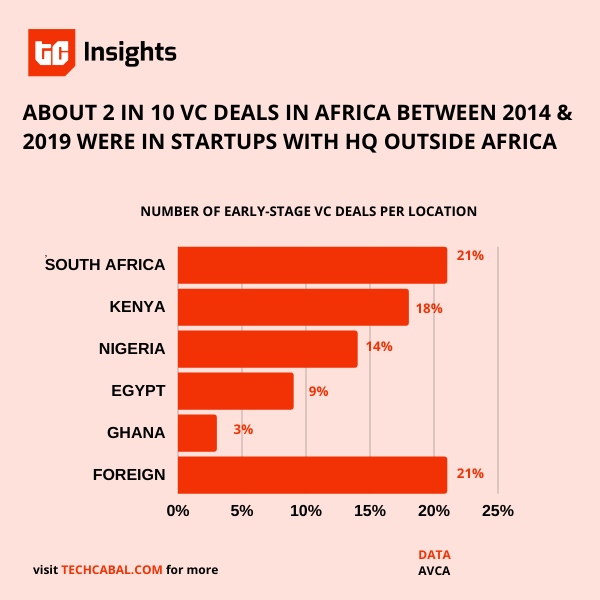
    In 2019, 17 companies raised $1 million or more from venture capital in Kenya.  4 were founded by a mix of expats and Africans, 11 by expats only, only 1 by locals.

    Of the 31 companies in other countries (outside Nigeria and South Africa) that raised $1 million or more, 14 were founded by expats, 10 by locals, and 7 by a mix of both.

    “The data is disappointing but the truth is there is bias. The question is what reasons can be attributed,” Omoigui says.

    The unvarnished assessment of many commentators is that racism is afoot. 

    Roble Musse, whose finding and blog post in February has been cited as evidence in many discussions, thinks so. Black entrepreneurs on the continent are convinced some of the condescension and humiliation they have faced with white founders has much to do with the color of their skin.

    The fault here does not lie with the expats being funded. Companies like Sokowatch and Twiga Foods and PayGo Energy are channeling VC money to innovative solutions tailored to African realities.

    Yet, opinion is converging on the need to challenge a North American lens that judges African innovation through the white pitch.

    Swaady Martin, an Ivorian entrepreneur, believes funding bias in favor of African businesses founded by non-Africans “is another form of neo-colonialism.” 

    “It’s a form of exploitation and is fed on white supremacy, white centering and white privilege, unconscious biases which have been institutionalized since the 15th century.”

    After an eleven-year career at General Electric helping expand its business portfolio in Africa, Martin founded YSWARA; a South African gourmet tea company that sources ingredients across Africa and exports to 17 countries around the world.

    Despite her network, professional achievement and sector knowledge, Martin says she has been unable to raise funding for the company. 

    But she continues to see capital cycle from white funders to white founders in ways that mimic the transfer of World Bank loans from Washington institutions to Africa-based NGOs led by white people.

    The crucial lede from Musse is that expat founders who receive more funding in Africa may not be more educated or experienced than black Africans. The dynamic perpetuates “the image of Westerners as superior, giving more of Africa’s resources to non-Africans,” Martin says.

    The compatibility argument

    Thanks to its large community of expatriates, Kenya remains the reference on this subject. Ada Osakwe, a Nigerian agro-entrepreneur and angel investor, describes it as the “soft landing pad” for foreigners who want to become African entrepreneurs.

    When foreign investors look to fund African companies there, they are drawn to these expats, assuming them to be capable and experienced. 

    This reading of the problem suggests that having Africans at decision-making levels in funding organisations will favor the continent’s black entrepreneurs.

    But even ostensibly African-led funds inadvertently relegate black founders to the background, prioritizing compatibility over color. 

    “You should ask how many Black investors in the US have funded Black founders,” Omoigui, who worked at US-based Intel Capital before founding EchoVC, says.  

    “There is an argument for ‘you fund those you see’ but the truth is ‘you fund those you think will build unicorns’.” 

    A workable VC-founder relationship goes beyond money. It is a contract laden with clauses for preferential treatment in times of big decision-making like changes in valuation, liquidations and exits. 

    For the VC, they want to enter this short term relationship as clear-eyed as possible, safe in the knowledge that, should the project fall through midway, there will be little friction getting whatever remains up for grabs.

    That said, VCs may be inclined to lean into this compatibility argument as justification for not doing enough to fund companies founded by people whose worldview they are not familiar with, i.e. black-founded companies. 

    venture_capital_funding_bias

    A version of this, for example, is that when some African founders take very early money from local angel investors, they create a predatory cap table that discourages subsequent investors.

    On the other hand, Africa-based expat founders would not fall into a similar trap because of the wider network of investors available to them. 

    “It is an unfortunate narrative we advance about African angel investors when other investors do the same,” Olu Verheijen, an African angel investor and former partner at Persistent, a Swiss-based venture building and early stage company, says to TechCabal.

    Incumbent and prospective investors can always resolve issues around a startup’s cap table by engaging in constructive discussions, agreeing on more balanced terms to align incentives and position the company for growth, she says. 

    In any case, deal terms shouldn’t overshadow the main reason for impact investing. 

    At core, impact investors should focus on “the overall goal of growing a resilient middle class of Africans through their investments so we can lift more people out of poverty in meaningful ways on the path of prosperity,” Verheijen says.

    But how do you get investors to combine the profit motive with diversity?

    Nudges or shoves

    VCs simply have to create structures that attract diverse deals to the table.

    “When one group is overrepresented at the table, you are likely to see that reflected in your investment pipeline and portfolio,” Verheijen says.

    “Diversify every level of investment decision making,” from deal origination units to general partners “and we should see a diversified outcome.”

    Musse would like to see greater adoption of revenue-based investing models and less reliance on venture capital.

    “I’m not saying there isn’t a role for VCs in the African tech ecosystem, [but we should] explore alternative funding models that are more patient and can profitably invest in niche ideas that address local problems,” he says to TechCabal. 

    While revenue-based investing is a potential alternative, businesses in the growth phase experience constant cash flow worries that will continue to make venture capital necessary, according to Claire Hoey, a British investment advisor based in South Africa.

    And for the foreseeable future, foreign VC money will continue to thumb the scale, making attention to how it flows inevitable.

    According to the Africa Venture Capital Association, venture firms headquartered in North America were responsible for 42% of VC deals in Africa in the last five years, with 20% coming from Africa-based firms.

    To the extent that they remain influential in who and what gets funded, foreign investors need to re-calibrate their thinking around transferring Silicon Valley deal-making patterns to Africa, Hoey says:

    “You’re going to have to be guided by the understanding of the local entrepreneur in terms of market dynamics and opportunities.”

    This change in approach involves a willingness to look beyond PowerPoint decks and economic models to focus on substance over form, according to Sele Inegbedion, manager for All On Hub, a Nigeria-based renewable energy venture capital firm.

    “Indigenous founders have the advantage of understanding their local market better than foreign entrepreneurs. The vested interest of indigenous founders is also more likely to be sustained in the longer term,” Inegbedion says.

    Martin, the Ivorian founder of YSWARA, doesn’t expect that VCs will sufficiently adjust their mindsets by themselves. She wants to go much further. 

    Her three-prong plan is to mandate that a minimum of 60% of VC deals be channeled to African founders; require non-African founders to give some equity to a fund supporting local entrepreneurs; and for Africans to invest in Africa.

    There is broad agreement on her third suggestion; African high networth individuals have yet to take up an active interest in the continent’s venture capital space.

    The Africa Development Bank has set up a fund called Boost Africa in partnership with the European Infrastructure Bank. Aimed at “empowering young African entrepreneurs” startups, the initiative will fund up to 30 funds over an 8 year period. 

    It is unclear at the moment which funds have been funded so far as there is no public record.

    The Next Wave: The color of investment

    But affirmative action or positive discrimination may be a hard sell.

    “I don’t think it’s fair. Money should follow returns freely,” Osakwe says. “Instead, my government should create an environment that allows us to thrive.”

    She argues that while it is good to raise awareness on bias, Africa’s future lies in being able to determine its destiny. “People fund those who look like them. The only way we can crack this is when we start being the providers of capital.”

    There’s also the notion that with more successes on the continent, the world will come around to seeking out Africans on Africa’s terms rather than determining the continent’s fate. 

    “Africa isn’t so unusual that foreign capital won’t find its way here either through local or foreign founders,” Omoigui says.

  • in partnership
    with

    FLUTTERWAVE

    29.07.2020

    Hello there,

    Welcome to TC Daily! In today’s digest: Kampala’s boda boda free zones suspended; Safaricom launches 2cents/day 4G phone ownership plan and Gozem expands into e-commerce delivery.

    Please take a moment to subscribe to our newsletter if this email was forwarded to you.

    PARTNER CONTENT


    Get access to quality medical consultations from licensed Medical Doctors right from the comfort of your home, at any time and at the tip of your fingers.

    Here’s a great opportunity for Medical Practitioners to earn more money from consultations. Learn more here.

    BODA BODA-FREE ZONE

    A new law restricting commercial motorcycle taxis to the Kampala’s suburbs has
    been suspended till August 31.

    On resumption of the activities of boda bodas following a suspension as a result of the coronavirus pandemic, operators were, on Monday, ordered to stay away from the 6 million strong Kampala Metropolitan Area which the government has termed boda boda-free zones. The law was already in effect with law enforcement impounding boda bodas before the suspension was announced to allow the creation of stages (similar to bus parks) out of the restricted zones.

    The idea for boda boda-free zones isn’t new. Earlier in May, Ricky Rapa Thompson co-founder of SafeBoda, one of Kampala’s major ride hailing operators told TechCabal that the restrictions were part of the plans the government was mulling over in its bid to regulate a largely cluttered sector. Like Lagos, the government in Kampala is facing challenges of rider identification, user safety and urban planning with the boda bodas.

    One of the recent measures it came up with which was lauded as forward-thinking contrary to what was obtainable in Lagos was asking informal operators to register on ride hailing platforms like SafeBoda to address identification and safety challenges.

    Also part of the new regulations from the Kampala Capital City Authority (KCCA) is the compulsory registration of operators at documented stages and with the KCCA through the ride hailing companies or the stages. The government says these are measures to curb the spread of the virus and to allow for effective contact tracing as activities gradually return to normal.

    REGIONAL MOBILE MONEY


    The Central African Economic and Monetary Community (CEMAC) has launched a financial service ecosystem called GIMACPAYwhich brings together card, mobile and money transfers that users in its six member states can access interchangeably. Approved by the Bank of Central African States (BEAC), the bloc’s central bank, the financial service was piloted in partnership with a number of financial service providers both traditional and digital and processed over 100,000 transactions valued at 1.7 billion CFA (about US$3 million). A mobile money user in Cameroon can transfer funds to an individual in the Central Africa Republic on another mobile money service as long as both are available within the GIMACPAY ecosystem. Airtel Gabon, MTN Cameroon, UBA and ORANGE Cameroon are among the operators on the platform.

    FUNDING


    Egyptian online furniture company Drowzy  
    has raised an undisclosed six-figure funding from a UAE-based angel investor. Founded in 2017, the platform offers speedy delivery of affordable quality furniture in a market where it says customers are often subject to long wait times when furnishing their spaces. The company says the funding will be directed towards expanding its reach, product catalog as well as increasing efficiency to further reduce wait times for users purchasing furniture through its platform.

    APPLY


    Startups from Ghana and Tunisia are invited to apply for the African European Digital Venture Programme (AEDV), which offers participants access to know-how and connections in the European market.

    Applications are open till August 15.

    SAFARICOM’S 2CENTS/DAY 4G DEVICES


    To move its 2G network user base to 4G,

    Safaricom has launched a new smartphone financing plan where users can make a down payment (US$9.3) to receive a 4G enabled feature phone and pay up the balance in daily (US$0.19/day) or weekly instalments (dependent on the phone purchased). For now, only the Neon Ray Pro 4G is available to users but more devices will be unveiled, according to CEO, Peter Ndegwa. The Lipa Mdogo Mdogo Campaign is open to active customers who have been on the network for at least a year and are at least 18 years of age. Much of Africa is still covered by 2G and 3G networks. Only 7% of Africa’s 774 million mobile connections is 4G and for Safaricom’s user base, only 17%. The company is low looking to add a million 4G subscribers before year end and is working with companies like Google to make this happen. Access to affordable devices will make a significant impact in driving 4G penetration across the continent.

    LOGISTICS


    Francophone West African ride hailing company Gozem has launched e-commerce delivery operations in Benin and Togo. In addition to the ability to order rides over the Gozem app, users can now shop and and have the items delivered to their doorsteps. Gozem is on its path to building a Super App. ”We don’t just want you to use our app once or twice, we want you to use it on a daily basis,” co-founder Emeka Ajene says. The company first launched with two-wheelers as dictated by the predominance of this mode of transport in Togo where it launched first. They gradually added tuk tuks and taxis. In May, the company added a mobile payments feature to its platform for users in Benin in partnership with Etisalat. After expanding into Benin in 2019, Ajene says the next countries in line are Cameroon and Gabon, the rest of Francophone Africa and eventually the Anglophone region.

    WHAT ELSE IS HAPPENING?

    • Inside the world of Muslim matchmaking apps
    • Join us on Friday, July 31, for the 6th episode of TC Live  with Tokunboh Ishmael, co-Founder and Managing Director of Alitheia Capital
    • A video showing a group of doctors disavowing the use of face masks and preferring a hydroxychloroquine cure for COVID-19 has been pulled off social media. After it went viral.

    That’s all for today,

    We’ll see you tomorrow.
    – Kay

    Share TC Daily with your friends!


    Copyright © 2020 Big Cabal Media,
    All rights reserved.
    You are receiving this email because
    you signed up on TechCabal.com
    Our mailing address is:
    Big Cabal Media
    18, Nnobi Street, Animashaun, Surulere, Lagos
    Surulere 100001
    Nigeria
    Add us to your address book
    Want to change how you receive these emails? You can
    update your

    preferences

    or

    unsubscribe

    from this list.

    Sent to:
    _t.e.s.t_@example.com


    Unsubscribe

    Big Cabal Media, 18 Nnobi Street, Surulere 23401, Lagos, Nigeria

    Email Marketing
    by ActiveCampaign


  • Airtel Africa’s data subscriber base has continued to grow across its 14 markets on the continent. The company recently released its financial report for the period between April 2020 and June 2020.

    During that quarter, Airtel’s data subscribers grew by 4.5%, rising from 35.4 million in March 2020 to 37 million in June 2020. The company’s total number of subscribers increased marginally, as it added around 900,000 new users at the end of the quarter.

    However, the pandemic and COVID-19 control measures made some impacts on the company’s finances during the last quarter.

    In its previous financial report published on May 13, Airtel had identified early risks posed by the pandemic. “Our performance during the month of April has been resilient despite customers’ behaviour being impacted by lower disposable income and restrictions on movements,” the company wrote.

    While noting that the pandemic posed challenges to its voice revenue, Airtel was optimistic about the future. As people stayed at home and banks closed, the company expected new growth in data services and mobile money. “Increase in data and mobile money revenue growth more than offset revenue decline in voice,” Airtel told investors in May.

    However, results are in for that challenging quarter, and growth did not happen as expected.

    On the one hand, data services did witness growth. Airtel internet users consumed 279.5 billion megabytes worth of data between April and June, higher than the 219 billion megabytes consumed in the previous quarter. To handle the growth in data services, the company expanded its network and added 562 new tower infrastructure across its 14 African markets.

    Airtel recorded 4.5% growth in data subscribers, generating revenue of $265 million (reported currency) at the end of June, up from $253 million in March. Data revenue grew 35.7% from last year and now contributes 31.1% of Airtel’s total revenue.

    However, this not was enough to fully offset the decline in voice revenue, causing Airtel’s total earnings to fall by 5.3% QoQ.

    In Nigeria telcos’ revenues are under pressure

    Voice services accounted for 53.3% of Airtel’s total revenue during the last quarter, down from 58.9% in June 2019, an interesting diversification. Voice revenue stood at $456 million at the end of the quarter, down from $510 million in March. That’s a 10% drop quarter on quarter.

    Voice services witnessed the biggest decline in Nigeria, Airtel’s largest market. In the West African country, voice revenue dropped 10.8% and users spent less time making traditional voice calls. ASimilar revenue decline was recorded in East Africa and Francophone Africa, but unlike Nigeria, voice usage continued to grow in these regions.

    However, while Airtel recorded quarterly declines in both voice revenue and total revenue,  figures are up 2.2% and 7% respectively from a year ago.

    Airtel Africa’s pivot to data services

    Between April and June 2020, Airtel continued to double down on its data services, mobile money operations and other non-voice services. Together, these non-voice businesses contributed 46.7% of Airtel’s total revenue.

    The company has been expanding its 4G network across the continent. In Nigeria, Airtel only introduced its 4G broadband in 2018 but it has quickly expanded the broadband since 2019. In its latest quarterly report, the telco said 70% of its total network sites in the country have been upgraded to 4G. The faster broadband now contributes 58% of total data usage in the country.

    Similarly, Airtel has expanded its 4G coverage to 68% of sites in its East African market and 58% in Francophone Africa market.

    Airtel is also growing its mobile money business; the number of users reached 18.5 million in June 2020, up from 18.3 million in March. Transaction value also grew by 12.5% to $9 billion during the last quarter. Yet, Airtel’s mobile money revenue remained stagnant.

  • Hadiza Garbati has her roots in Kano, northern Nigeria, but grew up in the country’s economic hub, Lagos. A chemical engineering graduate, Garbati has spent more than a decade navigating a career in the power, oil & gas sectors. 

    She has all this time been without, as she puts it, having anybody to look up to who was female, Northern, older, with as much or more local and international career experience and renow as she’s been able to garner over the years. 

    “All my mentors (men and women) were people from different regions,” she says. 

    Not knowing how to navigate wearing a scarf underneath a helmet on a rig may not seem like much but the limitations of this lack of cultural nuance and representation for Northern female would-be engineers, scientists and mathematicians is what she now hopes to tackle through the Kabara Community Development Initiative, a non-profit organisation seeking to drive educational and economic transformation in the north through STEM-D education as well as through interventions across a number of other economic sectors. 

    Garbati works with a team of secondary school friends who come with very varied skill sets, experiences and expertise in finance, engineering, policy development, economic sustainability, mining and construction among many others. 

    Kabara’s approach to STEM education is a mixture of Science, Technology, Engineering, Mathematics, and Design, which is fulfilled through its partnership with Kian Smith Trade & Co, a gold mining, trading and consulting company in Nigeria. 

    “We have a very natural artistic element to ourselves in Africa and we fill that from the minerals perspective, if we are able to build a downstream market for the gold value chain then we are able to allow people with their own natural talent hone it and that way we are able to mine, process and sell gold here in Nigeria,” Garbati says.

    Historically, much of the wealth of West African empires from the medieval Ghana Empire to Mansa Musa’s Mali and the Songhai Empire were built on gold trade. In the Ghana Empire, gold was often traded for another valuable commodity, salt, which the Sudan and southern West Africa region lacked. Mansa Musa was so wealthy in gold that he drove down the value of the metal in Cairo on a pilgrimage to Mecca in 1324 CE. Knowledge of gold mines were often a secret until the monopolies controlled by these medieval empires started to disintegrate. 

    Today, a lot of gold mining and trading particularly in northern Nigeria is artisanal and small-scale, often kept in the family and handed down from one generation of miners to the next.

    According to Nere Emiko Teriba, Managing Director of Kian Smith Trade & Co, there are a lot of fractures in the gold mining value chain and one of the ways the company is looking to close these gaps is through the adoption of technology tools that will digitize the process and bring the many disjointed parts of the value chain together. 

    “We realised a lot of jewellers were saying, ‘we can’t even access gold to make jewelry’. Because they need small volumes and because of the economics of gold, most of the mined gold goes towards the big traders,” Teriba says.

    Has technical know-how limited the adoption of these technologies especially for digitally non-savvy artisans?  Could it? Teriba says it is a matter of simplicity, useability and mobile-friendliness. As long as a tool is solving a need and increasing business opportunities, these are incentives that are hard to ignore.

    “We had a tool, Zokia, created for our artisanal miners to connect them,” she says and people said the artisans wouldn’t use it.

    “They did.”

    The tool allowed miners connect with each others and access resources as well as business opportunities.

    Users, regardless of tech savviness, age or social class, always favour tools that are easy to navigate.

    The BackEnd: Optimising KYC procedures for seamless UX experience

    Who are the programs for?

    Kabara’s STEM-D programs target northerners who by virtue of their social standing, do not have the opportunity or means to explore STEM education.

    The initiative has two centers; one in Kano and another in Lagos with the intentions of doubling this number in the coming years. The dynamics of running both are somewhat different but are all within cultural and religious margins.

    “The Lagos center really focuses on girls between the ages of 13-18,” Garbati says. 

    “What we’re trying to do is to take that focus from getting married once you leave secondary school. We’re not saying not to get married but that it’s possible for you to be able to further your education.”

    Hence, one of the core milestones for its Lagos hub is the number of girls who go on to gain admission into university. This year, about 18 girls have been enrolled in lessons in preparation for the Universal Tertiary Matriculation Exams, a prerequisite for admissions into institutions of higher learning in the country. 

    The girls are typically children of migrant northerners working in the city who by virtue of spending a number of years living in the north may have lacked access to such opportunities.

    Programs are run on a monthly basis and include courses in personal development, writing, presentation skills, robotics, programming and other core technical skills. There is also the sorely needed element of mentorship here where the girls are assigned to mentors who are women working in STEM for one-on-one mentorships. Much of the progress in this area, however, has been stalled by the COVID-19 lockdown and social distancing measures. 

    Girls undergo training in skills such as coding, robotics as well as learn presentation, writing and other skills for the workforce of the future.
    Source: Kabara

    “We’ve also had two of our girls partake in summer activities at FMDQ for fintech training on stocks and bonds,” Garbati says.

    “So, [the] Lagos [hub] is more of exposing our girls to all the opportunities that more privileged kids would usually have in this environment at no cost.”

    The demographic at its Kano hub is slightly different. Here, women oftentimes older, married and seeking to develop economically viable skills are more prevalent. Here, men are also welcome. 

    “We understand the cultural nuances where we cannot mix men and women so we’re able to seperate the hall (which sits 50-100 people). We also understand that we cannot have male trainers teach females and vice versa, and so we ensure males teach the male attendees and females teach the female attendees.”

    With movement restrictions and inability for trainers to meet physically to continue classes, Garbati is now pursuing partnerships, both local and international, to keep them going online. Courses are around introduction to small business finance, coding and technical skills set training for the job market although one of the immediate challenges of this route is a language barrier in the Kano hub and the need to have indigenous trainers take courses in Hausa.

    A Kano Gold Durbar

    From July 30 till August 2, both Kian Smith and Kabara, together with a number of other partners are hosting a gold durbar in the city of Kano. In September, another will take place in Ouaga Doré, a gold market in Burkina Faso. 

    According to Teriba, the purpose of the durbar is simple: to wholistically remind Kano of its gold heritage but also to show its future potential especially through the use of digitization in mending the many fractures in its value chain. 

    “We are saying instead of discussing how to take Almajiris off the streets, for example, let’s give people an opportunity to earn a trade that is convenient with their culture and religion,” Garbati says.

    “A woman stays in the confines of her home and once she’s learned these skills she’s able to manipulate the gold to create designs and sell them through IT systems and structures all within the comfort of what her religion and culture will permit.” 

    The durbar will feature opportunities for miners and traders to sell, artisans (including women and girls from Kabara)  will be commissioned to create pieces for Kian Smith’s Empires and Warrior Queens Kingdom Collections which will be marketed and shown across West Africa in a cultural gold festivals leading up to a November auction in Lagos. 

    The Gold Durbar will hold in Kano through the month of August and in Burkina Faso next month.

    Where do the training funds come from? 

    As a non-profit, Kabara’s activities are largely funded by donations.  Partnerships, like one with the Mohammed Inuwa Wada House which is where the hub is situated right at the center of Kano, also form a part of the means through which its activities are carried out or supported. As Kian Smith’s corporate social responsibility partner, the mining corporation also continues to support its projects and training programs. Part of the proceeds from the gold durbar will also go towards Kabara’s activities.

    Nonetheless, funding has been tough to sustain, Garbati says, and more funding will mean a wider reach and scope of Kabara’s activities in the region. 

    Fast-tracking paths to quality education and skill acquisition for the technology age is very critical to the country more so the north where 69% of Nigeria’s out-of-school children come from. For girls, the figures are even more problematic. Only 45% of girls of school age are enrolled in and attend school. 

    The pandemic has made apparent the place of technology in revamping traditional learning  systems both in the new forms of knowledge that are needed to build careers in today’s world as well as how this knowledge is obtained.

    “In Nigeria, once you say that you want to improve something, the first thing people do is buy hardware,” she says.

    Solving the hardware challenge alone, is only a very small part in the direction towards the digitisation of education on the continent.

    Rethinking learning tablet initiatives and their impact on education in Africa

    Garbati says that while there are many laudable initiatives like Kabara, seeking to optimise alternative paths to learning and opening up career and entrepreneurial paths to young people in the region through courses like STEM and Design, consolidating efforts will be more impactful in creating the desired changes in the region and the country. 

    The Kabara Dynasty

    Kabara (or Magajiya), the title after which the initiative is named, were matriarchal monarchs who ruled the Hausa people inpre-historic times. Queen Amina was one and Magajiya Daurama, the Last Kabara of Daura whose marriage to a prince from Baghdad, according to folklore, transitioned rulership to the patriarchy. 

    Today, in the traditional setting in the north, rulers from a matrilineal bloodline are now referred to as Waziri, what would’ve been a Kabara which was almost obliterated post-Islam. 

    While these histories are relevant and inform some aspect of the work that both Kian Smith and Kabara does (the Warrior Queen Empires Collection is inspired by this), Garbati is careful to note that the goal is not to exclude a certain gender but to ensure that girls and women, unlike her, get the representation they need to encourage them to pursue careers in STEM and Design.


  • Heads up courier operators in Nigeria, the FG wants 2% of your revenue

    • Share
    • Tweet
    • Share
    • Share
    Share

    Preview

    There’s been a lot of conversation around licencing fees

    in partnership
    with
    FLUTTERWAVE
    28.07.2020

    Hello there,

    Welcome to TC Daily! In today’s digest: we delve deeper into what we should really be worried about in the new Courier service regulations, the difficult business of media and details about the next TC Live.

    Please take a moment to subscribe to our newsletter if this email was forwarded to you.

    PARTNER CONTENT

    Get access to quality medical consultations from licensed Medical Doctors right from the comfort of your home, at any time and at the tip of your fingers.

    Here’s a great opportunity for Medical Practitioners to earn more money from consultations. Learn more here.

    LOGISTICS

    Here’s what everyone knows: on Saturday, July 25, hundreds of concerned Nigerians used the hashtag #SaynotoNIPOSTfees to protest the new regulations imposed on logistics companies.

    Because of public censure, Isa Pantami, the minister of Communications and Digital economy publicly denounced the new licencing fees.

    Here’s what really happened: the Courier and Logistics Services Operations regulation (2020) was issued by the Ministry of communications and Digital economy. It is the
    framework under which the new licencing categories are contained. It is especially important because the new regulations repealed the Courier Service Regulations (1992) in which NIPOST acted as operator and regulator.

    Here’s what everyone should really be worried about: According to Regulation 8(5) of the Courier Service Regulations, logistics companies are mandated to contribute part of their revenues to a postal fund.

    “There is now an obligation on a courier operator to contribute a sum equal to 2% of its total revenue to the Postal fund, which will be used for postal development and delivery of postal services in rural and under-served states.”

    While licencing fees are worrying, what company wants to give 2% of its revenues to a postal fund?

    MEDIA

    A lot has been written about the global challenges newspapers face and how the internet has disrupted what was once a super-important business. In Nigeria, where the circulation figures for national newspapers are only a matter of conjecture, the media conversation is still in early stages.

    How is Nigerian media holding up especially with the challenges of COVID-19?
    Typically, the answer would be: no one knows. But an internal memo sent by the management of Punch Newspapers was leaked last month and it paints a grim picture.

    Here’s an excerpt from the memo:

    “This pandemic has dealt with our business telling and severe blows. Our circulation and advertising revenues dipped dangerously, compounding the operational and revenue
    challenges birthed by the migration of a majority of print newspaper readers and adverts to digital platforms.

    “I am not at liberty to disclose all of the measures that the management has taken so far. But the ones that could be made public include an immediate reduction in print pagination; staff furloughing to comply with government and expert advisories on social distancing; the temporary shutdown of the sports newspaper; and significant financial reengineering.”

    It paints a grim picture and it explains why Punch newspaper is exploring subscription options. It will be interesting in the coming days to see how much the newspaper commits to a paywall and how much change their business will see.

    STARTUPS

    Jack Ma Foundation’s Africa Netpreneur Prize Initiative (ANPI) has selected 50 Startups for 2020 Competition to advance to the next round of selection and will participate in an exclusive virtual boot camp on July 28.

    The top 50 finalists were selected from over 22,000 applications across all 54 African nations; The finalists represent 21 African countries, half are female, and work in 18 sectors like agriculture, AI, e-commerce, fashion, healthcare, renewable energy and ICT.

    Read all about the finalists here.

    TC LIVE

    For the next TC Live session on Friday, July 31st we will interview Tokunboh Ishmael, co-founder and Managing Director at Alitheia Capital whose portfolio companies include MAX, Lidya and Tomato Jos. Alitheia Capital is one of the continent’s most prolific local investors.

    Ms Ishmael has a 20-year experience spanning investment banking, private equity investing, technology and new business development on and off the continent. She will answer questions in an interactive session about Building in Africa.

    Register here to join the session.

    WHAT ELSE IS HAPPENING?

    • TechCabal Weekly Podcast: How much do Nigerian businesses lose to cyber-attacks?
    • The allure and trajectory of the Egyptian tech ecosystem, as told by one of
      its oldest institutional investors.

    • We’re in the middle of the COVID-19 crisis. Big Tech is already preparing for the next one.

    That’s about it today,

    See you tomorrow.
    – Olumuyiwa

    Share TC Daily with your friends!

    Copyright © 2020 Big Cabal Media,

    All rights reserved.
    You are receiving this email because
    you signed up on TechCabal.com

    Our mailing address is:
    Big Cabal Media
    18, Nnobi Street, Animashaun, Surulere, Lagos
    Surulere 100001
    Nigeria

    Add us to your address book


    Want to change how you receive these emails? You can
    update your preferences or unsubscribe from this list.


    Sent to: _t.e.s.t_@example.com

    Unsubscribe

    Big Cabal Media, 18 Nnobi Street, Surulere 23401, Lagos, Nigeria


    Email Marketing by ActiveCampaign


  • Of the seven countries in North Africa, Egypt stands out in the remarkable acceleration of its technology industry in the last nine years. Prior to the 2011 revolutions that swept across much of the region, there were not a lot of players in the space. 

    “Those were very difficult times to start a business and to find capital,” says Tamer Azer, Principal at Sawari Ventures. 

    “There weren’t that many players in the space outside of Flat6Labs, which is probably the region’s largest accelerator.”

    But post-revolution and as the country moved towards political stability as the years wore on, the rise of the internet as an influential tool drove a lot of the younger population towards tech entrepreneurship. As a result of this momentum, increased capital [PDF] and the advent of more accelerators and incubators followed. 

    “Now, we’ve got multiple new funds, a number of accelerators, seed investors, multiple angel networks, as well as a few Series A investors in the market including Sawari Ventures,” Azer says. 

    Sawari Ventures, which has been around since 2010, is one of a few Series A venture capital firms investing in startups with clear product market fit. 

    With its US$40 million fund, the firm invests anywhere between US$1-3 million per ticket and up to US$5 million for the life of a portfolio company with operations in Egypt, Tunisia or Morocco. In the early 2010s, the firm started out building Flat6Labs, which was the first and is now the largest accelerator programme in the country, as well as offering seed funding to the trove of new startups that were emerging.  

    Its US$40 million fund is part of a US$70 million target Sawari Ventures North Africa Fund I which it plans to invest in the North Africa region in the next four years. 

    Just last month, co-leading with Partech Ventures, Sawari made a US$4million investment in MoneyFellows, a financial technology startup for loans and collective savings. It has also invested in Swvl, the tech-enabled public transportation company among a number of others.

    Venture funding in Egypt in the pandemic

    Since the coronavirus pandemic began late last year, Startup Genome has been conducting a series of research work to monitor the effect of the global health crisis on venture capital funding in the continent and around the world. Since December 2019, global VC funding has fallen 20% and while momentum picked up towards the end of March, funding levels are still understandably lower than pre-crisis numbers. 

    While a number of sectors have seen significant uptake as a result of the pandemic, many others will bear the brunt of the economic fallouts of the crisis now and in the coming months. 

    In Startup Genome’s The Impact of COVID-19 on Global Startup Ecosystems: Global Startup Survey report, about 50% of the startups surveyed were trying to raise funds pre-COVID. Of the percentage that had a term sheet (17%) signed or unsigned, only 13% of them were able to close the rounds. Many have had the fundraising processes delayed, completely cancelled or investors that have gone cold turkey.  

    When you think about the impact of the pandemic on the technology ecosystem, it is natural that some companies will survive while others won’t. 

    “To say now how this will change the investment strategies will be tricky,” Azer explains.

    “Because you have to think of investment strategy as a function of opportunity cost and the performance of your portfolio companies.”

    If an investor’s portfolio companies are handling the crisis well and taking advantage of the business opportunities it presents, then this will mean the investor’s opportunity cost will be low and they’ll have more capital to invest. However, if an investor’s portfolio companies need funding support then there is less capital now available but then, they might have fewer companies at the end of the day so that opportunity cost might remain unchanged. 

    “There are definitely people looking to invest in industries that are thriving because of this; fintech, healthtech, e-grocery, e-commerce, those types of things,” Azer says. 

    “That’s where a lot of people are going right now.” 

    As with many other institutional investors at this time, much of the work has been to stay in constant communication with portfolio companies to understand how the pandemic is impacting the business but also to ensure that staff welfare is priority and that founders are looking to pivot where necessary.

    “If any of our portfolio companies need money we help them secure that funding, bid around for and/or participate in a round for them,” Azer says.

    A lot of companies have had to take drastic measures to “cut fast and deep” while a number of others have had to explore new services and revenue streams to stay afloat.

    “One of our companies called Elves [a virtual assistant platform] has been moving into some fintech solutions,” he says.

    Ultimately as a company you can either stay the course and lower your operating costs or find new revenue streams. 

    One of the other conversations around how the pandemic will impact the ecosystem has been around valuations with many saying that the time presents opportunities to bring them lower down to their actual values. Azer is of the opinion that valuations will not drop just as a result of the clime but will also be subject to an investor’s opportunity cost based on how its portfolio performs, how many companies survive and how much capital is left in the investor’s fund. 

    “It’s really hard to say now,” he said during the Africa Tech Summit Connects podcast interview in May.

    And since this is a game of time, valuations will decline or not for a relatively young fund and a vintage or older fund a lot more differently. 

    “If you’ve got an older fund or early vintage fund, you’re going to want to invest in things like fintech and healthtech. But a young fund manager might look to also go into something like travel,” Azer says on our call. 

    “If you go into travel now, you’re looking at significantly value deals which you can take care of because you have a much longer runway,” he says of young funds. 

    The ecosystem in Egypt needs more exits

    Exits are rare and far between in the African tech ecosystem but the MENA region has seen a number of significant exits. Flat6Labs, Sawari’s accelerator and early stage fund exited its first company, Harmonica [online dating platform] to Match Group, owners of Tinder and OkCupid, last year. Also last year, Helios Investment Partners partially exited Fawry, Egypt’s leading fintech platform through an IPO on the Egyptian Stock Exchange. 

    Why these aren’t happening with as much gusto as investments are coming into the ecosystem across the continent is a combination of factors including valuations, a problem of scale oftentimes driven by the gaps in venture funding through the lifecycle of a startup from early into growth stage. 

    “As early stage investors it is our responsibility to push companies further down the value chain, helping them grow to the point where they attract international interest, because ultimately, the funding gap here means that you can probably take a company to series A or B  but once you get to that point you really need to be able to bring international players to move it further down the value chain,” Azer explains. 

    This is the next step for the investment players in the Egyptian and North African ecosystem.

    “Every entrepreneur, every VC, probably across the continent is really focused on exits because it creates the use case plus attracts more funding for entrepreneurs to feel that what they do is going to reward them eventually.”

    “And so everyone is trying to support companies to exit because that is how we get the snowball effect that we need for this industry to grow.”

    “We still haven’t seen a unicorn so to speak. But we have been seeing a lot more smaller exits,” Azer says. 

    “We are seeing some local investors exit their stakes and make fantastic results and we are, as investors and as an investor community, trying to collaborate to get more companies to that threshold.”

    With regards to scale, oftentimes the mandates of investors mean that their investments are unable to cross their geographical terrain and so very few investors can cross markets. One thing he advises is for investors across regions to do more deals together leveraging localised networks and market understanding to help the companies grow in their new markets. But this is not very straightforward with investors given the mandates that their funds come with.

    “You need local ecosystems to be able to support companies to grow to a certain extent so that they can then expand into other countries on the continent and that is an iterative process. It is a labour of love and it will take time.”

    The future is even brighter for the ecosystem as more of these smaller exits occur, investments continue to come in and the ecosystem continues to mature in the quality of technology solutions that they are building to solve the country and region’s problems.

    Two years ago, the ecosystem came together to create what it calls The Startup Manifesto, a comprehensive document of the ecosystem’s challenges, areas where it needed assistance and in what ways. 

    “It was our way as an ecosystem to get our voice heard and to get together and decide what are the things we need and want, not just from a regulatory perspective,” Azer explains.

    The Manifesto is publicly available for all the ecosystem players as a reference and working document and will serve as a basis for engagement with government and regulatory agencies as the ecosystem grows. Already, through funds like Egypt Ventures and an accelerator, Falak, the government is becoming more involved in the activities in the space.

  • This week on the TC Weekly podcast, we talk about Nigerian businesses and cyber-attacks.

    According to the NIBSS, Nigerian businesses lost ₦46 million to cyber-attacks in 2018. Yet, it is doubtful that this figure accurately represents the scale of losses suffered.

    What is the biggest problem to knowing how much we lose to cyber-attacks every year? The willingness of industry players to report these attacks.

    Away from cyber-attacks, we also talk about Audiomack’s decision to set up an office in Nigeria, what they hope to achieve and what this means for its competitors like BoomPlay and UduX.

    Listen to this week’s podcast here:


  • The Next Wave: The color of investment

    • Share
    • Tweet
    • Share
    • Share
    Share

    OPay & its Chinese Chairman

    JULY 26, 2020
    This newsletter is a weekly in-depth analysis of tech and innovation in Africa that will serve as a post-pandemic guide. Subscribe here to get it directly in your inbox every Sunday at 3 pm WAT.

    Hello,

    Most likely spurred by the global Black Lives Matter movement, the African tech ecosystem has been abuzz with conversations around funding bias.

    Even though this issue has existed on
    the continent for a while now, an
    article reignited the conversation and has gotten people talking. Ever since white founders have founded startups in Africa, data has shown that they have always gotten more funding than their fellow Africans.

    Again, this conversation is not new. But beyond nuanced debates around “white and black” founders and capital, there are introspective questions that need answering on this matter.

    Before we proceed, welcome to the second edition of your favourite weekend digest, today we are taking a look at some not-so-popular aspects to the aforementioned topic.

    You
    can still catch up with
    previous editions of The Coronavirus Weekly
    Newsletter
    and last week’s edition, the first dispatch of its iteration; The Next Wave.

    Let’s dive in.

    WHAT’S HAPPENING

    Where is the “black capital”?
    At a popular cafe in Nairobi, over a steaming cup of dawa, a startup founder sat across from me and lamented their inability to raise funding. They are
    sure this dearth has nothing to do with their 2-year-old business, and everything to do with the colour of their skin.

    “This startup with a white founder that does the exact thing we do has been in the market for barely a year, and raised a huge chunk of money, a lot of it from VCs we have been to before. They even asked me to come consult on the due diligence for the deal,” the founder lamented.

    I came to learn that this founder’s experience is commonplace in Kenya.

    Away from the East African country and across popular startup cities in Africa, white founders have always gotten a chunk of investment money coming into the continent.

    “It’ll be naive to believe that race doesn’t play a part in [raising] capital.” Rebecca Enonchong said in an event from yesterday that attempted to discuss the issue with stakeholders across Africa.

    Apart from Enonchong, Vuyisa Qabaka, Iyin Aboyeji, Meriem Jamme, and CK Japheth were other panelists on that particular edition of Startup Saturday Series from Kenyan-based Lawyers Hub.

    “Capital may not have colour, but certain colour definitely has more access to capital,” Vuyisa Qabaka said in response to Iyin Aboyeji’s insistence on decolouring capital, a move which can be construed as downplaying the conversation’s validity.

    But Aboyeji asked a question that is in line with today’s enquiry:

    “We [Africans] have capital too, what are we doing with our capital?”

    Constantly debating the rationale behind the disbursement of “white capital” is a conversation that is swinging between the blurry lines of valid, and entitlement.

    Beyond that, why do African HNIs, organisations, and governments not invest in African tech? Where is the “black
    capital”?

    Seeking black funding

    In May 2016, I wondered why “Nigerian moneybags” were not investing in the country’s then infant tech ecosystem. Two months later, I made a (wish)list of Nigerian HNIs that I hoped would do these investments.

    On an African level, a lot of the reasons from that 4-year-old introspection is still valid today: most of the potential investors are risk averse, have not seen any success markers, do not understand startups, and a surprising number of them have been burnt in the past, badly.

    “There are people that can invest in startups at their early stages, which is a crucial stage, but a lot of stability needs to happen on the homefront. From destabilising government policies to socioeconomic factors, and even toxic founder behavior, there are a lot of things we need to fix in Africa to unlock funding from within,” an active investor on the continent told me, pleading anonymity.

    This investor told me multiple stories of startup founders that have made away with African investors’ money, and shut down businesses without any due diligence.

    “Most times they do this because they believe there won’t
    be repercussions from their ‘brothers and sisters’, but this is erroneous, stories spread and reputations are damaged. Sometimes innocent people pay,”
    they said.

    Earlier in the aforementioned event, Vuyisa Qabaka had stressed the importance of accountability to investors.

    Things are looking up

    According to Aboyeji, he pitched Tony Elumelu in 2014 and the Nigerian billionaire banker, “laughed me out of his office,” Aboyeji recalls.

    By the end of that year, Elumelu most likely had a ‘Road to Damascus moment’ and the Tony Elumelu Entrepreneurship Programme (TEEP) was born. Till date, the “$100 million commitment to identify, train, mentor and fund 10,000 African entrepreneurs in 10 years has benefitted over 9,000 Africans with $5,000 equity-free seed capital, and mentorship.

    Change is painfully slow, and therefore easy to miss, but in this case, things are definitely not what they used to be. In the coming years, slowly but surely, Africa will yield more Elumelus who either have philanthropic and or purely business motives.

    I forgot to mention, if they have not already started, one person from my 2016 wishlist is definitely on the path to actively investing in African startups. Hint: they used to run a bank in Nigeria.

    On the VC front, there are more active African investors now than ever. TechCabal recently created a tentative list of early-stage investors in Africa, and the numbers are impressive, at least compared to say, five years ago.

    [A list of early stage investors in Africa]

    According to the African Private Equity and Venture Capital Association (AVCA), only 20% of investors who participated in VC deals in Africa between 2014 – 2019 were local ones. This is dismal, but the number has been improving over the last 10 years.

    While we fight funding racism in Africa’s growing tech ecosystem, we should devote the same energy, or even more, to creating an enabling environment for money from within the continent.

    FROM THE CABAL

    DR Congo’s early-stage tech ecosystem.
    In Francophone Africa, Congo is the most populated country with an estimated 84 million people. In its capital city, Kinshasa alone, 40,000 phones are sold every month. Technology and innovation lives here, but what is its tech ecosystem like?

    In this article, Alexander Onukwue spotlights the growing ecosystem with a focus on a group of entrepreneurs.


    The relationship between a Chinese tech billionaire and OPay. African super-app recently shut down some of its performing verticals, and TechCabal learnt that the company’s billionaire chairman Yahui Zhou made these calls.
    Zhou has made noteworthy exits and IPOs in America and China, and seeks to replicate the success with OPay. Abubakar Idris expounds on the intricacies of this story.

    THE CRYSTAL BALL

    Every week, we will ask our readers, stakeholders, and operators in Africa’s tech ecosystem what they think the new normal will look like, and will share their thoughts here. You can share yours with victor@bigcabal.com with ‘The Crystal Ball’ in the subject line.

    “Adtech will not be the same. Brands are currently investing ad dollars in experimental advertising, but there is a lack of technical know-how, hence a lot of uneducated experiments, waste and ROI issues. Things would need to be done differently, programmatic and data-based advertising will be the most effective means of reach.


    Audiomack has just moved into a new Nigerian office, Boomplay tripled users last quarter; Netflix launched in Africa; DStv is betting big on Showmax. That’s half of the pointers that streaming is finding its place in African culture and the earlier advertisers start thinking about moving with audiences the better.”

    – Abiodun Mudele, Senior Sales Account Manager, Transsion

    TC Insights

    African startup. Foreign HQ.
    Some of Africa’s famous and best-funded startups including Andela, Paga, Flutterwave, Paystack, Branch, Tala and SureRemit are actually foreign by incorporation. While choices like HQ and country of incorporation are sometimes influenced by the founders’ nationalities, the vast majority are investment and economic decisions.

    The opacity of tax laws and dynamism of regulation in African countries make VCs prefer domiciling their funds outside the continent. The favourable laws and the clarity of the regulatory environment in some US states and very few African countries like Seychelles and Mauritius make them natural habitats for investors. One other challenge is that
    getting money out of the financial systems in certain African countries can be problematic.

    The location where VC funds are domiciled in turn influences the choice of startups they invest in. It’s quite common for VCs to urge African founders to incorporate abroad.

    Using data from the African Private Equity and Venture Capital Association (AVCA), the majority of early-stage VCs deals between 2014 – 2019 were in startups that had HQ in South Africa. However, it tied with startups that had their HQ abroad; 53% of them are incorporated in the US.

    It is quite certain that data on
    later-stage deals will provide a different perspective but they are fewer in number. Most startups will likely die from not getting that first check.

    There’s been a growing trend of local VCs and funds emerging in places like Nigeria and South Africa which will reduce the need for more founders to incorporate abroad. But to retain capital and intellectual property on the continent, it will require more than an increase in local VCs and funds. There’s a need to take a critical look at the tax laws and regulations to ensure they support investing across the continent.

    If
    you are a founder in Africa, please fill our investor list here to let us know who gave you your first check. Get TechCabal’s reports and send us your custom research requests here.

    Best wishes for a great week

    Stay safe and please observe all guidelines provided by health experts.

    You can subscribe to our TC Daily Newsletter; the most comprehensive roundup of technology news on the continent, and have it delivered to your inbox every weekday at 7 am WAT.

    Follow TechCabal on Twitter, Instagram, Facebook, and LinkedIn to stay updated on tech and innovation in Africa.

    – Victor Ekwealor, Managing Editor, TechCabal

    Share this newsletter

    Sign up for The Next Wave
    by TechCabal

    Sign me up
    Copyright © 2020 Big Cabal Media,

    All rights reserved.
    You are receiving this email because
    you signed up on TechCabal.com

    Our mailing address is:
    Big Cabal Media
    18, Nnobi Street, Animashaun, Surulere, Lagos
    Surulere 100001
    Nigeria

    Add us to your address book


    Want to change how you receive these emails? You can
    update your preferences or unsubscribe from this list.


    Sent to: _t.e.s.t_@example.com

    Unsubscribe

    Big Cabal Media, 18 Nnobi Street, Surulere 23401, Lagos, Nigeria


    Email Marketing by ActiveCampaign


  • A brief on early-stage startup investment
    in partnership
    with
    FLUTTERWAVE
    27.07.2020
    Hello there,

    Welcome to TC Daily! In today’s digest: a government-owned logistics service provider tries to regulate competitors, Orange plans to launch a bank, and a brief on early-stage investments in the startup world.

    Please take a moment to subscribe to our newsletter if this email was forwarded to you.

    PARTNER CONTENT

    Get access to quality medical consultations from licensed Medical Doctors right from the comfort of your home, at any time and at the tip of your fingers.

    Here’s a great opportunity for Medical Practitioners to earn more money from consultations. Learn more here.

    LOGISTICAL BLUNDER

    In an ill-advised move last week, the Nigerian Postal Service attempted to grant itself preference in Nigeria’s courier and logistics space. A memo by the NIPOST CEO declared a new licensing regime for six categories of courier service deliverers. Licenses range from ₦20 million ($52,000) for international operations to ₦250,000 ($650) for a “Special SME” category.

    This surprising announcement has been halted after much outrage. Isa Pantami, Nigeria’s Minister of Communications and Digital Economy, denied having authorized the directive contradicting NIPOST’s statement which suggested the Minister had consented.

    Pantami says the increase in license fee was not part of new regulations he approved for the agency, asking that implementation be put on hold. It’s a temporary relief but the obvious questions then are: what was approved? And why is NIPOST, a government-owned and government-operated for-profit service provider, empowered to regulate its private-sector
    competitors?

    The fees may not be taking effect but the agency has attracted scrutiny to its history of snafus. Many Nigerians dug up memories of painful experiences, of broken seals and lost items. Even if there have been efforts in recent years to improve NIPOST’s quality of service – they have a decent address mobile app – this was not the best way to reintroduce the agency to an annoyed public.

    Logistics service companies – including former motorcycle-hailing companies like Gokada and MAX – will remain on high alert to see what new regulatory regime the Minister approves. We could have
    another moment of mass repulsion, depending.

    MOBILE BANKING

    Orange, the mobile network operator notably present in Francophone Africa, will launch a bank in partnership with NSIA Group, a company known for providing insurance products by collaborating with banking institutions. When active, Orange Bank – as the new venture will be called – will provide savings and small loans to borrowers. Users can access these services from their mobile devices, the company says.

    The bank will first launch in Abidjan, spread to other parts of the Ivory Coast, and then will be expanded to Senegal, Mali and Burkina Faso.

    BLOCKCHAIN FOR HOUSING

    Since its launch in 2018, HouseAfrica has been building a reputation as a potentially exciting real-world application of blockchain technology. By using the technology to create an immutable digital record for real estate, the Nigerian startup brings a genuine innovation into an industry with protracted problems.

    It has now caught the attention of a reputable organisation with government connections. Last week, it was announced that the Nigeria Mortgage Refinance Company (NMRC) and HouseAfrica will be involved in a partnership to deploy the latter’s digital title verification and authentication system called Propvat.com

    NMRC, a private-sector company, carries out mortgage financing by raising money from Nigeria’s capital markets. Licensed by
    Nigeria’s central bank, NMRC’s capital base is over N13 billion (>$30 million) and is partly-owned by no less than five Nigerian banks and the Nigeria Sovereign Investment Authority.

    While not a stamp of success, it is a sizeable coup for HouseAfrica. It is also a signal to the potential to be unlocked when blockchain is applied in other sectors.

    TC INSIGHTS

    In the movie The Social Network, there’s an iconic scene where Mark Zuckerburg heard Peter Thiel say he was going to invest $500,000 into Facebook, the startup’s first major check. Here’s how Reid Hoffman, also an early Facebook investor, describes Mark Zuckerburg in the early days on the 11th
    episode
    of his podcast, Masters of Scale:

    “We weren’t blown away by Mark Zuckerberg’s pitch, as we recalled. He’s grown into his articulateness. He’s very articulate now, but back then there was a lot of staring at the desk, not saying anything.”

    Hoffman described Zuckerburg as painfully quiet and awkward during important meetings. But they did bet on him, regardless. In 2012,
    Thiel sold the majority of his stake for almost $1 billion in cash.

    For many founders, the pitch for their first check makes all the difference. It goes a long way to
    determine whether they get a check and ultimately whether their startups die or live.

    In Africa, while the number of early-stage investors, especially local ones, has increased, there’s still a dearth of capital for entrepreneurs. Only 5% of the total amount of VC money invested between 2014 – 2019 was seed investment.

    Investors have little regulatory incentive to set-up funds locally and often say they have a hard time finding quality startups. For founders without an international education degree, it’s very difficult to access the networks necessary to get that first check.

    Solving the pipeline issue and introducing policies that incentivize VCs to set-up funds and invest locally will go a long way in encouraging more early-stage deals. It will ultimately boost the success of tech entrepreneurship across the
    continent.

    If you are a founder in Africa, please fill our investor list here to let us know who gave you your first check. Get TechCabal’s reports and send us your custom research requests here.

    WHAT ELSE IS HAPPENING?

    • Want to become a frontend developer? Here’s the manual to your DIY starter pack.
    • Looking for pre-seed funding? Check out our list of early-stage investors in Africa.
    • Man raids MTN’s base stations. Man lands 500-year jail
      sentence
      .
    • GET IT, a Rwandan food logistics startup, closes Series A round.

    A fruitful week to you,

    See you tomorrow.
    – Alexander

    Share TC Daily with your friends!

    Copyright © 2020 Big Cabal Media,
    All rights reserved.
    You are receiving this email because
    you signed up on TechCabal.com
    Our mailing address is:
    Big Cabal Media
    18, Nnobi Street, Animashaun, Surulere, Lagos
    Surulere 100001
    Nigeria
    Add us to your address book
    Want to change how you receive these emails? You can
    update your preferences or unsubscribe from this list.


    Sent to: _t.e.s.t_@example.com

    Unsubscribe

    Big Cabal Media, 18 Nnobi Street, Surulere 23401, Lagos, Nigeria

    Email Marketing by ActiveCampaign


  • “Tourism has its uses, but it can mangle a city, especially a developing city, and flatten it into a permanent shape of service: the city’s default becomes a simpering bow, and its people turn the greyest parts of themselves into colourful props.”

    In 2019, Bangkok, Thailand’s capital city received 22.7 million international visitors. It is ranked the top destination for global travelers, a title the city has held for four years running.

    It is the city that Dare Oluwajuyitan has lived in for over a year now, the city about which he says, “you can go to a different place every night for one year and still not see everything.”

    But his travel and tech experiences don’t start in Thailand, Malaysia or Ukraine, the three countries he has lived and worked in the past decade. It starts in Nigeria, where as a child, he had a sheltered childhood along with his brother and sister.

    “My parents never really allowed us to go out much, we were mostly at home. We only went from home to the school nearby. It’s because we were always home so much that we had to create our own games and toys.”

    Creating these games were an easy form of entertainment and Dare says he spent a lot of time making his own toys. “My mother encouraged it, so we made toy cars, torchlights and put pieces of everything together. We were always thinking of games to play indoors.”

    As he grew older, the computer became the center of entertainment and at 15, he tried a one-week crash course in computer programming which he failed. “It was the first time I failed at something and because of that, I didn’t try programming again for a very long time.”

    In hindsight, he laughs off failing at trying to learn Java and today, he says learning programming is not difficult. If you think an undergraduate degree in computer science comes next, there’s a curveball coming.

    “I studied mechanical engineering in Ukraine.” It was the first time he would leave Nigeria and it kickstarted a life of travel and tech experiences across the world.

    Dare’s note on choosing to study in Ukraine: I chose Ukraine because I wanted to be far from my parents. I only knew where Ukraine was on the map two or three days before I traveled.

    Digital Nomads Thailand

    Living in a new city and learning a new language

    One of the first realities of studying in Kharkiv, Ukraine was needing to learn Russian, because it was the primary mode of instruction. Russian is believed to be one of the most difficult languages to learn because of its complex grammar rules.

    Dare agrees that Russian is a difficult language. “In the first two weeks, I considered going back home because I was sure I could never learn the language.”

    But in the end, he did, thanks to a year-long language class as well as having Ukrainian friends who spoke the language. With a firm grasp of the language, it became easier to navigate Kharkiv, Ukraine’s second largest city.

    What’s city life like in Kharkiv, considering that he arrived in 2005 which marked the end of the Orange revolution.

    My note: According to Wikipedia, the Orange revolution was a series of protests and political events that took place in Ukraine from late November 2004 to January 2005, in the immediate aftermath of the run-off vote of the 2004 Ukrainian presidential election, which was claimed to be marred by massive corruption, voter intimidation and electoral fraud.

    “Kharkiv was a dull city and you could see that it was a city struggling to boom. I can compare it to Lagos in that although it’s not the country’s capital, it is the busiest city.”

    But one difference between Lagos and Kharkiv is that where Lagos has an estimated 21 million residents, Kharkiv has 2 million.

    Dare’s anecdote: the first thing I did when I arrived in my hostel in Kharkiv was drop my bag and go to the store nearby. I couldn’t speak Russian so I pointed at two bottles of Coca-Cola and for me, that was freedom.

    Unlike Lagos, Dare remembers Kharkiv as organised and efficient. “Things were old but everything still worked, even the metro system that was some forty years old. Transportation, water and internet were also cheap and infrastructure was reliable.” That kind of efficiency is important in a city where the weather sometimes drops to -35°C.

    While Kharkiv is a cold, old city, it is still Ukraine’s transport and industrial hub and there are hundreds of industrial companies in the city.

    Industrial companies in Kharkiv build tanks, nuclear power plants and turbines. If you can think it up, they can build it.

    It is the perfect place to study mechanical engineering and Dare says the learning process was focused on building and doing things. “A lot of our professors had built something or the other, and they shared their real life experiences. You learned from people who knew how to do things.”

    Dare’s learning made him eager to return to Nigeria where he had dreams of landing a job where he could put his skill set to use.

    A Nigerian interlude and life in Malaysia

    “In 2011, I came back to Nigeria and my biggest shock was that it was so unpredictable.” But he would find his biggest shock in his career path, after getting a job at an engineering firm.

    “In Nigeria, there’s a lot of fixing and repairing. There’s not a lot of infrastructure to build machines or automobiles. There’s no time or structure for design, we import finished goods.”

    It prompted him to consider a career change and he tilted towards business where he said he wanted to understand how to use technology to drive value. He would work for a first-generation bank for the next three years in which time, he started to think about an MBA.

    Deciding on an MBA destination: I thought of the US, the UK, Singapore and Canada. But I met some reps of a Malaysian University founded in collaboration with MIT and they convinced me. The program focused on innovation and entrepreneurship.

    “I was particular about the quality of teaching because I needed to build my knowledge of business.”

    Asia’s School of Business ticked all the boxes, with their action learning programs that allows students apply their classroom knowledge to real-time situations at two-month company placements.

    It was a good experience, given the interesting startup scene in Malaysia. Away from the startup scene, what’s life like in Kuala Lumpur, Malaysia’s capital city?

    “Kuala Lumpur is not a walk friendly city. People use the mass transit system, public buses and they drive a lot here.”

    Malaysia is also a communal society much and the Western African idea of conformity and respect for authority figures is a big deal here. “Most people seem to have the notion of the common good, putting society first as well as the same Nigerian idea of respecting your bosses.”

    Innovation and technology in Malaysia

    According to this publication, “despite some drawbacks, the Malaysian startup scene is seen by many as booming.”

    For Dare, the sectors driving growth in tech are telecommunications, lifestyle convenience apps and Big data and machine learning:

    “The general push is trying to find out who can be innovative and cut down costs for users using technology.”

    Dare believes  this is because most of their basic problems have been solved. Malaysia also has a young tech savvy population, with 15-39 year-olds making up 45.4% of the population and internet penetration of 81%.

    It is easy to get accurate population data because the country has a national database.

    “I was privy to see some of the structure behind the national database and it is really well laid out. Tied to this database is a national identity card which doubles as a payment card. The general theme of the country is that everything works seamlessly.”

    Internet service is no exception. So how much mobile data can you buy with $5? It buys you an unlimited mobile data plan which gets capped when you pass the 5GB usage mark.

    Reliable and fast internet service meant that research and schoolwork were also easy.

    For the action-learning phase of his MBA program, Dare was placed in a company in Thailand. “We were trying to switch the company’s business model from a 1.0 to a 2.0 model so we did some consultancy work for them.” In layman’s terms, that means using technology to drive another stream of revenue for your business.

    Thanks to the outcome of his action learning program, Dare received an offer to work with the company in Thailand after his program and he took them up on their offer without hesitation.

    Bangkok: the world’s tourism capital

    When a city receives 22 million visitors every year, it is a given that right from the airport, it must be functional. Yet, the city of Bangkok still leaves people with different opinions.

    “Some people like the hustle and bustle of Bangkok and some people hate it because there too many people. People often compare it to Singapore, which is cleaner, and comes across as modern.”

    It brings to mind my conversation with Cindy and what some people might call “authentic” travel experiences.

    While there’s no one answer, what Dare and 22 million other travelers often agree on is the disposition of Thai people. “They are nice and warm and they have some of the best service levels in the world- they’ve been doing this for years and it shows.”

    He also shares that it is the first city he has lived in where incidences of racism are few and far between. There’s much to recommend about Bangkok.

    “The roads are nice, public transportation works and Grab, the ride-hailing service is big here.”

    Grab is a multinational company that offers ride-hailing services, food delivery and financial services on a single platform. It is also valued at $14 billion. Dare says that while they’ve not attained super-app status yet in Thailand, they’re almost there.

    But Grab is hardly the only game in town in Thailand. Electronics and manufacturing are also pretty big sectors in Thailand.

    “Thailand for me is mobile-heavy and some of their apps are the best I’ve ever seen, especially for banking. Bank apps here have integration with QR codes and there’s so many services integrated with the payment system. You can pay your electricity bill by scanning it,” he says.

    Dare’s note: if you’re hoping to get a job in Thailand, there are opportunities for full-stack developers. Core software engineers are also valued here.

    It is why, in the end, Dare ranks Thailand a 7 because the technology is concentrated in the banking sector and is absent in so many other areas. Malaysia gets an 8 because everything is synchronized and Ukraine gets a 5.

  • Since 2014, the number of deals in the African venture capital landscape has been on the rise. Between 2014 and 2019, the number of VC deals topped 613, according to the African Private Equity and Venture Capital Association (AVCA). In 2019 alone, 139 deals were recorded.

    In the heyday of African VC activity, the most active funds were based off the continent. Over the last two years, investor thinking has changed; the number of dedicated African funds managed by Africans has increased, and  Africa-based funds are also on the rise.

    All these represent more opportunities for African startups to access crucial funding. 

    Between 2014 and 2019, VC invested $3.9 billion in African startups according to the AVCA. More than $2 billion was invested between 2018 and 2019 alone.

    The data suggests there are hundreds of VCs doing deals on the continent at the moment. More firms will emerge as they look for new opportunities in the last frontier market.

    For startup founders, the question then is: who are the investors looking to back African startups and what sectors are they focused on?

    While a number of investor lists exist, there’s no one easy way and place to find this information with deep local knowledge/context. Some VCs are great at doing press releases to announce their presence in Africa. Other firms, the majority actually, are more discreet, identifying and closing deals without any announcements.

    Typically, African founders need to access certain networks and communicate with their peers to understand what investors are worth talking to.

    Then there are global lists of investors that try to include information from all regions. But what’s missing is that deep understanding of the local market. It is an unsurprising information gap.

    We want to address it.

    In the coming weeks, we are developing an African list of early-stage startups investors. 

    Here’s what The List currently looks like.

    For now, The List will capture mostly early-stage VCs doing deals on the continent and what verticals they are focused on. In the nearest future, we’ll expand the list to include growth-stage investors. To ensure the list is robust and inclusive enough, we would need your help.

    Factsheet: How early-stage Nigerian investors identify potential portfolio companies

    Please include your submissions through this link and do note that the information you share is on-the-record.

    Our goal is to create value for startups, help find information that creates more opportunities for their business and other founders that will come after.

  • You are reading Factsheet, our series of specific guides on experiencing and using technology platforms in Africa. Whether you are looking for knowledge on getting your African film on Netflix, raising a seed round or finishing an online design course, we are covering all that.

    —

    Lucas Gompou learned useful programming basics in high school. Upon enrolling into University however, he realised there was a gap between what was being taught in computer science and what happens in the real world.

    So he dropped out in the second of his three-year undergraduate program and got a job to start applying his knowledge. In the years since, he has taught himself to be a frontend developer. He works for a startup in his home city of Abidjan, the capital of the Ivory Coast.

    In Africa, formal training for programming is often not good enough for professional practice as introductory courses in secondary and tertiary schools barely scratch the surface. 

    Hence in the last decade, we have seen companies like Andela, Decagon and Semicolon, as well as wholly online learning platforms offering MOOCs (Massive Online Open Courses) spring up to fill the void.

    Not many people can get into structured learning programs. For most Africans, the dream of becoming a software developer is pursued by self-learning.

    The good news is that Africa is the fastest-growing continent for developers. African talents made 40% of the open source contributions on Github last year.

    In 2019, 24% of tech job openings in Nigeria were for frontend developers. A wave of new startups like Africave and WeJapa are joining Andela in the talent matching space.

    HTML, CSS and Javascript are the foundations of frontend development, the latter being the most commonly used programming language in the world (for the eighth successive year) according to this year’s Stack Overflow developer survey. Javascript frameworks like React (developed by Facebook), Angular, and Vue are among the most in-demand in the business.

    It’s relatively easy to get started, but even the best learners could do with some guidance. Relative to North America or India, the entire field of software development is nascent in Africa.

    So from the experience of people in four African countries, here are a variety of pathways to take en route teaching oneself to become a frontend developer.

    Ire Aderinokun and Mathekga Leshabane, Nigeria and South Africa

    Five years ago, she was a freelance designer and developer. Aderinokun is now the co-founder and VP Engineering at BuyCoins, a cryptocurrency company. She’s also a lead organiser of Frontstack, a developer community in Lagos, Nigeria.

    In this step-by-step guide that features blogs, videos and online courses, she shares a great DIY syllabus that leverages multiple platforms and teachers to give access to just about anyone to the frontend engineering profession.

    The guide proceeds from the foundations of HTML and CSS, through concepts on web accessibility and Javascript, to an introduction to APIs. The mix of blogs – written by Africans and others – and audiovisual content creates a sense of flexibility to learning.

    factsheet_frontend_developer_africa
    Book, blogs, videos, courses. Take your pick, but feel free to mix it up.

    Transitions from one section to another are mediated by a project to check comprehension, tracking progress by practice.  But should learners start applying for jobs as they progress through the courses?

    “I think it’s healthy to put yourself out there to see what the options are,” Aderinokun says to TechCabal.

    Leshabane, a developer for PwC South Africa, echoes the sentiment. While YouTube was his go-to source, he never had the time just to focus on learning: “The best way to learn is to learn on the job.”

    Some of the material in Aderinokun’s guide will take some time to digest for absolute beginners, especially those without relatable scientific backgrounds. What should they do when they hit a mental brick wall?

    “Take a break! If I’ve really hit a brick wall, there’s no benefit to continuing because nothing will get done. Usually, some time away from the project will actually help me approach it in a different way when I do revisit it.”

    While her advice is to start applying for jobs when one feels ready, the fear of rejection should not be a limitation.

    “I’ve been rejected countless times, and yes it hurts, but you learn from the experience and you keep developing.”

    André Atchori and Lucas Gompou, Ivory Coast

    Atchori started by buying books and taking training courses on Udemy and Coursera. After reading the books and doing the exercises in them, he would visit Behance, a social media platform owned by Adobe for creatives. 

    “I found a website template posted and reproduced it. That was my challenge. and I’d post it for free on my Github,” he says.

    Like his countryman Gompou, he’d learned some things at school but it was behind the times. 

    Unlike people in Anglophone countries, Gompou and Atchori had one extra hurdle: they needed to learn English.

    “All the best books are in English, so i think it’s necessary to learn English to be a good Software developer,” Atchori says.

    And so with a good grasp of English and with three years learning through books, he landed his first job. He now works remotely from the Ivory Coast for a company in Italy as a software developer.

    If he had to do it all over again, he’d buy more books. YouTube, in his view, was good but “you won’t get too much detail even if there are YouTube channels that stand out from the rest.” 

    The books are deeper, he says.

    But reading without practicing isn’t enough. To be truly competent, Achori advises learners to explore and attempt front-end coding challenges, like the CSS Battle online.

    Bahati Robben, Rwanda  

    Robben’s break into software development was through Andela’s bootcamp. After an eight month stint there, he now works for One Acre Fund, a non-profit in Kenya.

    But he was only able to get into those places by relying on YouTube tutorials, Udemy courses and W3Schools. These were his options because he was an undergrad at the time “without enough funds to pay for courses.”

    In his view, good investments in time and some financial resources to get decent courses can put anyone on a path to a good junior frontend role in Rwandan companies like iRembo, AC Group, SPENN or one of the telcos. 

    For those who want the Youtube path, he recommends courses by Mosh Hamedani and Brad Traversy. 

    These “will give you the overview of what you need from setting up your development environment, to deploying an application,” Robben says.

    But beware of ending up in the “tutorial hell” of always watching but with no practice.

    factsheet_frontend_developer_practice
    Practice, Practice, Practice.

    “You learn by doing. Once you get the basics, attempt a real world project. This might be internships [including] unpaid internships,” Robben says.

    In summary, teaching oneself to be a developer can be a rewarding experience but it takes personal dedication. Out of the many resources online, a lot are actually capable of disorienting the beginner. 

    But with a good guide, two years of practice can prove to be transformative. Hope this helps.


  • Safaricom-backed ride-hailing company gets $3 million for Africa expansion

    • Share
    • Tweet
    • Share
    • Share
    Share

    Audiomack launches in Nigeria

    in partnership
    with
    FLUTTERWAVE
    24.07.2020

    Hello there,

    Welcome to TC Daily! In today’s digest: Safaricom-backed ride-hailing company is looking to expand in West Africa; Audiomack launches in Nigeria and Airtel Africa seals remittance service partnership.

    Please take a moment to subscribe to our newsletter if this email was forwarded to you.

    PARTNER CONTENT

    Get access to quality medical consultations from licensed Medical Doctors right from the comfort of your home, at any time and at the tip of your fingers.

    Here’s a great opportunity for Medical Practitioners to earn more money from consultations. Learn more here.

    RIDE HAILING

    Kenyan ride-hailing company, Little has received a $3 million investment from its parent company, Craft Silicon to expand across Africa.

    The ride-hailing service which launched in 2016 in partnership with the country’s leading telco, Safaricom is currently piloting in Accra and will use the investment to launch there and across West Africa. Due to the pandemic, it plans to conduct launch operations including driver recruitment and training virtually.

    Little is present in Kenya, Uganda, Tanzania and Zambia. In 2018, in a bid to raise capital for expansion, it sold a 10% stake in the business to an Indian investor for $3 million. Afterwards, last year it announced that it was seeking to raise $50 million for expansion.

    Little faces stiff competition especially outside Kenya where players like Uber and Bolt have gained a foothold. In Kenya, it is facing some opposition from Egypt’s Swvl which launched there last year and is also planning to expand to West Africa. Before Swvl, Little leveraged the robust Safaricom mobile ecosystem which includes MPesa to succeed. It will be tough to replicate the model in cities where Safaricom isn’t already present.

    THE BACKEND
    Nigerian digital bank, Kuda casts itself as the “bank of the free” that understands consumer needs for convenience. It has no branches anywhere: you sign up, get your account number and do your banking from your smartphone.

    With an operating license from the Central Bank of Nigeria, Kuda appears on the same lists with older institutions like Zenith, UBA and First Bank. But instead of attempting to replicate these incumbents’ growth strategy, Kuda is taking inspiration from the online hangout platforms that define today’s digital age.

    Kuda’s approach to offering banking services comes from the playbook of social media giants which are free but make money by extracting value from the data the frequent presence of users provide. Given the digital literacy required to use the
    product, is Kuda in danger of limiting itself to a small pool of potential customers?

    In this week’s dispatch of the Backend, Alex takes a deep dive into the thinking behind the product, how the company makes money and its plans for the future.

    TELECOMS

    The Nigerian Communications Commission has mandated six telcos to submit their annual financial reports within seven months after the financial year ends. The agency said it is doing this to improve competitiveness and transparency in the sector. The six affected telcos include Airtel Africa, MTN Nigeria, Emerging Markets Telecommunications Services Limited (9mobile), Globacom Nigeria, Main One Cable Company
    Limited, and IHS Nigeria.

    The directive is based on a new policy document named Determination on the Implementation of an Accounting Separation Framework for the Nigerian Telecoms Industry. The telco regulator says it was developed with input from operators.

    In simple terms, it looks as an avenue for the regulator to monitor the activities of telcos in the country and to consequently avoid breeding a dominant player. In Ghana, the government recently declared MTN a dominant player and is now in a legal tussle with the telco.

    The new policy requires the telcos to prepare individual
    reports for the different units and revenue centres within the company as against lumping them. For now, it only seems to apply to companies with an annual turnover of at least ₦5 billion ($12.9 million).

    MUSIC STREAMING
    Music streaming and audio distribution platform, Audiomack has expanded to Nigeria. The eight-year-old, US-based company has opened a Lagos office and hired a three-man team to lead operations across West Africa.

    The streaming platform offers artists an opportunity to distribute their music for free and monetize their sounds through the Audiomack Monetization Program. “Nigeria is home to so many influential artists and a distinct sound that other African countries, US music fans, and our whole audience want to listen to,” David Ponte, co-founder and CMO told TechCabal.
    “Our team on the ground shows that we are serious about dedicating resources to Nigeria ,” Ponte added.

    Audiomack is, however, entering a market that is somewhat saturated with players like Boomplay which comes preloaded on millions of phone brands. Although music streaming revenue is expected to rise to $18 million by 2023 from $3.3 million in 2018, illegal music download is still quite prevalent. Navigating these issues will be crucial to Audiomack’s success. Abubakar explores the company’s plans for the Nigerian market in this piece.

    CYBERCRIME

    Cameroon’s anti-graft agency has warned its citizens of online fraudsters on WhatsApp and Facebook. The Cameroon National Anti-Corruption Commission (CONAC) announced that using these social media platforms, fraudsters posed as government officials and promised exam candidates fake question scripts.

    “These cybercriminals request victims to download exam scripts upon payment (of money)
    through their Orange or MTN mobile money accounts,” CONAC said in a statement.

    Last month, the Cameroonian election body, ELECAM also had to deal with the activities of cybercriminals. Its Facebook page was reportedly hacked and false information was published. These events have raised concerns about the rise of cybercrime in the country.

    REMITTANCES
    Airtel Africa has partnered with remittance company, Mukuru. The partnership will allow Mukuru’s customers, mostly in South Africa, to be able to send cross border transfers to Airtel Money customers wallets in 12 African countries. The deal allows Airtel Africa to expand its mobile payment offering, particularly in Southern Africa, Mukuru’s
    primary market.

    Remittances are a big deal for Africans. The amount of money remitted by migrants has grown tenfold in two decades, from $4.8 billion in 2000 to $48 billion in 2018. Telcos and other financial players are looking to get a chunk of the pie as well as to keep users within their product ecosystem.

    WHAT ELSE IS HAPPENING?

    • How Netflix killed DStv in South Africa
    • OPPO’s spinoff brand, Realme, hits 40 million users globally
    • Vodacom grows revenue but loses subscribers during lockdown

    You’ve reached the end,

    Have a great weekend. See you next week.
    – Olanrewaju

    Share TC Daily with your friends!

    Copyright © 2020 Big Cabal Media,

    All rights reserved.
    You are receiving this email because
    you signed up on TechCabal.com

    Our mailing address is:
    Big Cabal Media
    18, Nnobi Street, Animashaun, Surulere, Lagos
    Surulere 100001
    Nigeria

    Add us to your address book


    Want to change how you receive these emails? You can
    update your preferences or unsubscribe from this list.


    Sent to: _t.e.s.t_@example.com

    Unsubscribe

    Big Cabal Media, 18 Nnobi Street, Surulere 23401, Lagos, Nigeria


    Email Marketing by ActiveCampaign


  • The BackEnd explores the product development process in African tech. We take you into the minds of those who conceived, designed and built the product; highlighting product uniqueness, user behaviour assumptions and challenges during the product cycle.

    —

    By the standards of today’s technological advancements, banking as a service should be more digitalised than ever. But a number of banking processes still require visiting physical locations. 

    On the day free movement returned to Lagos after the coronavirus lockdown was lifted, bank branches operating at half their capacities were stormed by agitated customers for reasons ranging from requesting debit cards to unblocking accounts.

    Change is happening, even if not at rocket speed. 

    Banking is increasingly a digital fair, and wholly digital banks are emerging in Africa to compete with traditional setups. One such new-age institution is Kuda, a Nigerian digital bank. 

    Kuda casts itself as the “bank of the free” that understands consumer needs for convenience. It has no branches anywhere: you sign up, get your account number and do your banking from your smartphone.

    With an operating license from the Central Bank of Nigeria, Kuda appears on the same lists with older institutions like Zenith, UBA and First Bank. But instead of attempting to replicate these incumbents’ growth strategy, Kuda is taking inspiration from the online hangout platforms that define today’s digital age.

    Banking for the free

    Facebook, Twitter, Instagram and most of today’s big social media platforms are some of the world’s richest companies with a presence in nearly every country. But they are mostly free to use. 

    They make money by extracting value from the data your frequent presence provides, selling to third parties such as advertisers, researchers and app developers.

    kuda_bank_web_page
    Screenshot of Kuda’s web page

    Kuda’s approach to offering banking services scoops from this playbook. Customers make deposits and manage their accounts, while the bank bundles these deposits and makes investments with them. The bank also makes money from merchants who pay a fee when Kuda users make payments at points of sale using Kuda cards.

    They plan to launch a lending service soon, charging a fee to the borrower.

    This is how banking happens normally, but Kuda is able to offer this service to account holders without the plethora of charges, declared and hidden, that Nigerian banks are known for. They don’t have overhead costs that could accrue from managing physical locations. 

    “We transfer the savings that we make as value to our customers,” says Tunde Mason, a product designer at Kuda. 

    “We can afford to say ‘free’ because we are not paying so much to keep our bank up and running for you.”

    Designing for the free

    The average Kuda user is between 18 and 25 years old, according to Nosakhare Oyegun, the company’s product manager. This is the peak age range for students in tertiary institutions in Nigeria.

    Unlike, say a decade ago, a typical Nigerian undergraduate has a smartphone and at least one social media account. But like graduates of yesteryears, this person doesn’t want the stress of physical banking competing with academic demands. They want as much free time for early-twenties social freedom.

    So when you request a debit card from the Kuda app, a tracker shows how it moves from when it’s processed to when it’s delivered, arriving at the customer’s address in a stylish blue pouch. 

    Users have taken to showing it off on social media. The word-of-mouth testimonies is increasing the brand’s recognition and adoption with the target population.

    To make it easy for users to resolve transaction issues that may occur while using the app, Kuda provides the 30-digit session ID for every transaction. This isn’t an industry standard and normally, you have to call your bank to request this reference number when things go wrong.

    Anticipating user needs and providing convenient solutions, in Kuda’s thinking, should define the age of digital banking.

    Modeling on social media

    Kuda’s interface is not different from what appears on most finance apps these days, whether it is Piggyest and Cowrywise. It’s ‘Spend and Save’ feature, which removes 2% of every expense from your balance for a rainy-day fund, plays off of features on savings apps.

    Being a new product trying to convince customers used to traditional models, it makes sense to follow established design norms already in use on similar digital finance platforms, according to Derek Kanu, a Kuda product designer specializing on graphic design.

    But the startup’s differentiation is in making banking as familiar as possible. That means ensuring that users don’t need a mental adjustment to reflect the serious nature of finance when using the app.

    Rather than sell itself as a challenger to the likes of Zenith and UBA – thereby reminding users of the associated difficulties they may have experienced – Kuda is modeling after everyday social media apps like Twitter and Tinder.

    Oyegun would not share specifics on this, but says the design approach is to look beyond traditional finance to platforms where users mostly spend their time.

    “You have to replicate this within the financial context because of the rules and regulations. But we have to keep [the experience] as familiar as possible,” he says.

    Who’s Kuda for?

    A smartphone-based, entirely paperless interface eliminates human interaction which tends to slow decision making. For this process to function optimally however, it has to be designed with a user profile in mind.

    From his previous job at Stanbic bank, Oyegun has first-hand experience on how slowly banks tend to adapt to digital initiatives. Now he’s helping shape a product targeted towards “people who are tired of traditional banks.”

    Going to a bank to fill a form for an internet banking token is arduous, and banks are moving away from this. Yet, the spectrum of services that are accessible remotely – including dispute resolution – remains too constrained for many customers.

    So Kuda has built their solution around providing access at the cost of minimal effort. With a name, email, address, phone number, Bank Verification Number (BVN) and a selfie, you get a basic account with a single deposit limit of ₦50,000 and maximum balance of ₦300,000. By uploading a government-issued ID, it becomes an unlimited bank account.

    Users can request a debit card even with a basic account. The card, which has no maintenance fee, can be used to withdraw at Access bank branches for free. Users get monthly reports that show transaction history.

    “At this time, we are trying to reach people in the millennial/Gen-Z age bracket,” Mason says. 

    Who is Kuda not for?

    This means Kuda, in its present form, is really for people seeking a second or third banking experience to improve on previous relationships with traditional houses. 

    It is possible to sign up and start using Kuda without a BVN but there’s a ₦20,000 ($52) limit on transactions. To upgrade, you need to get an account from a brick-and-mortar bank where a BVN will be assigned after on-site biometric verification.

    That makes the digital upstart dependent on its progenitors. They can’t bypass the BVN requirement; it is mandated by the central bank to prevent money laundering and terrorism financing, amongst other finance-enabled crimes.

    “In the future, we have some ideas around BVN registration that we’d like to try out,” Oyegun, the product manager, says.

    Kuda also assumes and requires familiarity with an internet-enabled smartphone and that one is formal enough to have a piece of identification from the government. 

    Digitalising for more users

    Kuda is conscious about not narrowing itself to a small pool of potential customers. 

    Ayoola Samagbeyi, the head of Kuda’s engineering team, says the need to support lower end operating systems have led them to hold back on certain features.

    That said, they are experimenting with new tricks to further the digital banking experience. 

    One in the works is a Google assistant feature on their Android app to improve navigation and transaction processes. 3D touch, or long-press on Android, has been activated.

    “We’ve tried to get a real sense of what people use. Most of our customers are tech-savvy people, so many of them have found it very easy to use the app and the features we’ve provided,” Samagbeyi says.

    Regardless of customer profile, a validation mechanism exists for every Kuda user. If you are a customer that usually does ₦50,000 transfers, a sudden ₦1 million transfer request will be flagged but as a circuit breaking mechanism to alert you to a potential mistake, as well as to check for fraud. 

    As with other online banking services, two-factor authentication is required for all transactions.

    With partnerships with GT Bank and Zenith Bank, Kuda users can make over-the-counter deposits in these traditional institutions to fund their app-based accounts. 

    Kuda also partners with Access Bank to allow its customers withdraw cash from the latter’s ATMs for free.

    Besides creating a BVN feature to give it independence from other banks, Kuda’s next step in customer acquisition is in providing loans to users. But Oyegun notes that the dawn of digital banking will truly emerge with more players demonstrating expertise and success.

    “The more, the merrier. If Piggyvest, Cowrywise and Carbon win, we win. It means more people are trusting the entire concept of being branchless,” he says. Competition in this state of multiple players will now be based on perfecting execution. 

  • Music streaming and discovery service, Audiomack has officially expanded to Nigeria with a new office in Lagos. The eight-year-old company is positioning itself for a growth in music streaming in the country over the coming years.

    Audiomack has hired a three-person team to lead operations in the West African country. They include Adeyemi Adetunji, head of operations and commercial partnerships; Charlotte Bwana, business development and media partnerships; and Olive Uche, head of content strategy. While all three new hires will be based locally, the company says they will also handle other activities across the continent.

    In an email to TechCabal, Audiomack said it is serious about dedicating resources to Nigeria.

    “Nigeria is the sixth biggest country in the world,” said David Ponte, Audiomack’s co-founder and Chief Marketing Officer. “And when you look at majority English speaking countries, [Nigeria is] second after the United States. Since most of the artists we have are English speaking, it makes practical sense to see Nigeria as a growth opportunity both for Audiomack and all of the artists who upload their music to the platform,” Ponte added.

    Beyond demography, the Nigerian music industry has matured over the last 15 years. The country now frequently produces international megastars famous for the unique brand of music: Afrobeats. Burna Boy, Davido, Wizkid among many others have become famous worldwide as the music business goes digital.

    While local artists depend majorly on concerts for their revenue, many of them now realise that streaming offers them a higher chance of being discovered by new fans and music lovers. In 2019, new acts like Joeboy and Naira Marley racked up millions of streams from just Spotify and other platforms, helping them to increase their fanbase.

    “Nigeria is home to so many influential artists and a distinct sound that other African countries, US music fans, and our whole audience want to listen to,” Ponte told TechCabal. “Our team on the ground shows that we are serious about dedicating resources to Nigeria.”

    The streaming platform offers artists an opportunity to distribute their music for free and monetize their sounds through the Audiomack Monetization Program. Ponte says the company is also looking to hold meetings with key music industry stakeholders and create “compelling video and audio content with artists in our new Lagos office.”

    By expanding to Nigeria, Audiomack is entering a somewhat saturated market. A number of important streaming platforms are already operating in this market. Boomplay is one of the biggest. Owned by smartphone manufacturer Transsion and Chinese streaming company NetEase, Boomplay has been in Nigeria for the last five years. The app comes preloaded on millions of phone brands such as Infinix, Tecno and Itel. It claims to have 75 million users globally with a significant number of them in Nigeria.

    Other streaming services in the market include Apple Music, Deezer, UduX, Spotify and SoundCloud. Telecom company, MTN also launched its own music streaming service in 2019 called MusicTime.

    Despite the presence of these services, the Nigerian streaming market is still small. Uptake has been slow as the country’s internet users switch to gradually to faster broadband.

    “The music streaming industry [in Nigeria] is in its nascent stage right now,” Ponte told TechCabal. “There is a big opportunity for growth and adoption by a higher percentage of the population.”

    In 2014, total music streaming revenue was just $300,000 with only 2 million gigabytes worth of streams, according to PwC industry data. By 2018, Nigerian internet users streamed 107 million gigabytes worth of music generating revenue of $3.3 million.

    This is still small for a country with an internet population of over 100 million. Illegal music download is quite popular in Nigeria, causing artists to lose the financial reward for their creativity. Concerts, which are expensive and delicate to plan, have historically been the biggest source of income for artists. But that revenue base has been flat at less than $4.3 million for the last six years and was expected to grow to just $4.6 million by 2019.

    However, a growing number of record labels and talent management companies have made strategic moves to give their artists more digital revenue streams. PwC predicts that Nigerian music streaming consumption will grow to 1.85 billion GB by 2023 with revenue rising to $18 million.

  • Can Nigerian banks and fintechs collaborate?
    in partnership
    with
    FLUTTERWAVE
    23.07.2020
    Hello there,

    Welcome to TC Daily! In today’s digest: Facebook is projected to grow Africa’s economy by over $50 billion in five years, a Chinese firm enters Africa’s super app race, and the state of tech in DR Congo.

    Please take a moment to subscribe to our newsletter if this email was forwarded to you.

    PARTNER CONTENT

    Get access to quality medical consultations from licensed Medical Doctors right from the comfort of your home, at any time and at the tip of your fingers.

    Here’s a great opportunity for Medical Practitioners to earn more money from consultations. Learn more here.

    FACEBOOK’S PROMISE

    In five years, Facebook would have grown Africa’s economy by $57 billion. The impact projection is based on a study published in June by Analysys Mason, a telecoms and media consulting firm based in London.

    Analysys Mason estimates that Facebook’s investments in infrastructure and connectivity in Africa will increase internet traffic by 9% by 2024. They project that Nigeria, Kenya and South Africa will benefit the most due to the presence of Facebook’s Points of
    Presence (places where ISPs can connect with Facebook’s internal network). The $50 billion-plus impact will proceed directly from Facebook’s investments and from multiplier effects in job creation and future growth in connectivity, the report says.

    When completed, Facebook’s $1 billion 37,000km subsea internet cable will link 16 African countries to Europe and the Middle East.
    For a company that generates revenue mainly from ads, it’s strategic long-term planning to harness the power of a billion people potentially buying, selling and practically living on the internet.

    SUPER APP RACE
    Chinese e-commerce giant Alipay is partnering with Vodacom to develop a super app that will launch in South Africa next year. The app will bundle services like lending, shopping, payments and money transfer on one app, following the one-stop-shop model that has made Ant Financial (owners of Alipay) the world’s most versatile (and one of the most valuable) fintech.

    That’s not all. The app will be built to offer lending and insurance to small and medium scale businesses. This app, yet to be named, will be operated by Vodacom while Alipay will provide the technology.

    Vodacom’s super app partnership will compete with other telcos in the country. MTN is targeting 16 million users for its version of an Africa-wide super app based on an instant messaging facility. Telkom has transformed its Yellow Pages into Yep, an online marketplace. They have signed up 500,000 SMEs as of last week.

    Africa’s financial services landscape is similar to how China’s was a decade ago in that it is not as formal as in Western Europe and North America. The super app model is an inspiration for replication attempts in South Africa and Nigeria (though OPay’s mixed signals has us thinking otherwise).

    It remains to be seen whether the model can truly be transported to Africa, without the political and regulatory frameworks behind China’s big fintech successes.

    BANKS vs FINTECH

    If you observe a battle between banks and fintechs in Nigeria, it is because both are increasingly encroaching into each other’s turf. Fintechs are bundling more services to offer variety, banks are strengthening their technology architecture to better reach customers.

    But is there room for collaboration and differentiation? If yes, what are the rules?

    There are no perfect answers but in a live conversation on Wednesday, the CEO of a bank that has lent more than $100 million through a barely two-year lending platform squared up with a famous fintech co-founder. Highlights of the engaging session are captured here.

    TECH IN DR CONGO
    Big money raises and acquisitions by startups in Nigeria, South Africa, Kenya and Egypt can create the illusion of an Africa transformed by technology. But when you look closely at activities in many other countries, reality knocks on the door.

    The Democratic Republic of Congo is the second largest country in Africa by land area and the fourth most populous. Yet it is one of the poorest in the world and doesn’t have much to say for itself on the technology front. As of 2015, only 3% of the country was covered by 3G network. 40,000 mobile phones are sold every month in Kinshasa, the capital city, but that’s not a representation of life in other parts of the country.

    It’s not all gloom however. There are tech startups in the DRC building in spite of the limitations in
    infrastructure and practically zero venture capital activity. In this article, I spoke with four members of the Congo Business Network to understand the alternative pathways they explore to grow their tech ecosystem.

    DIGITAL AFRICA EVENT

    Digital Africa is holding the 8th edition of its annual conference & exhibition from August 25-27, 2020.

    The virtual conference will feature industry experts who will discuss what’s next for the technology sector in Africa. Confirmed speakers include Prof. Joe Amadi-Echendu, Professor, Engineering & Technology Management, University of Pretoria; Prof. Yemi Osinbajo, Vice President of the Federal Republic of Nigeria; Karima Rhanem, Chief Executive Officer, Africa My Home, Morocco, and Dr. Isa Pantami, Hon. Minister of Communications & Digital Economy.

    Visit www.digitalafrica.com.ng to learn more and register.

    MY LIFE IN TECH: LAVANYA ANAND
    While volunteering at Tala, the Los Angeles-based digital lending company with a heavy presence in Kenya, Lavanya Anand became “fascinated with the role of technology in frontier markets in South Asia and East Africa.”

    Born in India, Anand has immersed herself in the world of digital technology in various sector, from entertainment to financial services. Now at VestedWorld, a firm based in Chicago, she has a direct role in supporting African startups build value in agriculture, healthcare and e-commerce. Here’s her life in tech, as told by Kay Ugwuede.

    WHAT ELSE IS HAPPENING?

    • Galactech, a Tunisian startup which aggregates Value Added Services (VAS) content for telecoms companies, has raised a six-figure investment from a funding round.
    • South African advisory firm partners with Google for $1 million online safety initiative.
    • Can fast-charging USBs expose mobile phones to hacking? Yes.
      Techpoint’s Oluwanifemi Kolawole explains how it happens and how to protect your device.
    • In this Nigerian lawyer’s very well-explained opinion, the recent directive by the Central Bank to activate Global Standing Instruction infringes on civil and constitutional rights of consumers. He alleges the bank is reaching beyond its mandate. Give it a read.

    You’re up to date,

    See you tomorrow.
    – Alexander

    Share TC Daily with your friends!

    Copyright © 2020 Big Cabal Media,
    All rights reserved.
    You are receiving this email because
    you signed up on TechCabal.com
    Our mailing address is:
    Big Cabal Media
    18, Nnobi Street, Animashaun, Surulere, Lagos
    Surulere 100001
    Nigeria
    Add us to your address book
    Want to change how you receive these emails? You can
    update your preferences or unsubscribe from this list.


    Sent to: _t.e.s.t_@example.com

    Unsubscribe

    Big Cabal Media, 18 Nnobi Street, Surulere 23401, Lagos, Nigeria

    Email Marketing by ActiveCampaign


  • My Life In Tech is putting human faces to some of the innovative startups, investments and policy formations driving the technology sector across Africa.

    Lavanya Anand was born in India to a very traditional family and considered herself very risk averse. She now spends her time in Kenya seeking out exciting startups to place a bet on as part of the team at VC firm VestedWorld. This is her life in tech.

    After graduating college in 2011, Lavanya Anand spent the next five years building a career in public accounting and finance working with various organisations across a wide range of  industries including global entertainment company Sony Pictures in Los Angeles. Between this time and 2016 when she went on to pursue a Master’s in Business Administration, Anand had become intrigued by the growing startup scene in Los Angeles.  

    She became involved in the activities of General Assembly, a tech education organisation with an LA branch as well as +Acumen, a community-based arm of the impact investment company, Acumen. It was also during this period she met and volunteered with pre-revenue stage Tala, an LA-based mobile lending app for emerging markets founded by Shivani Siroya.

    “During this time, I became fascinated with the role of technology in frontier markets like South Asia and East Africa,” Anand tells me.

    Born in India to a relatively traditional family of an engineer father, finance mum and medical doctor sibling, Anand’s career path seemed already laid out for her. 

    “I always found myself being drawn to entrepreneurial ventures but was always too afraid to take a risk,” she says on our call. 

    But her time at business school proved useful in changing her aversion for risk and shifting her away from finance towards technology and investments. 

    “I had less to lose in a way,” she recalls. “I felt like I had a backup plan. If I did take a risk and it didn’t work out, I have two degrees I can rely upon to pursue a more traditional career.”

    At business school, the two-year programme was dotted by practical internships with startups and investment firms including VestedWorld where she currently works. At the time, she was focused on the firm’s East Africa pipeline sourcing deals and carrying out due diligence. 

    In 2018, after VestedWorld had raised a fund and were looking to have someone stationed on ground in the region, Anand, eager to move abroad, joined the company full time and moved to Nairobi where she’s led the firm’s operations since then in her capacity as Vice President. 

    When I look back five to ten years, I did not realise 100% that this is where I’ll be but I am extremely happy with how my career transitioned.”

    Lavanya Anand

    How VestedWorld sources its deals

    Founded in 2014 and headquartered in Chicago, VestedWorld invests in early-stage companies in emerging markets usually with ticket sizes of about US$500,000 according to Anand.  Its portfolio boasts some  exciting startups out of the continent across a number of sectors including nascent ones like femtech. Earlier this year, VestedWorld made an undisclosed amount of investment into Kasha, a women’s-only e-commerce company with operations in Kenya and Rwanda. Other companies in its portfolio include Sendy, the Kenyan-based tech logistics company; Tomato Jos in Nigeria, and DrugStoc, the tech-based pharmaceutical distribution company based in Lagos. 

    “We are a relatively sector agnostic fund,” says Anand. 

    Sourcing deals is a mix of inbound and outbound efforts sporting a mix of startups recommended by members of the investment community, accelerator programmes or cold pitches as well as startups that the firm seeks out through events, meetups and other such interactions. 

    While companies in stages up to their growth phases are welcome, the firm’s ideal startups are those who utilise technology in their products/services as opposed to core tech startups, have already developed market fit, are generating revenue and are looking to scale their operations. 

    What does an investable company look like for VestedWorld?

    There are a few criteria that Anand and her team look for when deciding to invest in a startup. One is the team and founders that make up the company, with specific inquiry into their abilities to execute the business’ vision as well as whether they have a strong network of people to rely on for support and sound business advice when they need it. 

    “Typically, we like to see co-founders because we know how hard it is to grow a business from scratch,” Anand adds.

    “To the extent that you can have two people leading the business, the better.”

    VestedWorld is also keen on investing in founders that they find coachable, individuals who are willing and open to learning, receiving feedback and collaboratively thinking through problems and solutions. There is also consideration of what business models the startups are looking to adopt and how readily they can adapt to changes as informed by the needs of their target market.

    The size of the market within which the startup intends to play including competitors and regulatory hurdles already present, what potentials there are for scale, are also very critical in determining what deals pull through or not. 

    Understanding the expat-local founder gaps in Kenya

    Kenya, Nigeria and South Africa are often seen as the continent’s beacons of technology communities and development across the east, west and south. But they differ in a lot of ways. Nairobi, for one, attracts a more international population so that you find more expat founders in the region, a topic of aged concern particularly with respect to funding.

    “It’s probably 70% expat, 30% local in terms of the ones gaining recognition or the ones that have fund raising rounds being publicised, etcetera,” Anand says.

    She argues that, especially for new investors interested in emerging markets, the East African country (and region) offers a softer landing spot with quite a number of global venture firms headquartered there. With these investors looking at very similar pitch decks, there is an increased competition for the same pool of startups with expat founders who already have strong networks in Europe or the US more likely favoured over their local counterparts. This is because and they most likely have more experience to benchmark how to value their business, communicate effectively with investors or “sometimes even tell them what they are looking to hear.”

    In addition to being able to better market their startups, Anand says expat and local founders can differ in their understanding of the nuances of the market. Local founders who have lived long enough in the country tend to understand the nuances of their market better although overtime and through surrounding themselves with locals, expat founders may arrive at similar levels of understanding of the markets..

    “If you’re comparing expat founders in Nairobi to say local founders in Lagos, I would say there’s not a huge difference,” she says, in terms of the kinds of products and solutions that they are building. 

    Something she believes is improving with new accelerator programs in the market is the knowledge gap of the intricacies of venture capital funding between expat and local founders. The former, often with more experience in western markets, tend to come with the lingo and pre-existing knowledge of typical VC expectations and so are able to better position themselves and their companies.

    “I think part of it is just speaking the same language as investors which can go a long way in terms of first impressions and just presentability.”

    Another difference she admits she has seen repeatedly is the aspiration for scale.

    “There’s a broad range in terms of what they are aspiring their businesses to become,” she says of local founders but an expat founder “wouldn’t have moved here if they wanted to build a US$5 million business.” 

    “They are oftentimes coming here to build a US$50-100million business,” Anand says.

    “It’s not to say local founders aren’t aspirational but you tend to see a broader range of what they are striving for,” she’s quick to clarify.

    In spite of these differences, the Kenyan ecosystem boasts of a deep sense of community and camerederie which Anand says made her move and settling into the space much easier. People are willing to make introductions, connect and share their ideas and passions. 

    “And everyone is also doing very interesting things whether in the startup world or the NGO world or development world.” 

  • In the days before smartphones, the relationship between banks and technology companies in Nigeria used to be that the latter built platforms while the former offered services. 

    Companies like Interswitch and Systemspecs are forerunners of today’s fintech boom, helping banks receive payments and extend services across platforms in the first decade of the 2000’s.

    Today, fintechs and banks are converging in the business of building platforms and offering financial services. Starting off as platforms for singular products, fintechs are beginning to bundle services in ways that mirror the early stages of traditional banking. 

    Fintechs are taking up the role of financial intermediation, even as banks fortify their technology architecture.

    As such, the word “fintech” could soon become nebulous as an identifier of anything particularly different in the financial services sector. 

    The battle between banks and fintechs is just getting started

    It raises a question: what avenues of differentiation exist for tech startups in financial services who do not exactly want to go fully into banking, but need to collaborate with banks to expand access to their services?

    Fintechs as frontend, banks become the backend

    “People want to be able to bank the way they log into their Facebook accounts,” says Iyin Aboyeji, the co-founder of Andela and Flutterwave, and general partner at Future Africa Fund.

    Speaking at an online event by Fintech 1000+, a private industry group, he said the new wave of innovation in financial services has been spurred by the prospect of comfort and convenience being offered by upstarts. 

    Carbon and Kuda are among a host of new challengers, forcing banks to re-evaluate their operational strategies.

    “The role of financial intermediation needs to move to the background while technology becomes the first and foremost point of contact for banking,” Aboyeji said. 

    The idea is that a transition to a digital wholesale banking system is inevitable. In this not-too-distant future, traditional banks become the back-office departments while fintechs interface directly (through their tech) with customers.

    Consumers present deposits to fintechs, safe in the knowledge that banks get to decide on the lending and investment criteria.

    At the moment, fintechs and banks are engaged in varying forms of collaboration that may already be reflecting this frontend-backend dynamic.

    For example, Kuda, the digital-only bank, has partnerships with GT Bank and Zenith Bank where Kuda users can make over-the-counter deposits in these traditional institutions to fund their app-based accounts. 

    Kuda also partners with Access Bank to allow its customers withdraw cash from the latter’s ATMs for free.

    Piggyvest, the savings and wealth management platform, is a partner to Providus bank to create direct deposit account numbers for the fintech’s users.

    Banks want specific, unique tech enablers

    But contrary to the perception that they are dinosaurs, banks are not oblivious to changing consumer tastes for technology-driven convenience. Despite the exciting growth of fintech, banks still see themselves as well placed for the challenge.

    Apart from human resources and regulatory spending, banks are spending more today on technology for financial services access than on real estate, Abubakar Suleiman, CEO of Sterling Bank, a Nigerian bank, said.

    With Specta, a retail lending platform launched in May 2018, Sterling has offered loans of up to ₦50 billion ($139 million – $1: ₦360) at an average of ₦1 million ($2,777) per borrower. Over 500,000 requests have been received on the platform in the two years of operations, Suleiman says.

    sterling_bank_ceo
    Abubakar Suleiman, MD/CEO of Sterling Bank

    In other words, banks are able to do both aspects of customer acquisition and intermediation if there is no cost-saving incentive to outsource it to other parties. Wema Bank’s ALAT and GT Bank’s new fintech play are the early signs that banks are willing to take up the challenge themselves.

    However, banks are indeed looking for solutions to problems they would rather not spend time building internally. Suleiman gives two examples of such external features: workplace collaboration tools, and the USSD system from telcos.

    “We are looking for very specific problem-solving tech,” Suleiman says. “Nobody has given me a solution to the urban poor, and to the cost of managing cash.”

    “When there is a technology platform that offers a far better proposition to the customer, it is not negotiable. Customers will decide where they spend their valuable naira.”

    In his view, banks are looking for risk management solutions, tools that will help them better interpret data for decision-making and extend the reach of their consumer-facing services. 

    Suleiman says Sterling has collaborated with Social Lender, a fintech that uses borrower’s social media public data as a basis for lending, as well as with Tremendoc, a healthtech startup.

    In essence, the future of fintech-bank relationships rests on meeting at a point of common needs, where original value is exchanged at mutually beneficial costs. 

    Beyond increasing user metrics, the partnerships should generate more productive value for customers, Suleiman says.

    Fintechs and banks could do more to increase economic inclusion – providing access to capital and resources (education and health) that trigger productivity and quality of life – instead of financial inclusion, which has often been about merely digitizing access.

    Structures for collaboration: sandboxes and venture capital

    Among other significant catalysts like increased mobile and broadband penetration, the emergence of the Bank Verification Number has been central to the development of fintech in Nigeria.

    Launched in 2014 by the Central Bank of Nigeria in collaboration with the Bankers’ Committee, BVNs have been crucial for harmonising customer information across platforms. Fintechs today usually request it as a Know Your Customer tool for verifying users. 

    As the industry grows, collaboration will be boosted by the creation of more BVN-like tools Suleiman says. 

    BVNs will be central in the execution of Global Standing Instruction (GSI), the new initiative to help CBN-licensed lenders recover loans from defaulting borrowers which goes into effect on August 1. That is a bank-led innovation that benefits fintechs, especially those in the loans business. 

    In the fintech sandbox launched by the Financial Services Innovators association of Nigeria (FSI), BVN is one of many APIs open to product developers to integrate and experiment with on their platforms.

    Factsheet: How an African fintech sandbox works and how to access it

    Aboyeji played a role in the launch of the sandbox last December. But he expects that banks 

    could do more in creating financing structures for startups to experiment with innovative ideas.

    His suggestion is for banks to “invest in fintech [venture capital] that has the expertise to guide startups along the path of solving [banking’s] most difficult problems.” This way, banks can focus on the business of financial intermediation.

  • In Kinshasa, the capital of the Democratic Republic of Congo, 40,000 phones are sold every month.

    The city is home to 13% of the country’s 85 million people. Unsurprisingly, it is the country’s rallying point for entrepreneurship.

    While possessing a mobile phone is considered a normal thing, smartphone penetration is still fairly novel owing to low broadband availability. As of 2015, only 3% of the country had 3G connection according to a GSMA report.

    Thanks to digital finance initiatives from big banks like Ecobank and UBA, financial inclusion has grown to 26% in recent times. Vodacom Congo, Orange RDC and Bharti Airtel are among the leading providers of mobile communications to between 35 and 40 million subscribers.

    These are not great numbers. Indeed, the DRC should be doing better with its material and human resources. It is the second largest African country by land area,  the fourth most populous, and 60% of Congolese are between the ages of 15 and 25. 

    In the 21st century, they are not showing up much on the African tech conversation.

    While it is exciting to see global acclaim for startups in North, South, East and West Africa, a representative view of innovation in Africa must engage slower growing places like the DRC.

    Under the aegis of the Congo Business Network, a group of entrepreneurs from the country are doing that. 

    Though born in the DRC, Noel Tshiani has now been in the US for 24 years. A former military officer, Tshani founded an advisory company to advise businesses on strategy. 

    But after realising the difficulty in running businesses in his home country, he began the Business Network as a platform to amplify and help guide local entrepreneurs for global visibility.

    By attending events like the Africa Tech Summit, the Network hopes to tell an alternative story about the DRC as a country enthusiastic about the possibilities of technology. The trips are necessary as many of the country’s bright minds tend to migrate early for education and professional careers.

    Ruddy Mukwanu has lived in South Africa for 18 years. He goes back to Congo from time to time to oversee that side of MaxiCash, a startup he founded in 2016. 

    MaxiCash provides a platform to enable remittances and electronic payments, giving the unbanked an introduction to financial services. 

    Instead of opening individual accounts with multiple mobile money operators, MaxiCash gives the user a Visa Card with which one can accept all payments including from banks.

    Fintechs pushing the innovation needle have had to withstand initial skepticism and aversion from banks and telcos, Mukwanu says, but relations are improving.

    “Most of our startups are now working much closely with banks to develop products together,” he says, though a high capital barrier for entry in the financial services space preserves the banks’ dominance.

    At the moment, the biggest platform for collaboration between key actors in the DRC’s financial services industry is Multipay Congo launched in 2015.

    It is the DRC’s first inter-banking platform enabling interconnectivity between bank transactions. Created through a collaboration of Banque Commerciale du Congo, FBN Bank, ProCredit Bank and RawBank, the platform plays a settlement role that creates co-existence between payment platforms like ATMs and point of sale machines.

    “We really hope that we can start interconnecting,” says Djo Moupoundo, another one of the group of Congolese that cut their professional cloth outside the country’s shores.

    Moupoundo’s client acquisition company helps DRC banks onboard clients. With over a decade’s experience in the country’s financial sector, he would like to see more interconnection at lower levels.

    “Interoperability is what will create the ecosystem. DRC is huge and there is room for everybody,” he says.

    Of course not everyone in the DRC experiences financial services in the same way. The country is one of the poorest in the world with more than 70% living on less than $1.90 as of 2018.

    In Goma where Faysal Axam is based, low internet quality affects smartphone adoption. His startup, the Faysal Company, has a Tap and Pay electronic payment system for smartphones, but it is his USSD feature that gets traction.

    Thanks to Tecno feature phones – which retail at about $20 – people in that Eastern region of the country can access mobile money platforms. But it is not enough, and Axam would want the government to improve internet connectivity in the country to enable people outside of Kinshasa benefit from the promise of digitization.

    It would have been great if they didn’t have to wait for the government. In Nigeria, Kenya and South Africa, startups are leveraging local and international venture funding sources for disruptive innovation.

    But because the DRC ecosystem is barely two years old, there’s little significant investment going into startups. Startups that emerged in the last couple of years have only started to gain visibility.

    There are practically no venture capital firms dedicated to funding startups in the country. Even if a firm were interested in funding a startup with, say, $5 million, there are no metrics or data on which to evaluate how reasonable a deal it would be for both investor and the company. 

    Tshiani wants to use the network as a medium for propelling startups to global platforms where interactions can produce investment

    If it’s any consolation, neither Nigeria, Kenya, South Africa nor Egypt are in any way developed tech nations. Each has aspects of its climate that remain stumbling blocks to rapid growth.

    Yet, Moupoundou has no illusions as to the work they need to do in the DRC to catch up. “We still need to prove ourselves. Some of our startups are still scratching the surface.”


  • A $328 million Chinese loan to expand Nigeria’s broadband access

    • Share
    • Tweet
    • Share
    • Share
    Share

    Preview

    South Africa’s largest bitcoin exchange raises Series A

    in partnership
    with
    FLUTTERWAVE & ATARAPAY
    22.07.2020

    Hello there,

    Welcome to TC Daily! In today’s digest: Nigeria is planning to expand broadband to its Northern region; South Africa’s largest bitcoin exchange closes Series A funding and Zimbabwe is fighting its largest mobile money platform.

    Please take a moment to subscribe to our newsletter if this email was forwarded to you.

    PARTNER CONTENT

    Get access to quality medical consultations from licensed Medical Doctors right from the comfort of your home, at any time and at the tip of your fingers.

    Here’s a great opportunity for Medical Practitioners to earn more money from consultations. Learn more here.

    BROADBAND
    Backed by a $328 million credit facility from China’s EXIM bank, the Nigerian government is looking to expand fibre infrastructure to 19 states in its Northern region. The states include Abuja, Plateau, Gombe, Bauchi, Maiduguri, Kano and others in Northwest Nigeria.

    The project has been called the National Information Communications Technology Infrastructure Backbone, NICTIB II and is a result of an agreement between
    Galaxy Backbone Limited, the broadband company owned by the government and Huawei. The agreement was signed two years ago.

    Nigeria is looking to double down on its broadband plan. There has been a lot of talk about it in the past but the government now appears to be showing some seriousness about the plans.

    In December 2019, the country’s minister of digital economy appointed Funke Opeke, CEO of leading West African broadband company, MainOne to co-chair a broadband committee. The committee’s job was to create a new 5-year broadband plan to help it achieve a 70% penetration by 2025.

    Also recently, states have been crashing right of way fees to attract broadband operators. While there are questions about sufficient demand for broadband in states that very have low per capita income especially in the Northern region, expanding access to broadband is key to making states more competitive and building knowledge economies.

    Hopefully, the government further backs its talk and plans with more action.

    FINTECH

    Yahui Zhou, Chinese billionaire and Chairman of Nigerian fintech, OPay is planning an IPO for the company, according to company insiders. Zhou has set ambitious growth targets and committed serious finances to achieve his vision.

    The Chinese businessman already has two IPOs under his belt. He led Beijing Kunlun Tech Co, a Chinese video game company to the Shenzen Stock Exchange in China and two years after acquiring Opera, he listed the Norwegian company on the NASDAQ.

    Perhaps in a bid to achieve his IPO vision for OPay, Zhou resigned as Chairman
    of Beijing Kunlun to become full-time CEO of the fintech. However, his hands-on appears to be making employees uncomfortable. “He is using the Chinese method of corporate organisation to drive results at the fintech,” Abubakar reports. Here’s the full story.

    BITCOIN
    South African bitcoin exchange, VALR has closed a $3.4m Series A funding round. 100x Ventures was the lead investor in the round while South Africa’s 4Di Capital, US-based Bittrex and Montegray Capital participated.

    The company will use the capital to launch in new locations and to develop new products and services.

    VALR allows customers to buy, sell,
    store and transfer more than 50 cryptocurrencies seamlessly and securely. Last year it raised $1.5 million and currently has over 40,000 customers.

    PARTNER CONTENT

    AtaraPay, insured by Consolidated Hallmark Insurance Plc., enhances its escrow service in a way that can be trusted and relied upon by sellers and buyers involved in any offline or online commercial transaction, taking away the risk of any financial loss. Read More.

    CLEAN ENERGY

    Malian-based solar company, SolarX has raised an undisclosed amount from Energy Access Ventures and the UK’s CDC Group. The company will use the Series A funding to develop and operate projects in Mali, Burkina Faso and Ivory Coast.

    SolarX describes itself as a one-stop-shop for renewable
    energy solutions. It designs, installs and provides financing for commercial and industrial solar systems.

    MOBILE MONEY

    Zimbabwe is asking EcoCash, its biggest mobile money platform to provide subscriber and transaction details for the period January to June 2020. Police officers visited the company’s HQ last Friday with a search and seize warrant to confiscate data files.

    The government has accused the mobile money company of money laundering activities and for fueling street market foreign currency rates. Econet, the telco that owns EcoCash has challenged the warrant
    in Harare courts. It has described the demand for subscriber data as “unlawful.”

    Zimbabwe is suffering from foreign exchange and currency shortages. Ecocash has been a lifeline for millions of citizens because it is difficult to get cash. It currently has 7 million users and recently defied a government ban to keep serving them. The government’s assault on the mobile money operator could further increase the hardship citizens are facing.

    CHANGEMAKERS

    In a TEDxLagos talk, Chika Nwobi, Founder at Decagon and serial investor described an economy and government rescued by startups. Using the history of the country, he shares models, that have once worked in the past, to illustrate how this charge has a high likelihood of success if adopted right by members of the startup community. Check out Nwobi’s talk
    here
    .

    WHAT ELSE IS HAPPENING?

    • Nigeria suffers some of the worst cyberattacks on the African continent. Here’s why they don’t get reported.
    • Apply for Wimbart’s Office Hours Programme to learn the PR and communications tools to scale your business
    • South African shares set to erase 2020 losses, thanks to Naspers

    That’s It For Today,

    See you tomorrow.
    – Olanrewaju

    Share TC Daily with your friends!

    Copyright © 2020 Big Cabal Media,

    All rights reserved.
    You are receiving this email because
    you signed up on TechCabal.com

    Our mailing address is:
    Big Cabal Media
    18, Nnobi Street, Animashaun, Surulere, Lagos
    Surulere 100001
    Nigeria

    Add us to your address book


    Want to change how you receive these emails? You can
    update your preferences or unsubscribe from this list.


    Sent to: _t.e.s.t_@example.com

    Unsubscribe

    Big Cabal Media, 18 Nnobi Street, Surulere 23401, Lagos, Nigeria


    Email Marketing by ActiveCampaign


  • Organisations in Nigeria suffer more cyberattacks than any other country in Africa. But these attacks go unreported despite a mandatory regulation for disclosure.

    On July 17, Twitter suffered an embarrassing cyberattack. Hackers broke into a number verified accounts of popular individuals like Bill Gates, Jeff Bezos and Elon Musk, sending out tweets offering to send $2,000 worth for every $1,000 sent to an anonymous bitcoin wallet. During the short period the wallet link was shared, over $100,000 donations were made.

    According to the New York Times, the hackers got access to Twitter’s Slack channel, gaining access to account credentials shared on the organisation’s channels. The attack was disclosed immediately and Twitter continued to provide updates on the situation.

    Twitter’s Jack Dorsey called it a “tough day”. “We all feel terrible this happened,” he wrote in a tweet.

    Twitter’s attack is a harsh reminder that cyberattacks are a huge problem and threats are on the increase. But it helps that companies are willing to disclose these attacks and help tackle them.

    This is not the case in Nigeria.

    Cyberattacks in Nigeria

    In the West African country, cyberattacks are rarely disclosed, giving an ambience of safety. But in reality, Nigeria suffers some of the worst cyberattacks on the African continent.

    According to a report by Sophos, a UK-based cybersecurity company, 86% of Nigerian organisations surveyed said they suffered cyberattacks in the last 12 months; the second-highest after India.

    Importantly, the country ranked in the top five for major attacks including malware attacks, ransomware, stolen account credentials and crypto-jacking. 64% of cyberattacks in Nigeria exploited misconfigurations on the organisation’s server.

    Nigerian organisations suffered the most data leaks than any country surveyed in the report. 57% of Nigerian organisations said their public cloud data was exposed in the last year. Meanwhile, 46% of Nigerian organisations said their account credentials, the method hackers used to attack Twitter, were stolen in the last 12 months.

    While Sophos captured these types of attacks, other attacks such as brute force, email compromises, WhatsApp account hijacking among many others are also real threats.

    These are scary threats with increasing threat levels as the internet adoption increases, including growing digitization of enterprise activities like manufacturing and payroll. And with the pandemic forcing more workers in the services industry to work from home, the attack surface for cyberattacks has widened, putting more IT systems at risk.

    On the one hand, Nigeria is not a high-value target for cyberattacks, at least not on the scale seen abroad. The relatively low value of the Nigerian currency has also forced more local threat actors to double down on international scams such as dating scams and business email compromise schemes. In the last half of 2019, international anti-fraud efforts led to the arrest of over 100 Nigerian scammers and the disruption of over $100 million in fraudulent transactions.

    Yet in Nigeria, the culture of secrecy is strong and makes it difficult to know domestic breaches happen. Organisations are less willing to disclose when and if these attacks happen.

    In August 2019, Business Day reported that the Nigerian Yellow Card website was leaking data. The website housed sensitive health information for Nigerian air travellers who have been vaccinated against yellow fever. The government did not respond to the report.

    In another incident in 2018, customer data for Arik Air, a Nigerian travel company, was found unsecured on an Amazon S3 bucket on the cloud. The unsecured link held three months of customer data and was discovered on September 6. But it took 18 days for the company to acknowledge the leak after it was exposed. The data was secured after September 24 but Arik did not issue any statement regarding this development.

    Why attacks in Nigeria go unreported

    Speaking to TechCabal, cybersecurity expert Eyitemi Egbejule explains that Nigerian organisations have trust and cultural problems when it comes to disclosing cyberattacks.

    Egbejule, who has over 10 years experience in cybersecurity, says: “we Nigerians have trust issues.” “There are security researchers who would find critical vulnerabilities or get access to company data and want to responsibly disclose it, but some organisations have not fully gotten the importance of crowdsourcing reporting.”

    When researchers discover such leaks, rather than address the exploits, some companies choose to intimidate the source and accuse them of malicious intent.

    “I have seen cases where people have been arrested or had lawsuits against them for things [vulnerabilities] they’ve found on companies,” Egbejule explains.

    Yet, disclosing attacks is good practice, he said, but many companies choose not to do so.

    “[Some companies] may not want to go on-the-record about it because it could affect their investments, affect how customers perceive them, how people perceive the company going forward,” Egbejule shared.

    He added that in some other cases if the breach was not high impact or critical, companies may not want to talk about it.

    Yet, disclosing attacks and having a solid response when other security experts identify exploits are important cybersecurity practices. Nigerian cybersecurity law also makes this mandatory.

    The Nigerian Cybercrime Act was signed into law in May 2015. This is the country’s first legislature that covers cybersecurity in the country. Its enforcement is the shared responsibility of the Attorney-General of the Federation and the National Security Adviser.

    The Act created a National Computer Emergency Response Team (CERT) to manage cyberattacks. Section 21 of the Act mandates individuals and organisations to report cyberattacks when they happen:

    Any Person or institution, who operates a computer system or a network, whether public or private, must immediately inform the National Computer Emergency Response Team (CERT) Coordination Center Of any attacks, intrusions and other disruptions liable to hinder the functioning of another computer system or network so that the National CERT Can take the necessary measures to tackle the issues.

    But enforcement has been a problem. “We are still looking forward to seeing the implementation of these laws across organisations that have encountered security breaches,” Egbejule told TechCabal. “Because there is no serious enforcement of these laws, people do not feel the need to report these incidents.”

    There is a systemic benefit to reporting cyberattacks when they happen. It helps organisations understand new vulnerabilities that could be a threat to their systems in the future. Disclosures also offer a moment of introspection, causing organisations to review their security practices and tighten their system against known exploits.

    “That’s one of the reasons why people are mandated to report,” Egbejule shared, “so that there is a database of known breaches, how it happened and it helps to build security going forward.”

    But few organisations are on board with this practice and it is unclear if the government enlightens organisations on the benefits of disclosure.

    One challenge is that many organisations treat security as an afterthought, Egbejule said. They adopt basic security practices but rarely have a team handling this critical part of their systems.

    This low prioritization of security is more prevalent among newer companies. Older companies, like financial services providers, have more robust security departments said Ezra Olubi, CTO at Paystack. Years of regulatory obligations and standards compliance has allowed these older companies to develop mature teams to handle their security needs.

    For newer companies, they tend to move fast, focusing on building out their core business needs without maintaining a dedicated or full-time cybersecurity role.

    As tech adoption increases in Nigeria, this trend will have to change.

  • The Chinese tech billionaire has grand IPO designs for his African startup, a feat he has pulled off with Beijing Kunlun, Opera and attempted at Grindr.

    The second day of July 2020, was chaotic for OPay: A source at the company had leaked information to the press that OPay’s Chinese investors had directed the company to shut down most of its non-fintech verticals. 

    The decision was made in Beijing, the Chinese city which is seven hours ahead of Lagos. The Nigerian team received the memo by 2 AM local time, according to the source, and by 7 AM, the news was published.

    Insiders at the company corroborated this account to TechCabal, disclosing that OPay’s billionaire chairman Yahui Zhou had made the decision to suspend the services.

    Internally, after the news went public, OPay’s communications team struggled to control the narrative. Most staff at OPay woke up to find their company trending on Twitter. Former staff were surprised, calling contacts at the fintech startup to understand how services they created could be suspended out of the blues. Speculators assumed the company was going through yet another crisis and may collapse soon.

    After six hours, the company finally issued a press release explaining the decision. It quickly paid Twitter influencers to tweet scripted information about the announcement.

    The news would trend for the rest of the day. To staff, this was just another day at OPay. But outside, it sparked another round of conversations about what exactly is going on at the company.

    What is going on at OPay?

    The Nigeria-based fintech company has had a rough 2020. The dual impacts of the ban on passenger motorcycles in Lagos and the outbreak of the COVID-19 pandemic suggest the company is struggling.

    Despite these challenges, data available to TechCabal shows OPay’s core payments business has continued to grow. In April, the company claimed it had 5 million monthly active customers and was responsible for over 60% of mobile money transactions in Nigeria.

    The company blitzscaled its way to the top of the value chain by way of aggressive growth. It built out a number of verticals to achieve using discounts to gain traction.

    Exclusive: OPay’s core payments business is still growing

    Since 2018, Yahui Zhou, OPay’s chairman has been instrumental to the company’s growth plans. Described as “a darling of the Chinese tech world,” he has set ambitious growth targets and committed serious finances to achieve his vision. With a net worth of $1.1 billion, company insiders say Yahui’s grand plan is to list OPay on the stock market.

    He has pulled this off twice in the last six years. In 2015, he led Beijing Kunlun Tech Co, a Chinese video game company to the Shenzen Stock Exchange in China. The company raised $214 million when it went public 31 January 2015, turning Yahui into a billionaire with a net worth of $1.7 billion according to Bloomberg.

    How Chinese Billionaire Yahui Zhou is calling the shots at OPay
    Image credit: Forbes

    In 2016, Beijing Kunlun acquired Norwegian browser company, Opera for $1.23 billion. Two years later, Yahui listed Opera on the NASDAQ with an IPO that raised $115 million.

    He attempted a similar plan with US dating app, Grindr. Beijing Kunlun bought a majority stake in Grindr for $93 million in 2016. But following pressure from the powerful Committee on Foreign Investment in the United States (CFIUS) over possible Chinese access to sensitive health data on Americans, Yahui was forced to sell the dating app. He made another glorious exit when he sold Grindr in March 2020 for $608 million.

    “My investments are early, and we aren’t afraid of failures,” Yahui told Forbes in 2016. “Failures are just a cost companies have to pay for.”

    He has the same IPO vision for Nigeria-based OPay.

    From the onset, there had been questions around the sustainability of his aggressive strategy in Nigeria. Burning cash in this manner is sometimes a recipe for failure, or at least makes it hard for a company to become profitable over the short term. 

    In October 2019, TechCabal questioned OPay’s growth and agent figures, enough to force its investors to send a team to tour Nigeria and investigate the claim. The company also moved quickly to introduce a new geolocation feature to find nearby agents.

    Regardless of the sustainability question, OPay’s cash burning route worked, allowing it to grow from around 100,000 monthly active users in April 2019 to 5 million a year later. After raising $170 million in 2019, the company allegedly raised extra funding in Q1 2020 and offered equity to important employees.

    But while OPay’s fintech business may be doing fine, Yahui stepped up his influence in the company. On April 13, he officially resigned as Chairman of Beijing Kunlun to become full-time CEO of OPay, explaining that the “new crown epidemic in Africa and has brought huge challenges and opportunities.”

    Opera did not comment on this story at the time. And in an interview in June, OPay’s Country Manager, Iniabasi Akpan didn’t speak directly to Yahui’s announcement story. “[But One] thing I do know,” Akpan said, “is that we have an active Chairman, a busy Chairman, a hardworking Chairman who supports the business with the entire team that he has to make sure we are achieving our goals.”

    “That’s what matters to me,” he added.

    Yahui’s approach at the company has however has caused some intrigues.

    In its June announcement, OPay announced the suspension of ORide and OExpress. But according to company insiders, the decision to suspend the services was not based on data or any future trend. Usage statistics suggested that both services were doing fine, the sources disclosed.

    While ORide was restricted in Lagos, the bike hailing service remained functional in locations like Kano and Ibadan. In the latter city, a rival company, SafeBoda announced, rather joyfully, that it had crossed 100,000 rides in the city nearly a year after it launched. With its earlier discounts and traction, ORide could possibly have been doing more rides per day than SafeBoda.

    More so, OPay was on the verge of an expansion to Ghana when the news went public. A small team had been working out of Accra to introduce ORide in the country.

    But according to company sources, Yahui downplayed these figures and growth plans. ORide was designed as a payment enabler. But according to former OPay employee, ORide didn’t lead to high payment volume. Instead, it simply brought in users who got sucked into OPay suite of services.

    Yet with ORide’s growth rate in Lagos, Yahui saw an opportunity to build a solid bike hailing operation similar to the Indonesian market. The value of Indonesia’s bike hailing market is expected to top $5.6 billion by 2025 with two billion-dollar companies, Go-Jek and Grab, leading the industry.

    But once the Lagos government banned passenger motorcycle in February, Yahui’s bike hailing dream became shaky. Any growth outside the city’s 20 million residents was not real growth, he concluded.

    ORide was the last of Lagos’ three bike hailing services to make a pivot. It only announced its logistics service, OExpress nearly four months after the ban. Between May and June, the service started gaining some traction. In the last week of June, it fulfilled over 250 orders per day, according to an OPay source.

    But Yahui didn’t see a future for the new service. Despite spending millions on bikes, helmets and operations, he suspended the new service with no clear plans on what to do with the bikes.

    Entry into E-Commerce

    After affirming OPay’s place as a leader in the payments business, Yahui reportedly wants to increase the company’s value prospects by delving into the e-commerce business. In March, the company quietly launched OMall and OTrade.

    With the creation of these new e-commerce services, Yahui also imported Chinese competitive values into the company. Internally, there is a competition between key team leads on the same organizational objectives and this is obvious in OPay’s new e-commerce ventures.

    In its original communication, both OMall and OTrade are different. The former is a consumer shopping service, a Jumia clone of some sorts. While the latter was designed to help vendors in Nigeria buy products from other vendors including those in China.

    But in reality, Yahui reportedly has both services competing with each other. Whichever service records the most growth stays, the other gets absorbed under the former. This sort of experiment is not a typical Nigerian style, especially since it cost money to execute. But for Yahui it’s nothing, a former staff explained. He is using the Chinese method of corporate organisation to drive results at the fintech.

    Why Nigeria’s biggest payments companies have entered e-commerce

    A few months after both services launched, OTrade has gained better traction than OMall. According to insiders, OTrade recorded around $100,000 in revenue, enough for Yahui to reconsider the need for OMall.

    Insiders explained to TechCabal that the company used OTrade to understand how Nigeria’s local vendor supply chain works. By June, OPay resolved that while OMall had less value proposition, it had a better brand. OTrade became OMall.

    As OPay shuttered its transport verticals, the new plan is to double down on e-commerce. Considering the company’s past approaches with its various verticals, aggressive growth could be the plan.

    “Ecommerce is going to happen,” Iniabasi Akpan, the Country Manager of OPay, told TechCabal in June. “And we want to be a big player if not the biggest player for both businesses and consumers.”

    By doubling down on e-commerce, OPay would be able to drive more transaction activity on its mobile app. Its reach among the unbanked population and its network of agents, especially in rural areas, could be an advantage.

    But how will it pull this is off?

    OPay’s e-commerce ambition became slightly complicated after it suspended its OExpress logistics service. Without it, the company has to rely on and integrate with third-party providers. On the OMall app, the service did not promise same-day delivery. “In Lagos, it will take 2 working days to deliver,” OMall’s app store listing stated, “[and] outside of Lagos it will take at least 10 working days to deliver.”

    Meanwhile, OPay is not the only company targeting e-commerce. Four of Nigeria’s biggest payments companies, Flutterwave, Paystack, Remita and GT Bank, have recently entered the space. TradeDepot, a four-year-old startup enabling offline commerce represents another formidable competitor for OPay’s business-to-business ambitions.

    These companies are financially capable and, excluding TradeDepot, are focused on social commerce. Social commerce is on the rise as more vendors crave visibility for their products and services.

    OPay investors and industry stakeholders will be keen to see what the company achieves in the e-commerce space.

  • in partnership
    with

    FLUTTERWAVE

    21.07.2020

    Hello there,

    Welcome to TC Daily! In today’s digest: Bolt launches low-entry service for South African drivers; Kenyan central bank to regulate digital lenders and applications for the HiiL 2020 challenge is open.

    Please take a moment to subscribe to our newsletter if this email was forwarded to you.

    PARTNER CONTENT


    Get access to quality medical consultations from licensed Medical Doctors right from the comfort of your home, at any time and at the tip of your fingers.

    Here’s a great opportunity for Medical Practitioners to earn more money from consultations. Learn more

    here

    .

    MOBILITY

    Estonian ride-hailing company Bolt has launched

    Bolt Go, a cheaper mobility  service, in South Africa. After successful trials in East London and Port Elizabeth, the company is rolling the service out to 35 cities and towns where its service is active beginning with secondary provinces and extending gradually towards urban centres. Rides will cost 20% less than its most basic plan Bolt (Sedan). On the driver
    side, the company is welcoming hatchback car owners to sign up on the Bolt Go platform as a way to reduce entrepreneurial barriers into the ride-hailing economy. Because prices are generally low compared to sedans and costs of maintenance are low, fares can be cheaper than what is obtainable on other Bolt services. It is unclear if drivers receive the same commissions as their counterparts on Bolt,  Isolate, Premium, XL and Van.

    The reduced entry barrier for drivers comes at a dire time. Unemployment in South Africa has soared to more than 30%, a record high. Between February and April, more than three million South Africans lost their jobs and President Ramaphosa warned in June that the unemployment situation was expected to worsen. The National Treasury has said that more than

    7 million

    jobs in total could be lost in the coming months. For hatchback car owners with up-to-date licenses and car documents, this presents and ample income opportunity.

    Bolt, whose revenues were down 75% in March during peak lockdown periods across the globe as with many sharing services, has pivoted to deliveries and are exploring

    e-scooter micro mobility

    services in some of
    its markets as it looks to make a recovery. Even with customers paying less for rides in this one market, its June raise of

    €100 million

    gives it the cushion its competitors lack.

    INVESTMENT


    Six South African entrepreneurs

    have come together to launch the Entrepreneurs-for-Entrepreneurs Africa (E4E) fund. Backed by a founding investment from the South Africa SME Fund, the new venture capital fund will support very early-stage South African entrepreneurs in their mission to build globally successful businesses.
    There will also be a focus on supporting black-and female-owned businesses.
    With a starting US$8 million fund, the founding partners are hoping to put to use their years of entrepreneurial experience, network and know-how to help South Africa’s younger crop of entrepreneurs succeed. Already, the group has begun working on a pipeline of entrepreneurs to bet on in the country.

    MUSIC STREAMING


    Audiomack has opened a new office in Lagos, Nigeria

    and made three new hires of A-list executives. As a free music streaming platform, Audiomack allows artists upload their songs for free and generates revenue through ads and a premium tier subscription option ($5/month) from which it pays out artists. By allowing andconstantly shoring up new artists and sounds as well as having an offline feature that allows streaming without data, the company has built a considerable loyal fan base in Africa over the years and reportedly grew its audience activity by 1,600% in the past year.

    Its three new hires point to the direction their on-ground presence will likely take in its bid to establish itself in the city of Afrobeats and by extension, the continent. Audiomack will be building on their existing influence to connect new artists and audiences; possibly forge more offline music event partnerships as it has done in the past with events like Afrochella and Afronation as well as continue to spotlight African Afrobeat artists especially new artists.

    MOBILITY


    Uber has debuted


    its Uber Bus intercity
    service in Egypt. An earlier intracity service launched in 2018. Egypt will be the first country globally where the mobility and logistics company will trial the intercity bus service. In light of the coronavirus pandemic, it has added new hygiene protocols including a reduced maximum number of passengers per bus ride from around 14 to eight and the use of card payments instead of cash. The pandemic has hurt mobility services across the continent with many pivoting to logistics to stay in business. Careem Bus, its subsidiary from its January acquisition of Careem Networks, earlier suspended its services in May citing economic reasons. With lockdown lifted in Egypt, individuals will show preference for safer mobility alternatives to overcrowded public transport buses in order to maintain healthy distances and prevent contracting the virus. Egypt is the second worst hit country on the continent with regards to the coronavirus.

    REGULATION


    Kenya’s apex bank is in the process

    of enacting new laws to regulate the loan rates of digital lenders in the country. Proposed amendments to the Central Bank of Kenya Bill 2020 will mean that digital lenders will require approval from the apex bank to revise loan rates or launch new digital products. The move is in line with efforts to provide fair access to credit but more importantly, to curb predatory lending practices which many digital lenders have been accused of in the past. However, only half of Kenyans who borrow money from digital lenders repay their loans and with negative economic projections as a result of the coronavirus pandemic, default rates are expected to spike. Earlier in March, the apex bank asked lenders to extend repayment periods to cushion the economic effects of the pandemic on borrowers.

    APPLY


    The Innovating Justice Challenge invites startups innovating in the justice sector to be a part of its 2020 accelerator cohort. Startups with justice-oriented products and solutions who employ strong business models and who are already showing serious traction and measurable impact are invited to apply.

    Applications close on August 5

    .

    WHAT ELSE IS HAPPENING?

    • South African restaurant owners are not happy with Uber Eats

    • Highly anticipated
      fintech IPO is finally set in motion

    • An AI wrote this article.
      Will I have a job in another five years, is all I can think about.
    • And finally, we have a new podcast series you should listen to! Find it here.

    That’s all for today,

    We’ll see you tomorrow.
    – Kay

    Share TC Daily with your friends!


    Copyright © 2020 Big Cabal Media,
    All rights reserved.
    You are receiving this email because
    you signed up on TechCabal.com
    Our mailing address is:
    Big Cabal Media
    18, Nnobi Street, Animashaun, Surulere, Lagos
    Surulere 100001
    Nigeria
    Add us to your address book
    Want to change how you receive these emails? You can
    update your

    preferences

    or

    unsubscribe

    from this list.

    Sent to:
    _t.e.s.t_@example.com


    Unsubscribe

    Big Cabal Media, 18 Nnobi Street, Surulere 23401, Lagos, Nigeria

    Email Marketing
    by ActiveCampaign


  • In June 2020, Paystack launched Paystack commerce and became the latest company in the fintech space to roll out a social commerce product in the last six months. Flutterwave joined the party in May. 

    Both companies caught the headlines. But a smaller player in the e-commerce space, Seller has not registered a blip on the radar. Seller is an e-commerce product created by a little known marketing technology company, Mercurie.

    Their proposition sounds the same as what the other players offer: a virtual store for small and medium businesses (SMBs) that has payment integration and shipping tacked on. 

    But Seller’s engineering team, led by Damola Bamgboye say they are different from all the other offerings in the market. Regardless of their differences, these companies are sparking an interest in powering social commerce.

    Online commerce is not new in Nigeria. For years, Konga and Jumia have put their money where their mouth is in trying to show that there’s a viable market online. But for many SMBs, getting listed on Jumia and Konga has not always been the way to go. Despite Jumia’s utility, for small retailers, getting listed would need a registration and vetting process.

    It is a complex process that Jumia or Konga must insist on. This is because trusted third party merchants are important to ecommerce companies. Instead of going the Jumia route, the same small retailer can set up a Twitter and Instagram account in minutes, list their products and reach a mass of people. 

    If getting online is the first step, then organising payments is the second necessary step. 

    But payments is a problem which has been solved. We have come a long way from when Interswitch owned the market for payment gateways online. Today, adding payment integration to your website is easy and cheap. It’s in part thanks to the newer entrants like Paystack and Flutterwave. 

    There’s also the fact that instant transfers are popular in Nigeria, so it is worth asking, what will these platforms do for SMBs and why can’t they get it on classifieds?

    The problem with classifieds in Nigeria is that, although they are useful, they have a harder time sifting through shady listings or merchants. By the time classifieds in Nigeria had come up with the idea of verifying merchants, many of them already had the uphill task of distrust to deal with. 

    When verification happens, disclaimers from classifieds such as telling users not to make transfer money to merchants they have never met hardly eases the trust problem.  

    But social commerce scales this problem. First they provide a virtual storefront for SMBs that allows them to collect payments and handle shipping all in one place.

    It helps that many of the businesses they provide virtual storefronts for already have social proof and are trusted on one or two social platforms. In this interview, Omowumi Kolawole told SLA that most of her sales come from Twitter, where she is a trusted authority.

    Apart from trust and convenience, many of the social commerce platforms fintechs are building are free for SMBs, collecting only a commission on sales. 

    It shows that for many of these players, payments is the real play. How will Seller hope to compete with the more established players that already have these payment platforms?

    Building on existing platforms vs building from scratch

    Damola Bamgboye, Seller’s team lead thinks their chances of success are good. He tells TechCabal: “one of the obvious parts of fintechs coming into the e-commerce space is that they are putting an add-on to what they already have. They are leveraging their payments game.” 

    Seller, for its own part, has no fintech platform to leverage on. Instead, it is “built from ground up and runs on our own proprietary code, not some template like most others.”

    Despite their pride in pointing this out, it’s doubtful that building a platform from the ground up will matter to customers at the end of the day. 

    What will likely make a difference is which of the players will commit to playing the long game. 

    One of the sub-sector’s pioneers is GTB. In 2015, it launched an SME market hub. In 2018, the bank also launched an e-commerce platform, GTHabari which has a two-year head start on all the other players. Despite their early starts, both platforms are far from being household names. 

    This inability to make something out of a head start may validate Damola’s argument that there are a lot of moving parts to ecommerce and if ecommerce is not at the core of a company’s business, progress may be slow. 

    But it also says something about what the expectations of these fintechs are. While social commerce is a low-risk move for them, they will be counting on increasing their core offering, payments, by leaning on Twitter and Instagram. 

    They will also be counting on creating network effects as the race to sign up some of the most influential SMBs on social media is on. While it is too early to judge adoption, it is hard to argue against using these virtual stores if most of the online businesses you patronise are signed up.

    These online retailers are experiencing a boom, with Google’s latest COVID-19 community mobility report showing that the percentage of people going out for retail and recreation is down by 18%.

    Google's mobility report expalins why Social commerce is gaining ground in Nigeria
    Google’s COVID-19 community mobility report

    In a sense, the timing for a social commerce play could not be better as people look for smoother online shopping experiences. Cindy, a Kenyan national who lives in Lagos is disappointed at the existing online shopping experience.

    She points out that most of the online shopping she tries to do is routed through Whatsapp instead of payment platforms.

    Sentiments like Cindy’s are great for established fintech players who are making a low-risk social commerce play that will hinge on achieving a network effect to grow. Seller, on the other hand, will be banking on their long-term view. 

    “For us, this is our core and we have a long-term view and what we’ve built is more of a technology solution than a payment solution,” Damola tells me. But it is not yet uhuru for the company that is using some of its competitors’ products to power payments.

    What is Seller trying to do differently?

    While the Mercurie team speaks about its competitors, they still use the payment integration of two of these competitors, Flutterwave and Paystack. 

    But they say it is part of their strategy to give merchants the power to choose. “Most of these platforms will only have their payment gateway as options. Seller will use Paystack and Flutterwave and allow the merchants to choose,” Damola tells me. 

    The choice will extend to delivery partners as well, as merchants will be able to choose between options. But right now, there’s only one option: Sendbox. 

    Logistics is the final unsolved piece of the commerce puzzle in Nigeria and solving the logistics problem will be a game-changer. Seller’s attempt to solve the logistics puzzle is by creating options to choose from, despite having only one logistics company signed on for now. 

    In spite of this paradox of choice even with only one logistics service signed on, Seller will take hope from the fact that online shopping is seeing more first timers. In June, a survey by VISA showed that 71% of the consumers they spoke to (amongst the banked population) in Nigeria, shopped online for the first time as a result of the pandemic. 

    Yet, the real story is that it is less about customer willingness to try online shopping for the first time than about their experience with logistics. According to Technext: “38% of shoppers will never shop with a retailer again if they had a poor delivery experience.”

    Without a robust logistics backbone, these social commerce platforms are unlikely to be game changers. Yet the reality is that Nigeria is some way off from solving the logistics problem because without a functional government backed postal service, many players are building from scratch. 

    It’s a view echoed by Stears, who say that “although adequate logistics improve delivery time and increases the likelihood of retaining customers, the cost of building stronger logistics networks —akin to the 1-day delivery services offered by the likes of Amazon Prime, can be prohibitive for new players.”

    Is Seller’s decision to market choice enough to persuade merchants to use the platform? Or will it prove to be a pesky detail for retailers who want things served to them on a plate? 

    That is still up in the air. What will matter almost as much as logistics is visibility. Will these platforms be visible enough to become reliable avenues for sales?

    Right now, there are no easy answers, save to say that it’s a multi-step process. The first step is creating the platforms, but the crucial next step will be for the platforms to be worth a seller’s while. SMBs will gravitate towards channels that deliver the most value. 

    As SMBs look out for themselves, platforms will also be looking at covering their costs. The bigger players may have the pockets to cover the cost of operations until business becomes viable, but Seller can hardly do this.

    It is why the company says it is not pursuing the “commission on sales” model the other players use. It will instead have two subscription tiers; a free, basic subscription, as well as a paid subscription that will cost ₦5,500 ($14.20) monthly.

    Mercurie’s hope is that people will do the math and see that with a flat fee, they may save more money than if they paid commission on a large volume of sales. 

    For now, the company says it has a hundred users. It is easy to make the jump that a good number of these users are its digital marketing clients which it has onboarded. Yet, onboarding existing clients will not be their marker of success. Footing the cost of their operations will come down to finding subscribers who are willing to pay.

    In the end, despite their optimism on subscriptions, it will fall to merchants to decide if Seller’s approach and “built from scratch” engineering brag will prove important enough to pay for.

  • Eversend’s African neobank ambition

    JULY 19, 2020
    This newsletter is a weekly in-depth analysis of tech and innovation in Africa that will serve as a post-pandemic guide. Subscribe here to get it directly in your inbox every Sunday at 3 pm WAT.

    Hello,

    Welcome to your favorite weekend digest, today we have an important announcement: The Coronavirus Weekly Update is being reborn, and here’s why.

    The virus is still out there, and raging, but what will tech and innovation in Africa look like after this period? Beyond the immediate now, what are the long tail effects of this pandemic on the continent?

    Basically, questions along the ‘what next’ lines are what we’ll attempt to answer on a weekly basis. To do that effectively, I give you The Next Wave; a broader analytical outlook on tech and innovation in Africa.

    In the coming weeks, there’ll be a few gradual tweaks to content structure, beyond that and the new name, there’s not much else changing. It is still the same insightful, and hopefully useful, analysis of tech, innovation and the business of both, delivered the same time every
    Sunday.

    You can still catch up with previous editions of The
    Coronavirus Weekly Newsletter.

    Let’s dive in.

    WHAT’S HAPPENING

    Shiny vs functional edtech.
    In Kenya, the academic calendar, that is usually from January to November, has been canceled for the rest of the year. Education Minister George Magoha, says “the 2020 calendar year will be considered lost”, and rightfully so.

    Frankly, this is not surprising. Countries that are considering opening schools are doing so purely on a political basis as there is no health or data-backed indicator that this is a good decision.

    If formal education as we know it has been disrupted until further notice, what then happens to structured learning, especially for learners already in the system?
    A few weeks ago, in an earlier version of the newsletter, I had posited that edtech as we know it is pretty much ineffectual. Internet access and smartphone ownership are still a luxury for a large part of Africa’s population.

    I had suggested using one of the most popular mediums in African homes; transistor radios.

    “….radio and television are the quickest answers to this problem as they are easier to access. Even in places without electricity, battery-powered transistor radios are a feature of most African homes in rural and peri-urban areas.”

    And it seems someone was listening and taking notes.

    Last week in Nigeria, the Lagos State government announced that it was distributing 10,000 radio sets to pupils for homeschooling. There were also talks of broadcasting lessons in Kano, and Oyo States.

    Kenya was already on the radio wave. Even though it did not distribute physical radio sets, the Kenya
    Institute of Curriculum Development (KICD) was the first to begin programming the curriculum through radio stations.

    In Lagos, the announcement did not state a detailed plan for making sure these devices get around. In both Nigeria and Kenya, there are also no apparent plans for continuity and sustainability of these projects, but nevertheless, this is a good thing because it signals a shift in focus from the aesthetically pleasing to the functional.

    But what does all this mean for Africa’s >$1 billion edtech industry?

    The retooling of a monolith

    Firstly, I don’t know that
    e-learning in Africa truly has a value of over $1 billion. That figure is from a
    GlobeNewsWire report that said the industry will reach a $1.8+ billion valuation by 2024, and was the first thing that popped up on my timeline when I googled, so I used it. The report said the market was worth US$ 792 Million in
    2018.

    There is a growing population that needs to be educated, so edtech in Africa truly has the potential to be a $100 billion industry, but with current realities, that 2024 valuation will be a far cry from reality.

    According to the United Nations;

    “…226 million youth aged 15-24 lived in Africa in 2015 representing nearly 20% of Africa’s population, making up one-fifth of the world’s youth population. If one includes all people aged below 35, this number increases to a staggering three-quarters of Africa’s population.”

    There is no physical classroom to hold these people, so yes, endless possibilities. But a revamp has to happen.

    Government-led hardware efforts have largely failed, and private companies are building mostly sexy technology with limited access.

    The factors that make radio attractive are quite clear; it’s a technology that is popular in underserved
    communities. The learning curve is pretty low; lack of electricity and high data costs are also key issues.

    In its latest research, released in 2018, AfroBarometer showed that radio is still by far the most frequent information source for Africans despite audience gains for television and digital media. It is unclear what percentage of listeners use their mobile phone radio app.

    Radio’s limitations
    The simplicity of radio is also its major limitation. How do you keep a child engaged and make the learning interactive?

    In Tanzania, an edtech company, Ubongo Kids solved the problem by allowing children to send in answers to questions via SMS. The higher you go, from primary to tertiary education, the more difficult
    it gets to use radio effectively.

    The economics of using radio as an edtech platform is also tricky as it’s difficult to monetize, and an obvious option is advertising revenue.

    Another viable option, as in Ubongo’s case, is to split SMS fees with telcos. Compare this with the straightforward model of selling tablets with learning content or subscription-based edtech businesses.

    Nonetheless, from a social perspective figuring out how to make radio work as a learning platform for underserved communities is a noble exercise. As a business, it’s tough but when you consider the massive access it provides, it’s worth investigating perhaps as an additional distribution channel.

    Alternatively, low data distribution channels like dongles as in uLesson’s case are another major bet.

    Either way, what’s definitely clear is that fancy, shiny tech just won’t scale.

    I am going to close this
    with words from Kay Ugwuede’s article;
    Rethinking learning tablet initiatives and their impact on education in Africa;

    “That technology can help improve the literacy of Sub-Saharan Africa’s 97.5 million out-of-school children is a no brainer. But solutions that are not thinking more robustly about accessibility, infrastructural deficits, and measurable impact will not make a dent in this illiteracy behemoth on the continent.”

    FROM THE CABAL

    Inside Eversend’s ambition to build an African neobank.
    The Ugandan startup calls itself a “neobank for Africans,” and wants to become a one-stop-shop for financial services.

    In this article, Eversend’s founder, Stone Atwine explains the company’s driving force, and why it recently raised $1 million through a crowdfunding equity campaign.

    Mapping Nigeria’s technical talent from 1963 to 2018. Nigeria undoubtedly has one of the biggest, and arguably most talented, pool of computer and software craftspeople in Africa. Most of this large skillset seemed to bloom in the last 15 – 20 years, but there is more history behind this conversation.
    In a new two-part research, Olanrewaju has outlined a robust timeline and history from over 50 years ago; way before it was cool to write code and do computer things.

    THE CRYSTAL BALL

    Every week, we will ask our readers, stakeholders, and operators in Africa’s tech ecosystem what they think the new normal will look like, and will share their thoughts here. You can share yours with victor@bigcabal.com with ‘The Crystal Ball’ in the subject line.

    “When you look at B2C business models you will generally find that there will be more businesses that are resilient than B2B businesses. An example is e-commerce. Corporates across the US are suffering right now but Amazon is hiring 100,000 workers… Generally speaking, corporates will pull back on investment and spend more than consumers will… I think it (coronavirus pandemic) will force more organizations to become much more efficient… Businesses will be forced to diversify geographically earlier than planned…”

    – Sim Shagaya, CEO, uLesson; Founder, Konga on TechCabal Live

    TC Insights

    Funding SOS for African Edtech.
    Africa’s edtech industry is nascent but growing. In 2017, the continent’s leading edtech accelerator, Injini received 170 applications to its program, in 2018 the number was 805. In part because it doubled down on publicity but also because there was an uptick in activity in the sector.

    While the pandemic has put a spotlight on the sector, historically funding for the sector has been relatively low. In 2018, the sector received $32 million in investments, 2.7% of total funding that year, and a 51% increase from 2017. The majority of the 2018 edtech funding, $28 million (88%) went to a European startup, UNICAF, which provides a higher-education platform for Sub-Saharan Africans.

    In 2019, the
    funding went up, only if you consider Andela an edtech company. The only other edtech company that received funding was
    Noon Academy, a Saudi startup. It doesn’t seem like 2020 will be any different in terms of the total amount going to the sector. So far, it is only claiming 0.7% of total funding as of
    July 13th, 2020,
    according to data from Briter Bridges.

    What might however be
    different is that there will be more deals (mostly seed stage) and funding from diverse investors going to a diverse set of founders; local founders.

    Get TechCabal’s mini-report on edtech in Africa and send us your custom research requests here.

    Best wishes for a great week

    Stay safe and please observe all guidelines provided by health experts.

    You can subscribe to our TC Daily Newsletter; the most comprehensive roundup of technology news on the continent, and have it delivered to your inbox every weekday at 7 am WAT.

    Follow TechCabal on Twitter, Instagram, Facebook, and LinkedIn to stay updated on tech and innovation in Africa.

    – Victor Ekwealor, Managing Editor, TechCabal

    Share this newsletter

    Sign up for The Next Wave
    by TechCabal

    Sign me up
    Copyright © 2020 Big Cabal Media,
    All rights reserved.
    You are receiving this email because
    you signed up on TechCabal.com

    Our mailing address is:
    Big Cabal Media
    18, Nnobi Street, Animashaun, Surulere, Lagos
    Surulere 100001
    Nigeria
    Add us to your address book
    Want to change how you receive these emails? You can
    update your preferences or unsubscribe from this list.


    Sent to: _t.e.s.t_@example.com

    Unsubscribe

    Big Cabal Media, 18 Nnobi Street, Surulere 23401, Lagos, Nigeria

    Email Marketing by ActiveCampaign


  • IntiGo, a Tunisian bike hailing company, has raised over $1 million for expansion

    in partnership
    with
    FLUTTERWAVE
    20.07.2020
    Hello there,

    Welcome to TC Daily! In today’s digest: Uber’s logistics plans, IntiGo raises $1 million and Komaza, Kenya’s Komaza raises $28 million Series B funding.

    Please take a moment to subscribe to our newsletter if this email was forwarded to you.

    PARTNER CONTENT

    Get access to quality medical consultations from licensed Medical Doctors right from the comfort of your home, at any time and at the tip of your fingers. Here’s a great opportunity for Medical Practitioners to earn more money from consultations.

    Learn more here: bit.ly/TremendocFLW

    UBER’S LOGISTICS PLANS
    Uber has expanded its Uber Connect delivery service to Kenya, TechMoran reports. Uber Connect is a same-day delivery service that allows users to send items to one another. According to the report,
    orders in Kenya will be delivered primarily using Uber’s bike hailing service, UberBoda. UberConnect will use the same billing system as UberBoda, with a base fare of $0.51.

    The expansion of Uber Connect is part of a new strategy at Uber, as COVID-19 has forced the company to rethink its business direction. With millions of people isolating at their home and others concerned about the health implications of sharing rides, Uber’s core ride hailing business has suffered. In the first quarter, its ride-hailing bookings were down 80% from Q1 2019.

    As Uber’s passenger transport business suffered, deliveries are soaring. At the end of March, bookings on Uber Eats, Uber’s fastest growing business, was up 50%. Now, the company is doubling down on its diversification plan pivoted on logistics. It wants to become the “Amazon of logistics,” or an “everyday service” as Uber’s chief executive, Dara Khosrowshahi said on a call with investors.

    Since April, Uber has made strategic moves in this direction. It launched two new consumer-facing delivery services: Uber Direct and Uber Connect. In July, it completed a $459m deal to acquire a majority stake in Latin American grocery startup, Cornershop. Uber also acquired on-demand delivery service, Postmates for $2.65 billion. While these acquisitions were in the works, Uber also struck deals to provide delivery services in countries such as the UK, Portugal and France.

    Now, by expanding Uber Connect to Kenya, Uber is signalling its interest in Africa’s delivery market. And the choice of motorcycles for deliveries is interesting and hints that it could use this strategy for other African countries. But how would it do it?

    In Kenya, Uber Connect is benefitting from the presence of
    Uber Boda which launched in East Africa in 2018. The bike hailing service is available in Kenya and Uganda but Uber has been slow to expand it to more countries. In June 2019, Uber’s Global Head of Business Development, Brooks Entwistle told TechCabal the company will consider regulatory issues before making any expansion.

    Unlike passenger transport, regulations for logistics services are more straightforward in many countries, including Nigeria, Africa’s biggest market.
    In the West African country, motorcycle-based delivery services are already witnessing serious growth as
    e-commerce makes a resurgence. For example, Gokada, the former bike hailing service, pivoted to deliveries in February. By May, it told TechCabal its daily delivery volume could soon surpass its ride-hailing business. Uber could be looking to enter this market. But how would it do it?

    The first route would be to simply expand UberBoda into Nigeria and onboard as many bike riders as possible. That won’t be an as easy task as government regulation in places like Lagos has forced many riders to leave the city.

    An acquisition is a second option. Services like MAX, Gokada, Kwik
    and Dellyman have on the ground operations that Uber could benefit from. Rather than build a new service from scratch, why not acquire one of these operators?

    As Uber deepens its focus on logistics in Africa, these options may come up.

    FUNDING

    IntiGo, a Tunisian startup, has raised over $1 million to explore new expansion options. The funding round was led by Tunisian investor, Capsa Capital Partners with participation from some angel investors. Founded in 2019, IntiGo is a delivery and ride-hailing service in Tunis. The company operates a fleet of 50 bikes and uses a hire-purchase model to rent out these bikes. Its riders pay a fixed amount
    as rent in addition to 20% commission on each ride they fulfil. With its latest funding, the company has now raised $1.6 million and is looking to expand to car-hailing and build out a research and development unit.

    NATIONAL IDENTITY

    Nigeria’s federal government has set up a new committee to provide digital identity for citizens within the next 5 years. Nigeria has been struggling to develop a single national database for citizens. Different attempts over the last 20 years have failed,
    forcing different government bodies to develop their own alternative identity schemes. For instance, the Bank Verification Number (BVN) was developed by the Central Bank of Nigeria (CBN) for the financial sector. Outside finance, businesses and the government use the voter’s card, driver’s licence and the international passport to verify people’s identity. However, each identity system is managed by a different government body, with minimal interoperability.

    According to Joe Abah, the chairman of the new committee, the plan is to integrate these existing identity options to give each Nigerian a digital identity by 2025.

    FUNDING

    Komaza, a Kenyan agritech company, has raised $28 million Series B funding. Komaza is in the forestry business. According to Disrupt
    Africa, “[it] uses artificial intelligence (AI) and satellite data to map existing tree growth and real-time mobile apps on the ground to track farmer progress.” The company claims it works with 25,000 farmers and said it has planted six million trees. Investors who participated in the round include Novastar Ventures, AXA Investment Managers, Dutch development bank FMO, and Mirova’s Land Degradation Neutrality Fund.

    TECHCABAL FACTSHEET

    Early-stage investors are privy to some of the most disruptive tech ideas and solutions in the market. Some ideas are solid and will succeed, others are risky bets that may fail. So how do early-stage investors pick startups to back? Speaking to TechCabal, a number of investors said their funding decision is based on certain variables. Alexander Onukwue has more details in the latest entry of Factsheet.

    TC INSIGHTS
    In 2001, about two decades ago, Chika Nwobi, an investor in some of Nigeria’s earliest internet startups attempted to hire a developer.

    After trying to find a developer without success, Nwobi ran into a fresh graduate, Oletu Godswill who had never even written commercial-quality software. However, Godswill had been training himself in software engineering using internet access at the local ISP where he was working as a network engineer.

    Six months later, Godswill joined Nwobi’s company MTech, self-taught, and built MTN MLife — the first mobile content and email service in Nigeria using open source tools.

    Nigeria’s technical talent industry, which comprises organizations and initiatives that recruit, train, and supply developers and other technical talents, has come a long way since Nwobi’s developer search 19 years ago. There are at least 25 key players in the
    industry.

    But the industry’s history precedes the award of GSM license in 2001 or Andela’s famous launch in 2014 and goes as far back as 1963 when IBM set up its Africa education center.

    In our two-part series, put together in partnership with Tek Experts, we track the industry’s history and map the key players. Read it here and here. Get more TechCabal reports and send us your custom research
    requests here
    .

    WHAT ELSE DO YOU NEED TO KNOW?

    • Global air passenger slump to persist till 2023
    • Africa’s super-rich class holds old money with small appetite for local startups
    • Back to school in Africa: Five lessons learned so far
    • Kenyan MumsVillage and BabyBliss Nigeria merge to expand e-commerce businesses

    That’s all for today,

    See you on Tuesday.
    – Abubakar

    Share TC Daily with your friends!

    Copyright © 2020 Big Cabal Media,
    All rights reserved.
    You are receiving this email because
    you signed up on TechCabal.com
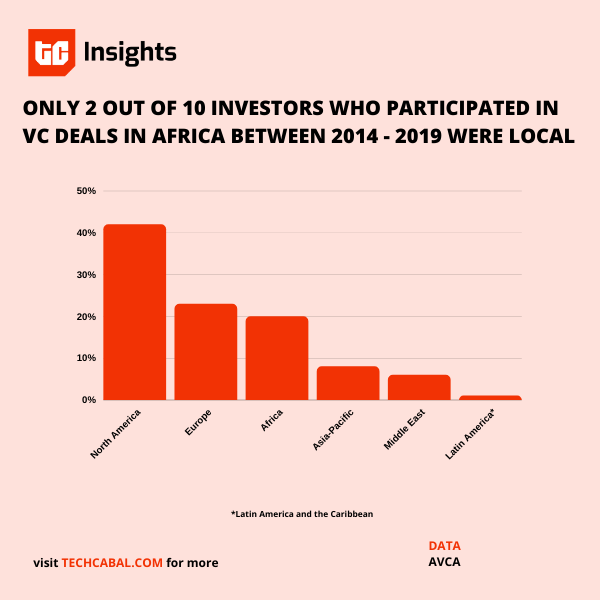
    Our mailing address is:
    Big Cabal Media
    18, Nnobi Street, Animashaun, Surulere, Lagos
    Surulere 100001
    Nigeria
    Add us to your address book
    Want to change how you receive these emails? You can
    update your preferences or unsubscribe from this list.


    Sent to: _t.e.s.t_@example.com

    Unsubscribe

    Big Cabal Media, 18 Nnobi Street, Surulere 23401, Lagos, Nigeria

    Email Marketing by ActiveCampaign


  • Since the term was coined in 2016, femtech, a sub-sector in health technology dedicated to creating solutions that address female wellbeing continues to gain traction and attract VC funding globally. In Africa, however, the space is still very much in its budding phase. This segment is dedicated to telling stories of innovators, their solutions, the investors and challenges of the sector as it blooms in the continent.

    Kenya-based maternal care and e-commerce platform MumsVillage has announced a merger with BabyBliss Nigeria. The new business entity from the merger, Bliss Group, is set to become a pan-African omnichannel e-commerce platform for maternal and child care products.

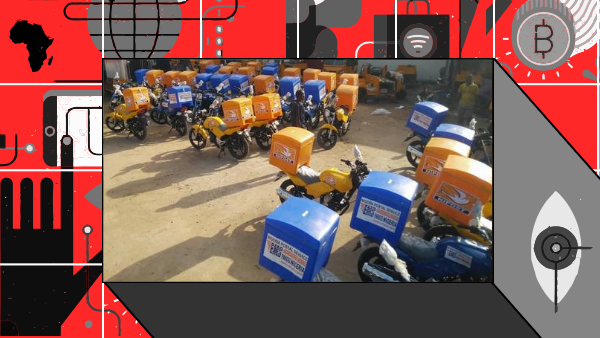
    MumsVillage launched in 2015 as an online community to support pregnant women and parents in Kenya on their motherhood and parenting journeys. Under CEO, Isis Nyong’o-Madison, MumsVillage, through multimedia content distributed through digital channels, has amassed a dedicated audience by providing quality information around parenting, healthcare, as well as family-oriented events and services. 

    In 2019, it launched its e-commerce arm, MumsVillageShop, to leverage on the trust of the community to provide access to a wide range of quality maternal and baby products from global brands including Johnson & Johnson, Cussons and Aveeno among others. Its foray into e-commerce came after it participated in the Unilever DFID Transform, Alibaba eFounders Fellowship and Gray Matters Capital Calibrators digital accelerators program.

    With the merger, MumsVillage will be taking advantage of BabyBliss Nigeria’s  deep retail and e-commerce experience in Africa’s largest economy to expand its retail presence and distribution network across the continent. 

    BabyBliss Nigeria was founded in 2017 and retails products for expectant mothers and their babies from local and international manufacturers/suppliers. According to a statement announcing the merger, the company is said to have recorded a 100% growth rate in the past year and has received funding support from 440.ng, a venture capital firm founded by investor and Decagon founder, Chika Nwobi. 

    “I’m excited to lead this new entity into meeting the changing needs of African women and showing that they are indeed a market that cannot be ignored,” says Group CEO, Isis Nyong’o Madison.

    According to Madison, when MumsVillage launched five years ago, the goal was to not only provide access to quality parenting information and maternal/child care products to women in Kenya but also across the continent. The merger with BabyBliss offers MumsVillage the opportunity to scale beyond Kenya.

    “Bliss Group will leverage on our networks, learnings and reach to convert the financial opportunity that exists into reality by delivering not just greater shareholder value for our investors but looking to build a real powerhouse with women at the helm,” she added.

    The Bliss Group Company will be co-headquartered in Kenya and Nigeria and in the immediate MumsVillage will be broadening its online inventory for its audience.  

    “MumsVillage has been on a mission to empower women to make informed decisions through quality information and products they discover online,” says Kenyan CEO, Millicent Muigai.  

    “It is exciting that through this merger, the reach and combined experience both entities provide will enable us to provide a great Pan-African experience to African pregnant women and mothers to make informed choices for their family’s well-being.”

  • This month Main One Cable marked 10 years of being in operation. As Technical Project Lead and one of the pioneer staff to Main One working with the visionary CEO Funke Opeke it feels amazing to mark such an amazing milestone with the teams responsible for delivering such a groundbreaking private sector project.

    The Main One story is actually a remarkable one. While I was at Vodafone I had been fortunate enough to work on the most cutting edge of mobile technology projects, including the early stage version of what the Mobile Internet is today (WAP1.0 and WAP2.0). Back then we called it ‘The Internet On Your Mobile – IOYM). 

    I also worked on our launches of 2.5G and 3G, especially the 3G dongles that got inserted in your laptop to give you internet on the move, and then Blackberry Internet Service (the move from enterprise to general public). It was the cutting edge of technology at the time and I was excited to be working in it.

    I remember my family had been nudging me to come back home, and I’d bought 3G handsets to sell (in an attempt to make some extra cash to fund my holiday). Glo had been advertising the launch of their 3G network everywhere, but when I turned on the phones they just didn’t work on 3G. 2G worked though. The stalls I gave those phones to never paid me. Salesman, businessman, fail.

    In response to my family’s requests I said “What would I come and do in Nigeria, there’s barely any internet access!?” At the time I was setting up my tech consulting firm, and had just got my first contract with BSkyB. I couldn’t imagine servicing clients from Nigeria. Everyone was worried I was leaving Vodafone. And it was on one of those occasions that my father said one of his oft stated quotes “You are either part of the problem, or part of the solution”. 

    Decades later I came to find out that quote is attributed to Eldridge Cleaver. I didn’t even know who Eldridge Cleaver was but the quote stuck. 

    In 2008 I got a phone call out of the blue. It was Funke Opeke. She said she was looking for a Technical Project Manager and someone had recommended me. Now I’d never been ‘headhunted’ before, so this was new. And then she told me what the project was, her passion and commitment was palpable. She had done 20 years at Verizon, leaving to join MTN, then being called to turn NITEL around, running one of its few assets SAT3, only to realise that as crazy as it sounds, building a brand new cable might make more sense.

    I was instantly sold on the mission! Those who know Funke, or FKO as we call her, know she can be forcefully persuasive. The rest was a series of interviews meeting with Bernard Logan and a couple others near Heathrow Airport. 

    MainOne_CEO_Funke_Opeke_003
    Funke Opeke, founder and CEO of MainOne

    I said I’d need 8 weeks to get myself sorted, she said I had 2! I was the last person any of my friends expected to move back to Nigeria. I didn’t even tell my family, so it was a shock when I called Lisa to say I needed a place to stay. And that’s how in under 21 short days I moved from London to Nigeria.

    The rest as they say is history. 

    I Just Got Back (IJGB)

    So call me aloof, but I didn’t really know about all this IJGB stuff, until I met Oswald and Chukuka and their Move Back Club. I hardly had time for it. Getting up to speed at Main One; it was called Main Street Technologies then, was a full time gig. 

    I went to sleep every day with the 700 page Tyco Telecoms Turn-Key contract. I memorised most of it and the obligations (both vendor and partner). Bear in mind, I had done computer networks, mobile technology/GSM, but I had never done submarine telecoms before and it was in working on this and understudying the likes of Bernard Logan, Howard Kidorf and Keith Schofield I began to get to grips with most of it. 

    Back then when I started work I wasn’t even thinking that far into the future. The core focus was to deliver the project on time and on budget. We had communicated that we would deliver the cable in 2years, June 2010. We did. 

    There were  a lot of fond memories, I particularly remember when Main One Cable was lit and went live. MTN had been the first off-taker and anchor tenant, and instantly, that day, they were able to announce a price reduction in the popular MTN Blackberry Internet Service monthly package from ₦6,000 to ₦3000. An instant 50% price reduction; it was magical. 

    That for me was one of those moments that validated the pain, late nights, and hard work. I had decided that I was either going to be a part of the solution to bring better access to Nigeria and Africa, rather than stand on the sidelines and wait for someone else to do it.

    We broke a lot of new ground delivering the project. For example we had to draft the first official version of the Submarine Cable License and I had to explain to a Nigerian Customs officer how the Power Feed Equipment that powers the 7000km cable line was not a ‘Generator’ a la Mikano, even though it generated power. Generators attract a 20% customs duty you see. For that explanation to sink in well, I joined him to eat amala for lunch.

    Even funnier still, a competing private cable project that had been in the works long before we arrived on the scene saw our Mariner’s notice in the press announcing we would be landing in Two Weeks and suddenly announced they had landed their cable before ours. It didn’t matter. We had done something remarkable, something groundbreaking, Funke’s vision had come to pass, and there we were, a $300m privately held submarine cable project funded by mostly Nigerians and Africans, led by Fola Adeola and friends had been delivered , on time, below budget and to great impact.

    I am proud of what MainOne has become, what Funke and everyone involved over the years have achieved. Proud of the more than 600 strong workforce, continuing to focus on delivering exemplary service and quality in a market that is very difficult, often very hostile, and still delivering growth. 

    I look forward to seeing what Main One becomes in another ten years. Well done Team!

    Jinmi_oluanuiga
    Jinmi Oluanuiga. Image source: RaveTV

    Editor’s Note: Jinmi Oluanuiga is a large-scale infrastructure connectivity professional. He writes for TechCabal as a Technology, Media and Telecoms specialist. Before his current role Jinmi worked on Express Wi-Fi, Nigeria’s first ever National Broadband Plan, the $300m submarine cable project: Main One, and as National Deputy Coordinator for the Alliance for Affordable Internet (A4AI).

  • This week, the question on my mind is how much of a city we really experience as expatriate workers. I’ve been thinking around this question since Cindy talked about “authentic” travel experiences last week. 

    Are travel and tech experiences “authentic” if we fold our sleeves and explore the nooks and corners of new cities? Or are we still due our nomad badges even if our experiences in places like Afghanistan are from a protected house and office?

    I don’t have any of the answers yet, but this week, *Edith, a teacher who has done a lot of traveling shares her experience. 

    Edith was born and raised in East London and says that her love for travel comes from her childhood experiences. “I suppose I like travelling because I grew up in a multicultural area and  I’m interested in different places and cultures,” she tells me

    My note: One-third of all Londoners are foreign-born, and over 200 languages are spoken throughout its many streets and neighbourhoods.

    She shares a timeline to her travels. “I first went to Uganda in 2007 with a friend who was Ugandan. We stayed for one month. We loved it so much  we went back after two months for another month. After that I visited almost every year until I moved there in 2014.” 

    She says her love for travel influenced her decision to become a teacher. For her, being a teacher means that you can work from anywhere in the world.

    So her first stop for work on the continent was Uganda, but the offer didn’t drop in her lap. “I kept asking the school principal for a job for like 3 years before he finally said he would give me an interview and I got the job.” 

    In 2014, she packed her bags and moved to Uganda. Uganda’s principal international airport is near the town of Entebbe, and is some distance from the capital, Kampala. 

    What’s the first thing you want to do when you’re in a new country? For a lot of people, buying a SIM card is right up there. 

    “In 2007, SIM cards could easily be bought anywhere but in 2014 onwards, you needed to be registered. I do believe there is a place outside the airport doors to register a SIM.” 

    The Entebbe airport is small, but organised and is a “40-minute drive or 3-hour depending on the traffic situation.” 

    Living in Kampala

    “I loved living in Kampala. During the time I spent in Kampala on holidays, my friends were all Ugandan/Lebanese so I got to know all the local places very well. But when I moved there I made friends with other expats that I worked with so the scene was very different.”

    Edith’s note: Kampala is within reach of so many wonderful places like Bujumbura, Kigali and Nairobi. I would go on road trips all the time. The night life is fantastic, Ugandans are proper party animals.

    In Kampala, Boda boda’s are the primary means of transportation and ride-hailing services did not arrive until 2016. 

    “In the time I lived there, they did have yellow taxi and private taxi and also matatu which is the danfo bus.”

    Digital Nomads Kampala: Downtown Kampala
    Downtown Kampala

    While transportation is organised, Edith says the shopping process was “not good” and that food items are expensive. But to pay for anything in the country, she had to open a bank account and she also used mobile money.

    “I had a Stanbic account and sometimes I also used my UK ATM card there. Mobile money is also a big thing because they don’t do instant transfers.” 

    My note: Mobile money services in Uganda began in 2009. Today, four in ten adults in Uganda have mobile money accounts.

    While mobile money was reliable, the internet service was not. “At my job I used the internet there, I didn’t take work home with me and while I honestly don’t remember the cost of the internet, I remember that the internet service wasn’t great.” 

    After two years in Kampala, Edith knew she needed a new start outside of Uganda and she had her sights set on Ghana or Thailand.

    Eventually, she received offers from Abuja, Mexico and Thailand and she decided to move to Abuja, Nigeria’s capital city.

    Edith’s anecdote: I never planned to move to Nigeria but my housemate and I used to watch MTV and Nigeria looked really cool. Of my three job offers, Mexico presented a language challenge, the area in Thailand didn’t seem good so I picked Abuja.  

    Living in Abuja

    “I lived in Utako and unlike Kampala, the power situation was terrible. There was always noise from the generator and shopping was terrible. There were no opportunities for little road trips except the dam and the falls which are far.” 

    While Kampala is mostly divided into the busy downtown and quiet leafy suburbs, most parts of Abuja are quiet and have an efficiency which may seem soulless. 

    “Kampala is lively, you can always hear music and people but in Abuja everything is behind compound gates.” 

    Edith says she was largely dissatisfied with Abuja and in 2018, she took an interesting opportunity to move to Lagos, which she believes is better than Abuja even though she faces some of the same problems.

    “I took boda bodas everywhere in Kampala but I can’t do that in Lagos because it’s confusing trying to figure out where they’re allowed and where they are not.” 

    She also notes that in Nigeria, people are not “foreigner friendly.” “I wouldn’t try to bargain here.” 

    One thing she definitely didn’t bargain for was her dance with Nigerian banks. She says her experience with Nigerian banks has been painful.

    “I didn’t open an account until it was unavoidable. I then waited over 3 months for my ATM card. I can’t use the bank app because they misspelled my email.  There were some other issues.” 

    But it’s not all bad, as she says Lagos is a city she can enjoy on holiday with a lot of money. As we round up our conversation, we talk about her internet provider.which she says is “pretty rubbish and expensive.” 

    “It’s also expensive compared to the UK. In the UK, I pay about 30 pounds for unlimited broadband per month.” 

    In the end, where’s next for Edith, who has been to more African cities than most Africans and where does she rate these cities for tech experiences on a scale of 1-10?

    Kampala gets a 7.8, Abuja gets a “generous 4” and Lagos gets a 5. 

    “Outside these cities, the nicest African city minus South African and North Africa is by far Kigali. It’s very clean, safe and functional.” 

  • You are reading Factsheet, our series of specific guides on experiencing and using technology platforms in Africa. Whether you are looking for knowledge on getting your African film on Netflix, raising a seed round or finishing an online design course, we are covering all that.

    —

    An innovative business idea is like a seed that needs fertile ground to reach its potential. The good soil is complemented by a favourable climate, attentive weeding and regular supply of nutrients like water.

    An early-stage startup can be thought of in this way. More often than not, a first-time founder with a compelling business case needs external guidance and resources to build and run a successful company.

    A number of institutions provide this guidance, either as venture building studios or venture capital companies. The latter is the focus here.

    Due to their capacity to provide initial financing to largely untested business ideas, early-stage venture capitalists are a key cog in a startup ecosystem. In Nigeria, companies like Ventures Platform, Microtraction, Future Africa and Co-creation Hub operate in this space. Angel networks and individual investors are also involved at this stage.

    With funding and mentorship, these entrepreneurs take on the pleasure and risk of introducing new companies to the market. Sure, they try to cut good deals for themselves and do due diligence, but what do they look out for as a signal of potential? 

    The specifics vary for each company but we’ll use norms in five entities to demonstrate common threads in the industry.

    Founders’ history – Ventures Platform

    “We try to dig in a bit into what the founders have done historically,” Kola Aina, founder of Ventures Platforms said on a webinar about valuing African startups this month.  

    “There are ways to extrapolate execution capabilities from whatever prior experience folks have either in employment or in prior startups… People are only going to be slightly better than their last venture, on average.”

    This last venture doesn’t have to be a prior for-profit engagement. Firms like Aina’s scan the founding team’s life experience for signs of missionary and executive character.

    Tambua Health is one of Ventures Platform’s most recent portfolio companies. The startup is a health diagnostics venture and has produced a proprietary hardware device that scans lungs for generating images through sound.

    It’s a product that stirs your attention and could find a space in global respiratory health circles. But according to Aina, it was the “personal story of adversity” of Lewis Wanjohi, the startup’s founder, that sold the ambition to Ventures.

    Aina, who sometimes invests as an individual investor, says he sometimes seeks to first develop a mentorship relationship with the founder, as a way of gauging the latter’s inclination to his ideas. 

    He would be more confident deploying capital towards a team that enthusiastically listens to a mentor’s ideas and free advice, considering them for implementation.

    “It’s not a function of telling founders what to do,” he clarifies “but it is really a reflection of how much they value your time and your input.”

    Technical competence – Microtraction

    In February, Microtraction initiated a scouting team to help it source deals across Africa. Until now, the firm’s standard procedure has been to invite startups and ideators to apply for funding on its website. There are fourteen assessment questions to answer.

    With a focus on funding viable products at the pre-seed stage, Microtraction engaged the scouts because of a need for “local network and insights to understand market dynamics when identifying the best investment opportunities,” Dayo Koleowo, one of three partners at the firm, said in an email to TechCabal.

    But the profile of startups being sought after remains the same: those led by “remarkable” technical founders. The phrase refers, not to credentials, but to how the potential company owner thinks about the problem.

    Now in its third year, Microtraction has changed its standard deal; raising the ticket from $15,000 to $25,000 while reducing the percentage they take from 7.5% to 7%.  

    Like Aina of Ventures Platforms, Koleowo also desires “an ambitious founder who listens, who has a pragmatic approach to things, who knows when to interact and reach out.”

    Social impact – Co-creation Hub

    In 9 years, CcHub has invested in over 60 startups mostly at the early stage. There have been many defaults, but the success stories resonate strongly.

    One of such successes is LifeBank, the medical logistics company connecting blood banks with hospitals and patients in need of blood products. LifeBank has saved nearly 10,000 lives with its service, according to Temie Giwa-Tubosun, the founder and CEO.

    CcHub is more a community building organization than most VCs. But their adventure with LifeBank and BudgIT, a civic tech organization founded by Seun Onigbinde, shows a space exists for solutions that target social ills like maternal mortality and public sector corruption.

    Big problem solvers – Future Africa Fund

    By virtue of his being a co-founder of Andela and Flutterwave, Iyin Aboyeji is able to position the Future Africa Fund as an early-stage firm associated with some of Nigeria’s most valuable companies (Big Cabal Media, the parent company to TechCabal, is a portfolio company of the Fund).

    But Aboyeji, with his team of co-founders and executives including Nadayar Enegesi and Olabinjo Adeniran, hopes to replicate his early success by spotting new opportunities in existing and frontier sectors.

    The operating thesis is to spot ideas that solve big challenges. That could mean funding three startups in a new sector – as they did with Risevest, Bamboo and Chaka – or staking out for one unique player, as was the case with 54Gene.

    Flexibility – Angels and angel networks

    A venture capital firm has a number of general partners who work together on deals, as one company.

    But they are not the only source of early-stage investment for startups. Angels – individuals who invest personal income directly – are as useful as VCs in providing a springboard for a startup’s main entry into the market.

    An angel can be anyone from company founders to general partners at venture capital firms. For example, Risevest, the dollar-denominated investment platform, has received funding from Kola Aina in his capacity as an angel investor.

    Angels and angel networks can bind together on a deal-by-deal basis to invest together, as was the case recently with Trove Finance.

    What interests one angel will usually differ from another. They tend to make quicker decisions than VC firms on whether to invest or not after forming an opinion on the founder’s credibility.

    In summary, early-stage investors in Nigeria have a mix of factors they consider in startups pitching them. Some have fixed terms for each deal, but nearly all base their decisions on a balance of competence and character. 

    As the group of investors taking a first dip, they help produce the first important lessons we learn about these startups. It is to be hoped that more firms play in that space to increase the pool of potentially successful Nigerian companies.

  • Although Eversend started out solving the problem of cross-border transfer, the company says that from the jump, it always had bigger ambitions.

    The story of how Eversend, a neobank was founded is a familiar anecdote. While the company started out trying to solve the thorny problem of cross border transfer within Africa, it has always had bigger goals.

    “We are not just a money transfer company,” Stone Atwine, the company’s founder and CEO said in one interview. Eversend describes itself as a “neobank for Africans,” and the company’s goal is to become a one-stop shop for financial services.

    The idea of neobanks which operate exclusively online without the traditional physical branch network is not new. In Europe, N26, Revolut and Monzo are some of the more popular names and they sell themselves to customers on being innovative.

    Internet shutdown in Ethiopia enters its eighth day

    Unlike traditional banks, they’re more willing to try out new product ideas. Revolut, for instance, lets customers save small amounts of money by rounding up figures whenever they make payments. If you were out having a drink with friends and receive a bill for $10.20, Revolut will round the figure up to $11 and help you save the change. 

    Those are features which are unlikely to be available with traditional banks. Yet, the real driver for neobanks is that they want to help you put everything in one place. 

    Organising a myriad of fintech services

    The average smartphone user in Africa is likely to have a slew of fintech apps. An app from her traditional bank, a loan app, something for savings as well as a mobile money app. 

    Eversend wants to become the one-stop shop for financial services
    It is not unusual for people to have five or six fintech apps

    Companies like  Eversend are trying to make sure this happens in one app. “Our game is to build a one-stop shop: transfer, take a loan, buy stock and trade crypto,” Stone Atwine tells TechCabal. 

    Acknowledging the difficulty of what his company is trying to achieve, Atwine says “it is not sexy to try to do many things.” 

    Most of the challenges they face are around regulation in a disintegrated continent. It is a familiar problem across the continent and among individual nations.  With each country throwing up its own regulation, scaling will undoubtedly be difficult. 

    “Regulatory compliance across Africa is a nightmare. Sometimes, regulators may not understand how we operate. It then becomes a business of educating them on how we manage risk and do business.” 

    Atwine shares an experience with a regulatory agency where Eversend applied for a licence and the response did not come back until six months later. When it came, the agency said there was no law in place right now to regulate companies like theirs. 

    Yet, he’s quick to put the conversation in context, adding that some countries are making progress in making regulations easier. How is the company working around these regulatory hurdles? Where it can, it is educating regulators on its business and more sensibly, expanding to countries with clearer regulatory frameworks. 

    Another problem with disintegration on the continent is that the company finds itself building infrastructure from scratch to fit individual countries. Is the market size big enough to justify solving these challenges across Africa?

    The tricky business of cross border transfers

    At the moment, there are not a lot of services that let you transfer money across the continent. While Chipper Cash provides this service, there are not a lot of other digital options available. 

    This is because cross border transfers are tricky businesses that constantly require currency balancing. 

    Atwine uses the example of Nigeria where it is difficult to hedge because there are two currency windows and rates. 

    “It is extremely difficult and we have to be very careful. Let’s say you use the CBN [Central Bank of Nigeria] rates ($1 = ₦380)  to decide the exchange and someone else uses the street rate of ($1 = ₦450).”

    Eversend has to ensure that it doesn’t go with the wrong rate and end up with a pile up of Naira that no one wants. 

    One way Eversend is working around this is a fair usage policy which gives a daily or weekly limit to customers. After all, what is the point of having an open service if the company cannot find the money to exchange with?

    There are other money conversations for the company which recently raised $1 million through a crowdfunding equity campaign. 

    According to Atwine, “the reason we did an equity crowdfunding was that we wanted our customers to be involved in the process. Africans in the diaspora came through strong.” 

    But customer inclusion is hardly the only reason. With the world dealing with the impact of COVID-19, investors are moving slowly. Yet, the company still has plans to raise money to fund its ambitions. 

    The company is expecting some institutional funding that it says will be larger than the crowdfunding round as it expands its footprint across Africa. Its next stops are Francophone Africa, Europe and a plan to launch its Nigerian operation. 

TechCabal is a future-focused publication that speaks to African innovation and technology in depth

Follow us

  • X
  • LinkedIn
  • TikTok
  • WhatsApp
  • Facebook
  • Instagram
  • YouTube

Copyright ©2025. All rights reserved. Privacy & Terms.

TechCabal

Become a TC Insider for free to finish this story.

Sign in to read the full story and stay ahead of Africa's tech ecosystem.

TechCabal

Check your email

Enter the 6 digit code sent to

Incorrect code. Please try again.
Resend code in 40s
TechCabal

What kind of stories are you interested in?

Choose the topics you'd like to see.